



If your competitors changed their prices this morning and you are unaware of it, your current pricing decisions are based on outdated data. This implies that you are already behind.
Competitive pricing software closes that gap. It tracks competitors’ prices, alerts you when prices change, and, in some cases, automatically adjusts your prices.
We look at the 10 best price tracking software in this blog. Here are the top three:
Why listen to us?
We built PricingHunter for online retailers who needed competitor pricing data without enterprise contracts or add-on costs. We talk to eCommerce teams every day about how they track competitor prices and make pricing decisions. This guide reflects what we hear: what works, what breaks, and what matters.
What is competitive pricing software?
Competitive pricing software tracks what your competitors charge for the same or similar products and helps you set your prices based on that data. At the basic level, it scrapes competitor websites and delivers pricing data to a dashboard. At the advanced end, it uses AI to recommend optimal prices based on demand signals, market position, and margin targets.
10 best competitive pricing software compared
1. PricingHunter
Best for: SME retailers who want competitive pricing data without having to write code, manage proxies, or sign contracts.
Competitive pricing approach: Automated product matching with daily competitor alerts and unlimited price history.
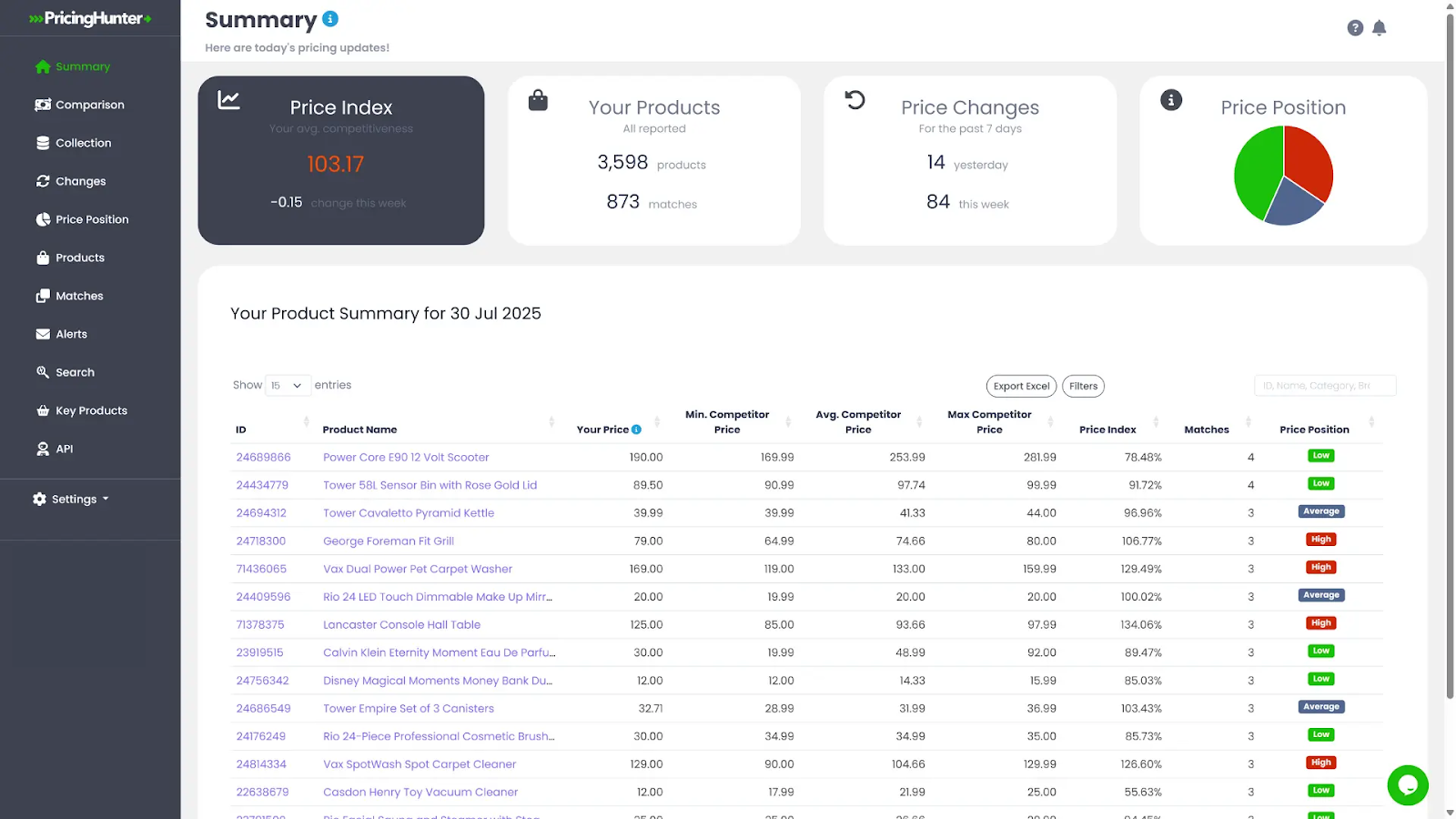
PricingHunter stands out for doing what most competitive pricing tools make unnecessarily complicated: delivering competitor price data to your inbox every morning without requiring a developer, an enterprise contract, or a sales conversation. It gives your team visibility into unlimited competitors across every plan, with automated product matching and price history that never expires.
This transparent, all-inclusive approach removes the hidden costs from competitive pricing. With PricingHunter, teams track every relevant competitor, receive daily alerts, including on weekends, and access full API integration without a surcharge.
Key features
- Unlimited competitor tracking on every plan
- Automated product matching with manual approval
- Daily price change alerts, including weekends
- Continuous Price history
Pros
- More products per plan than Prisync at every price point (200 vs 100 at $99/mo)
- No add-ons, no contracts, no hidden upgrades
- Setup takes minutes, live data from day one
Cons
- No built-in dynamic repricing engine
Pricing
- Essential $99/mo (200 products),
- Professional $199/mo (2,000 products),
- Premium $399/mo (6,000 products).
- 14-day free trial. No credit card required.
2. Prisync
Best for: eCommerce retailers on Shopify, Magento, or BigCommerce who want competitive tracking with dynamic repricing built in.
Competitive pricing approach: Product-based tracking with one-click store sync and dynamic pricing rules on all plans.
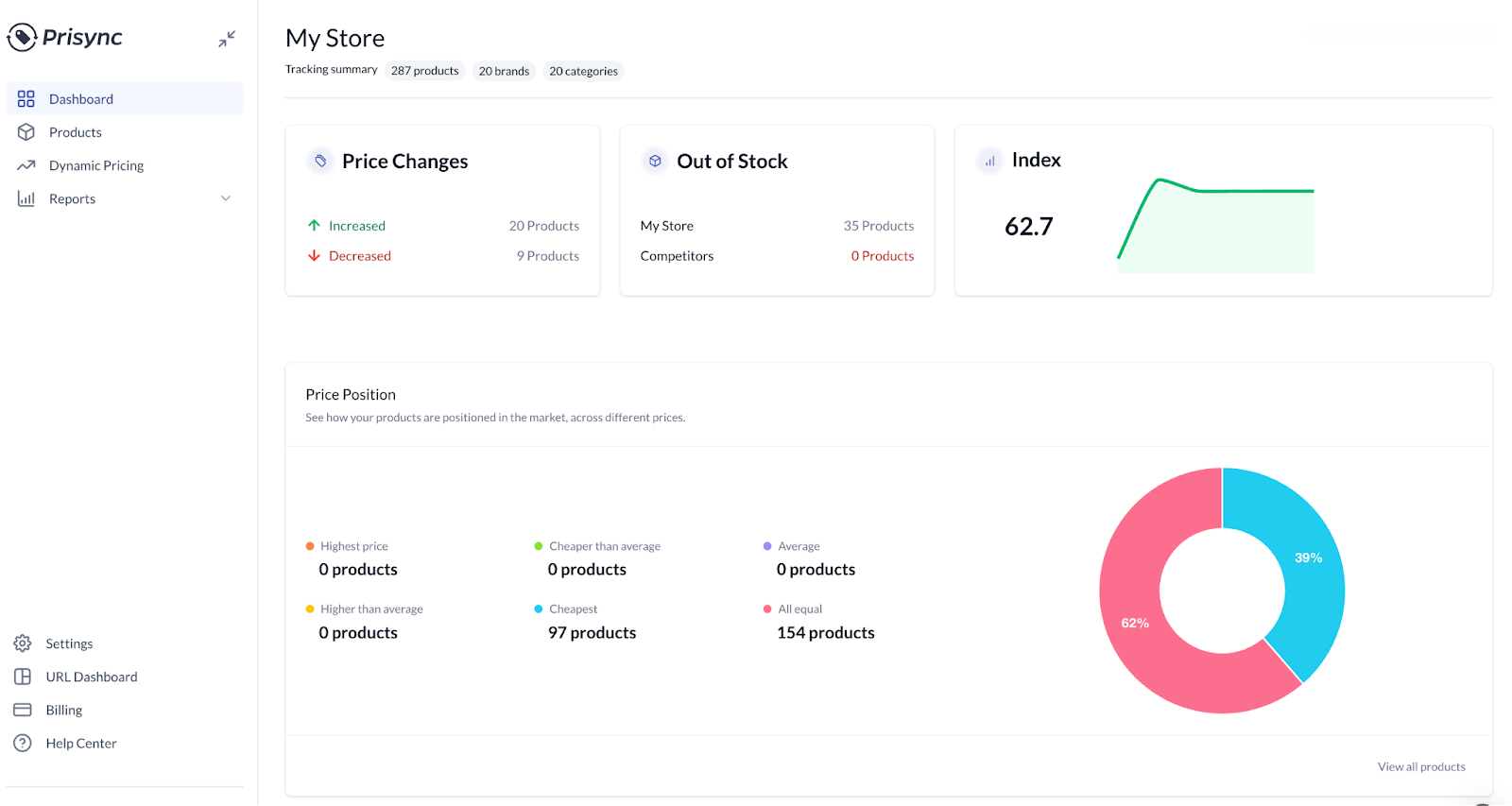
Prisync is a competitor price-tracking and dynamic repricing platform designed to help eCommerce retailers monitor competitors’ prices and automate pricing adjustments from a single dashboard. Because of its focus on product-based tracking with one-click integrations with Shopify, Magento, and BigCommerce.
Key features
- Product-based tracking with unlimited competitors
- Dynamic pricing rules on all plans
- One-click Shopify, Magento, BigCommerce integration
- Automated competitor discovery and stock monitoring
Pros
- Repricing and tracking in one tool, no separate modules
- Transparent published pricing with a 14-day trial
- 24/7 customer support
Cons
- API access costs an extra 20%
- Dashboard customisation is limited
Pricing
- $99/mo (100 products) to $399/mo (5,000 products).
- API adds 20%. 14-day free trial.
3. Price2Spy
Best for: Mid-market retailers and brands that need high-frequency competitive tracking with MAP enforcement and deep analytics.
Competitive pricing approach: URL-based tracking with stealth IP technology, up to 8 price checks per day, and 25+ built-in reports.
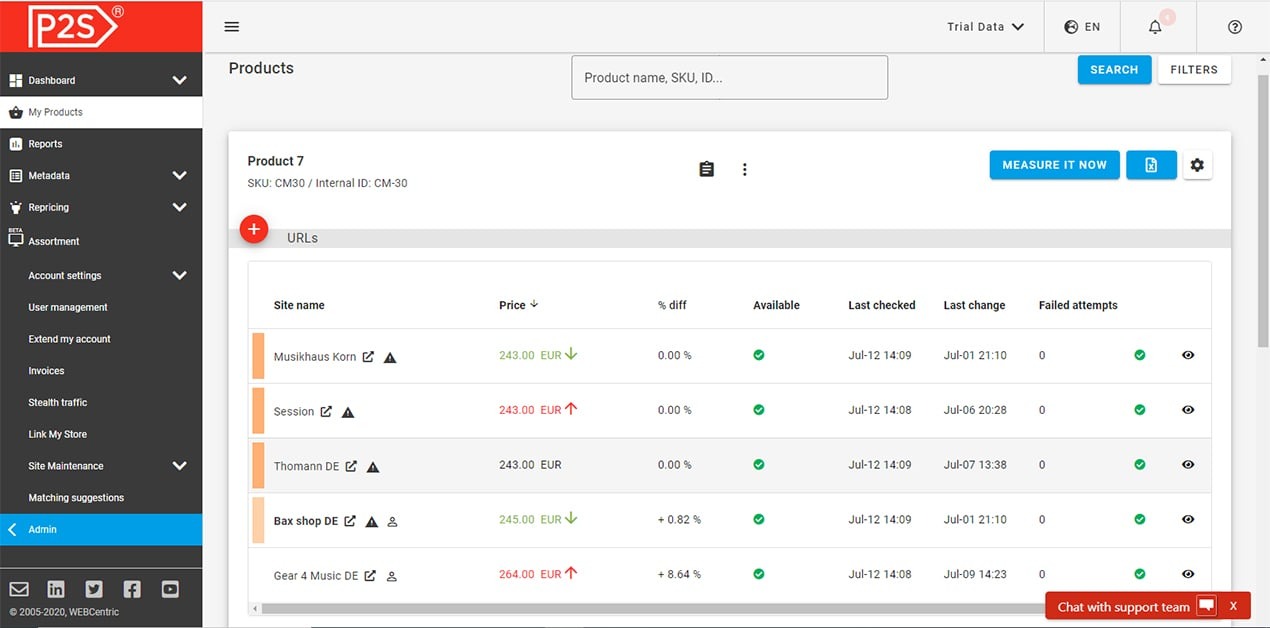
Price2Spy is a competitor price-monitoring tool built to track pricing across even the most protected ecommerce sites. It uses stealth IP technology to bypass scraper blocks and monitor prices up to 8 times per day, while also capturing stock availability, shipping costs, and promotions. The platform operates on a URL-based model, meaning each competitor listing is tracked individually.
Key features
- Competitive tracking with up to 8 checks per day
- Stealth IP technology for bot-protected sites
- MAP monitoring with screenshot capture
- Rule-based repricing + 25+ built-in reports
Pros
- Published starting prices with a 14-day free trial
- Handles bot-protected sites that most tools cannot reach
- Tracking, repricing, MAP, and analytics in one system
Cons
- URL-based pricing model scales unpredictably
- Add-on costs for repricing and automatch
Pricing
- Starter $39.95/mo (500 URLs)
- Basic $157.95/mo (2,000 URLs)
- Premium custom. 14-day free trial.
4. Minderest
Best for: Brands and manufacturers monitoring competitive pricing across distributor networks, marketplaces, and offline channels globally.
Competitive pricing approach: AI-powered data collection across eCommerce sites, Amazon, Google Shopping, shopping apps, and physical stores in 40+ countries.
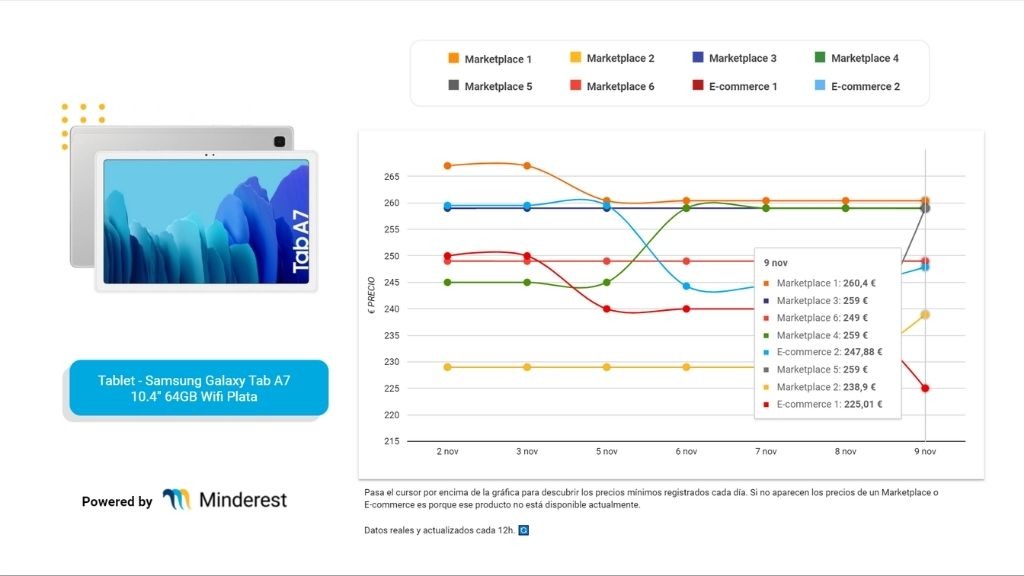
Minderest is a competitive pricing intelligence platform designed for brands that need visibility beyond online retailers. Its biggest differentiator is its AI matching, which works across languages, currencies, and inconsistent product naming conventions.
Teams choose Minderest when they need broad, multi-country coverage that most pricing tools can’t reach, especially across complex retail ecosystems.
Key features
- Competitive tracking across online, offline, and app channels
- MAP and MSRP compliance monitoring
- AI-powered product matching across languages and currencies
- Catalog intelligence and assortment tracking
Pros
- 400+ customers across 40+ countries
- Tracks channels other tools cannot reach
- Dedicated customer success manager
Cons
- No public pricing, no free trial, minimum 3-month contract
- Product matching sometimes requires manual correction
Pricing
Custom only. Contact sales for a demo.
5. Competera
Best for: Enterprise retailers with dedicated pricing teams who need AI-driven competitive pricing recommendations, not just data.
Competitive pricing approach: Machine learning that analyses 20+ demand factors, including elasticity, seasonality, and cross-category effects, to recommend optimal prices.
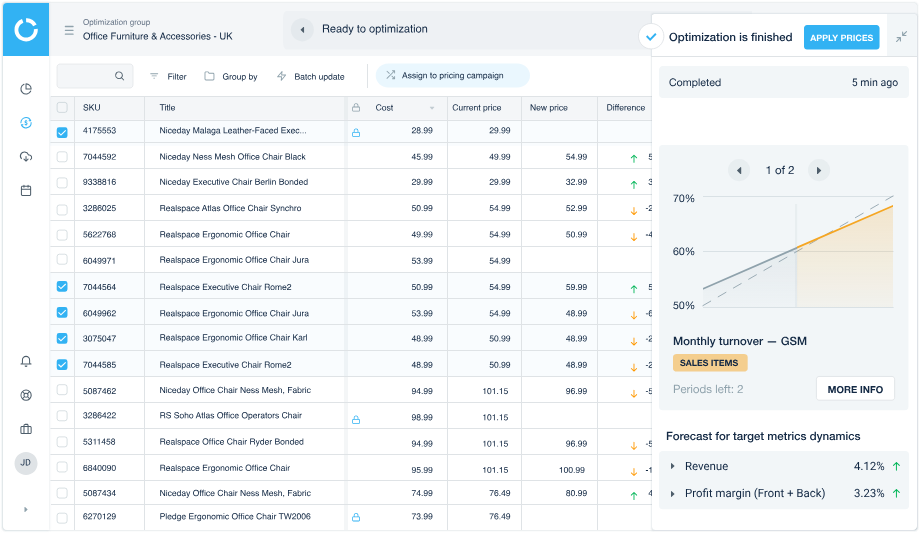
Most competitive pricing tools stop at telling you what competitors charge. Competera starts there and keeps going. Its ML models analyse demand elasticity, seasonality, and cross-category effects, then recommend your prices. Its scenario modelling lets pricing teams test strategies before rollout.
Key features
- AI pricing recommendations based on 20+ demand factors
- Scenario modelling before rollout
- Competitor data collection across marketplaces
- Enterprise integrations and dedicated account management
Pros
- Goes beyond tracking into pricing optimisation
- Scenario modelling reduces pricing risk
- Dedicated implementation support
Cons
- Enterprise pricing only
- Significant setup and onboarding time
Pricing
Custom only. Contact Competera for a demo.
6. Omnia Retail
Best for: Mid-market and enterprise retailers and brands that need automated pricing execution across online stores and marketplaces.
Competitive pricing approach: In-house competitor scraping across domains feeding into a visual Pricing Strategy Tree for automated rule-based pricing execution.
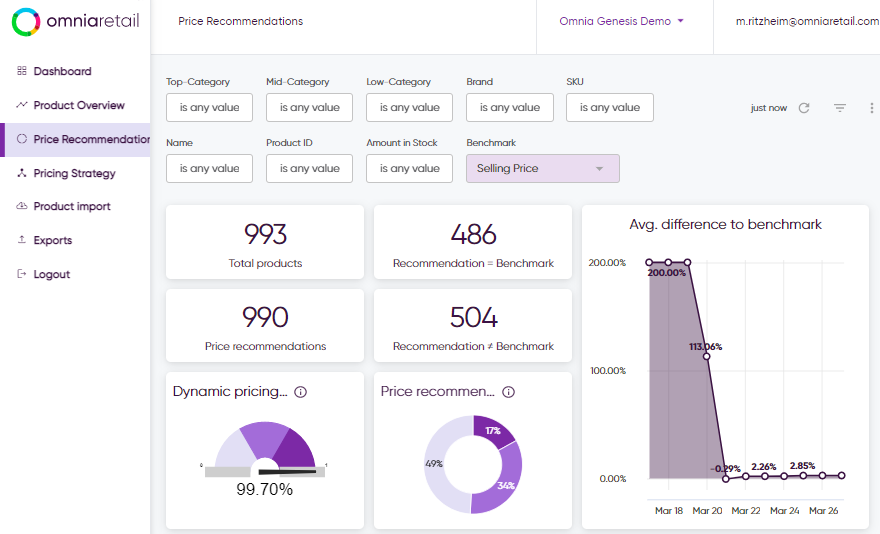
Omnia Retail is a dynamic pricing automation and competitor monitoring platform designed to help retailers and brands continuously optimise pricing across online stores and marketplaces.
Because of its focus on automated pricing execution through its Pricing Strategy Tree and in-house data collection across 35,000+ domains.
Key features
- Pricing Strategy Tree for defining, testing, and automating pricing rules
- In-house scraping across 35,000+ competitor domains and marketplaces
- Omnia Agent AI for proactive pricing insights without manual reporting
- Marketplace coverage including Amazon, eBay, Google Shopping, Idealo, and Bol.com
Pros
- Most advanced visual pricing automation engine for retail teams
- In-house data collection removes dependency on third-party scrapers
- G2 Leader Winter 2026 for Retail Pricing Software
Cons
- No published pricing, requires a sales conversation
- Implementation takes days to weeks, depending on complexity
Pricing
Custom only. Contact Omnia Retail for a demo.
7. Intelligence Node
Best for: Enterprise brands and retailers needing real-time global competitive analytics with AI-powered product matching at scale.
Competitive pricing approach: Patented AI matching across 1.2 billion+ SKUs with sub-10-second data refresh and pricing recommendations.
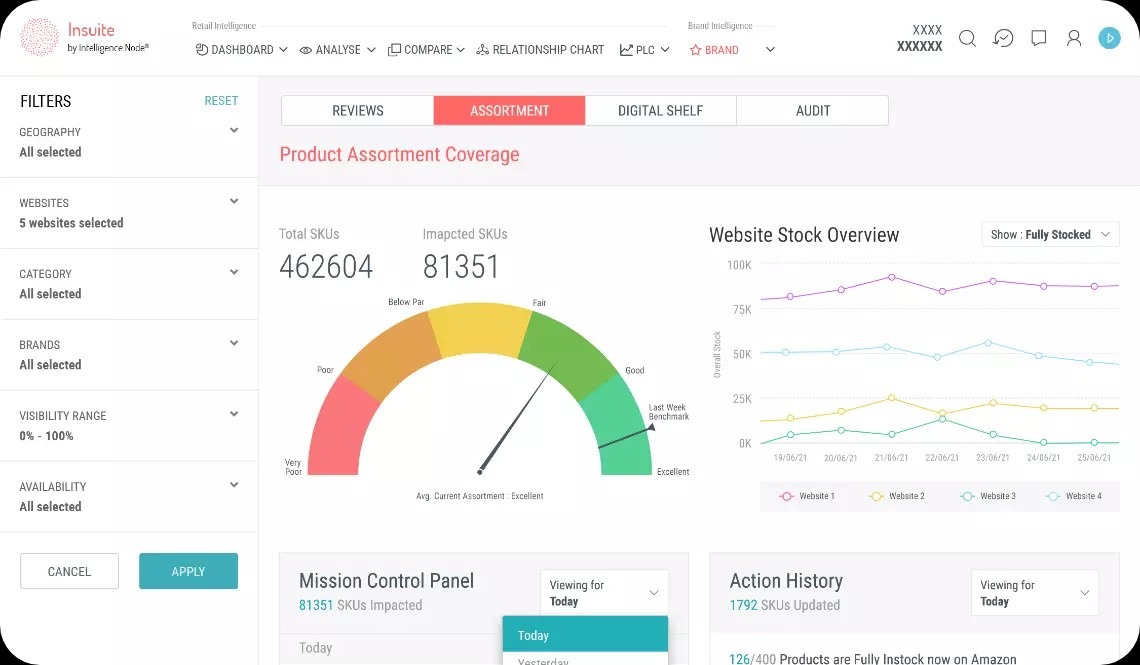
Intelligence Node is a competitive pricing and retail analytics platform built for brands operating at massive scale across millions of SKUs and global retailers. Its biggest differentiator is its patented AI, which delivers up to 99% product-matching accuracy with near-real-time data refresh.
Teams choose Intelligence Node when they need enterprise-grade visibility across pricing, promotions, assortment, MAP compliance, and digital shelf analytics.
Key features
- 99% product matching accuracy with 10-second refresh rates
- 1.2B+ SKU repository across 190,000 brands
- MAP monitoring with digital violation capture
- Plug-and-play APIs with no integration required
Pros
- Unmatched scale and data refresh speed
- Modular pricing lets you buy only what you need
- G2 Leader 2025 for Pricing Software
Cons
- Custom enterprise pricing only
- The interface can be complex for new users
Pricing
Custom subscription model. Contact the Intelligence Node for a quote.
8. Pricefx
Best for: B2B and B2C enterprises that need competitive pricing embedded in a full pricing management suite with CPQ and optimisation.
Competitive pricing approach: Cloud-native pricing platform with 125+ AI pricing agents, configure-price-quote (CPQ), and price optimisation in one system.
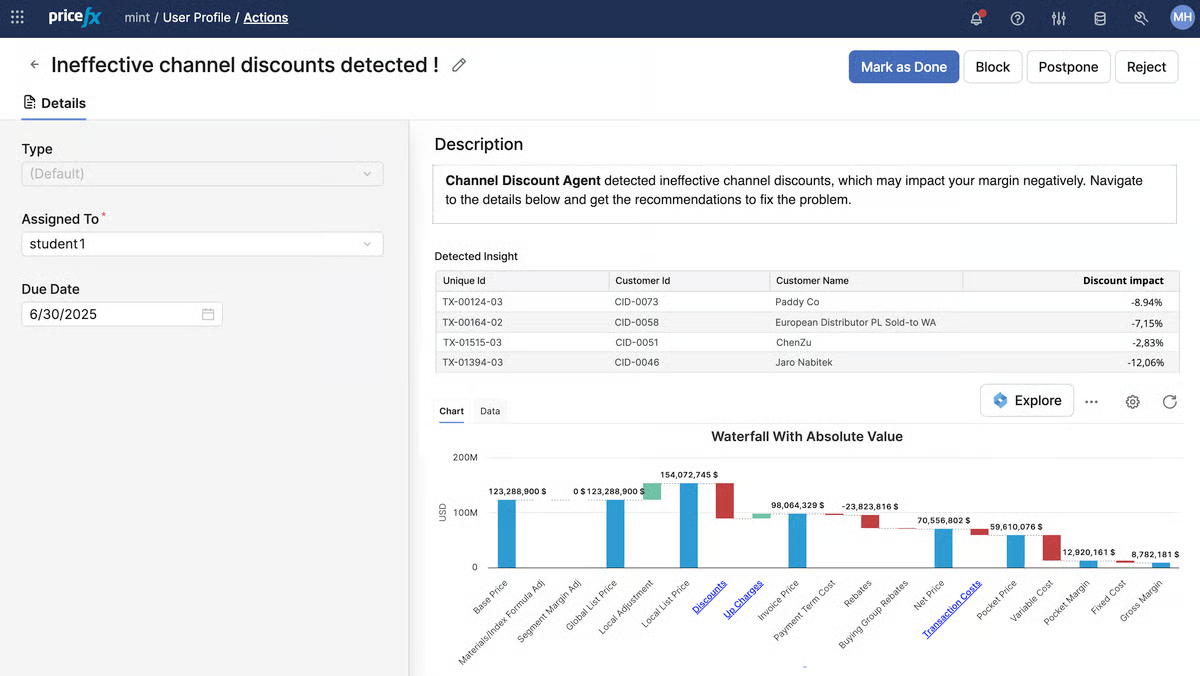
Pricefx is a cloud-native pricing platform that combines competitive pricing, CPQ, deal management, and margin optimisation into one system. It is designed for complex B2B and B2C organisations with large sales teams and multi-tier pricing structures. Pricefx uses 125+ AI pricing agents to handle everything from competitive analysis to deal guidance and margin protection.
Key features
- 125+ AI pricing agents across competitive analysis, CPQ, and optimisation
- Configure-price-quote for complex deal management
- Margin optimisation and rebate management
- Cloud-native with enterprise integrations (SAP, Salesforce, etc.)
Pros
- Full pricing management suite, not just competitive tracking
- 125+ AI agents cover the entire pricing workflow
- Cloud-native with fast deployment relative to legacy pricing tools
Cons
- Enterprise pricing only, well beyond SME budgets
- Overkill for teams whose core need is competitor price tracking
Pricing
Custom only. Contact Pricefx for a demo.
9. Pricefy
Best for: Small retailers who need basic competitive pricing data and marketplace tracking without spending much.
Competitive pricing approach: Website and marketplace monitoring with Google Shopping integration and a repricing simulator.
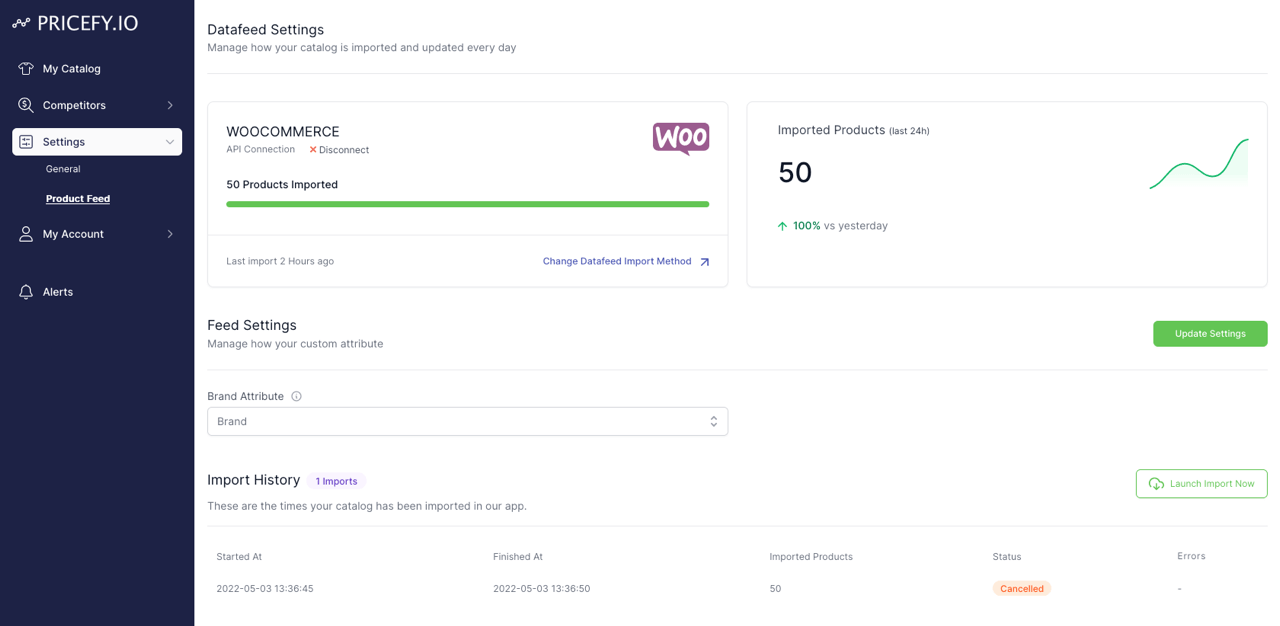
Pricefy is a lightweight competitive pricing and repricing tool designed for retailers that just need to track a small set of competitors without enterprise complexity. Because of its simplicity and accessibility, Pricefy works best for lean teams that want quick visibility into competitor pricing across websites, marketplaces, and Google Shopping, as well as repricing.
Key features
- Competitor tracking across websites and marketplaces
- Google Shopping integration
- Repricing simulator and price alerts
- Manual and automated product matching
Pros
- Free plan covers 50 SKUs
- Marketplace monitoring at base tier
- Clean, simple interface
Cons
- Smaller user base and community
- Advanced analytics less developed
Pricing
Free (50 SKUs), $49/mo (100 SKUs), $99/mo (2,000 SKUs).
10. BlackCurve
Best for: eCommerce retailers who want AI-driven competitive repricing with Google Shopping optimisation and price testing.
Competitive pricing approach: AI analyses competitor data, demand signals, and product performance to recommend and automate pricing decisions.
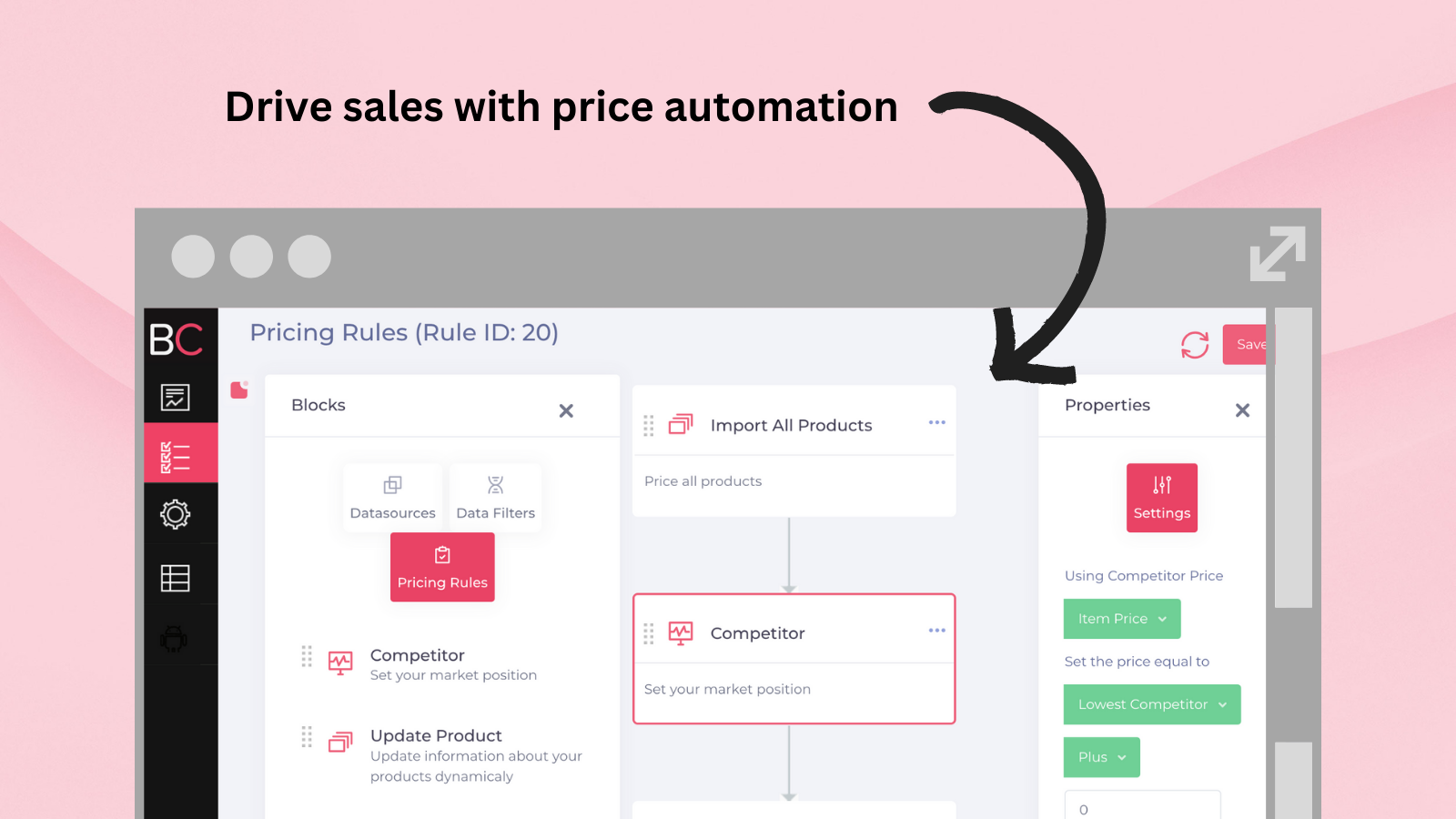
BlackCurve is a competitive pricing and optimisation platform that helps retailers automatically adjust prices based on competitor data, demand patterns, and inventory levels.
Instead of just tracking competitors' prices, BlackCurve provides AI-driven recommendations to improve margins, supported by features like quick setup, ecommerce integrations, and A/B price testing to measure impact before rolling out changes across your catalogue.
Key features
- AI-driven repricing based on competitors, demand, and inventory
- Google Shopping competitor monitoring and optimisation
- A/B price testing for measuring pricing impact
- Integrations with Shopify, Magento, BigCommerce, Amazon, eBay
Pros
- AI repricing goes beyond simple competitor matching
- Free plan available with a paid plan from $28/mo
- Set up under an hour with strong eCommerce integrations
Cons
- UI could use a refresh, according to some reviewers
- Less known than Prisync or Competera in the market
Pricing
Free plan available. Paid plans start at $28 per month, with four pricing editions available. Free trial available.
What distinguishes a good competitive pricing software from bad
Competitor coverage and matching accuracy
The tool needs to find the right competitor listings and match them to your products. Bad matching means bad data. Look for tools that let you review matches before trusting them.
Speed from sign-up to usable data
Some tools deliver competitor prices within hours. Others take weeks of implementation. If you are comparing tools, test how fast each one gets you to live data.
Repricing capabilities
Some tools only show you competitor data. Others let you set rules to automatically adjust your prices. Know whether you want visibility or automation before you choose.
Pricing transparency
Some tools publish pricing. Others require a sales conversation. A few charge extra for features most retailers consider essential. Know what you are paying before you commit.
Scalability
A tool that works for 200 products may not work for 20,000. Check how pricing and performance scale with your catalogue.
How to choose the right competitive pricing software
- Visibility or automation? If you want to review data before acting, pick a tracking tool. If you want prices to adjust automatically, pick a repricing engine.
- Will it scale with your catalogue? Calculate the cost at your current product count and at the level you expect to reach in 12 months.
- How fast do you need live data? Self-service tools deliver data in hours. Enterprise tools can take weeks.
- Does it cover where you sell? Match the tool's marketplace and geographic coverage to where your competitors actually operate.
Start tracking competitor prices today
If you want competitive pricing data without enterprise contracts, add-on costs, or a sales conversation, PricingHunter is worth a closer look.
Upload your products, approve the automated matches, and start receiving daily price data, including weekends. Every plan includes unlimited competitor tracking, price history, and variant tracking,. Try PricingHunter for free.