



Every e-commerce pricing decision starts with data. You can check competitor pages manually or use a tool that scrapes competitor prices automatically and delivers them in a format your team can act on.
Price scraping tools range from turnkey platforms to raw developer APIs. The right choice depends on your catalogue size, technical resources, and how often you need fresh data. Here are the top three choices based on your needs:
Why listen to us?
We built PricingHunter for online retailers who need competitor pricing data without having to write code or manage scraping infrastructure. We talk to eCommerce teams every day about how they collect competitor data, and this guide reflects what we hear: what works, what breaks, and what matters.
What is price scraping?
Price scraping is the automated extraction of pricing data from competitor websites, marketplaces, and comparison engines. A scraper visits a webpage, extracts price data from the HTML, and delivers it in a structured format such as CSV or JSON. Some tools handle the entire process. Others provide you with an API and let your developers build the pipeline.
10 best price scraping tools compared
1. PricingHunter
Best for: SME retailers who want to scrape competitors' prices without writing code, managing proxies, or signing contracts.
Scraping approach: Automated scraping with product matching, daily alerts, and unlimited competitor tracking.
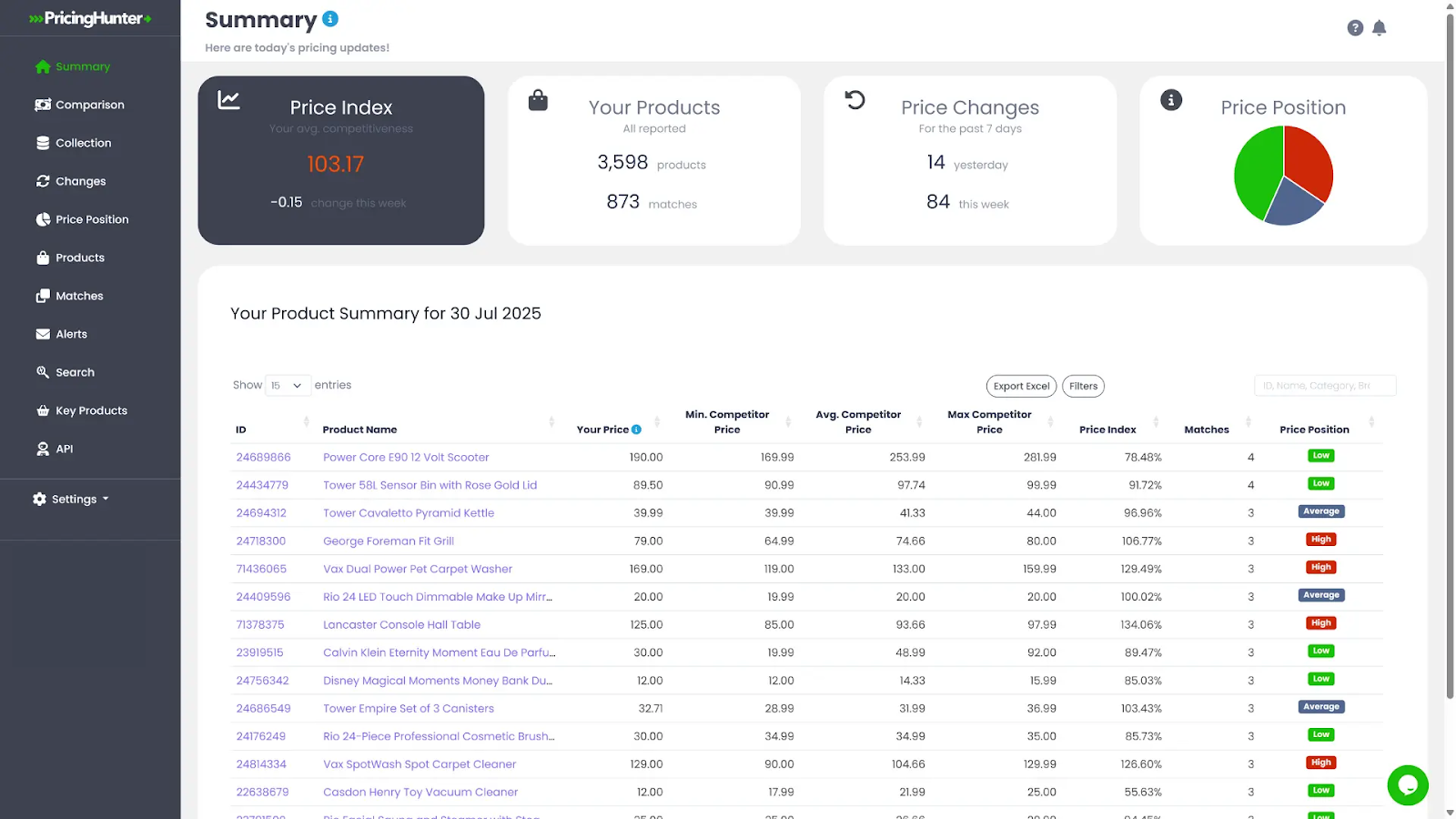
Most price scraping platforms in e-commerce assume that you have a developer on staff for technical setup. PricingHunter assumes neither a developer nor patience for API configuration. What you need to do is upload your products, approve the competitor matches the platform suggests, and start receiving scraped pricing data in your inbox every morning.
Every plan includes unlimited competitor tracking, automated product matching, full price history with no time limit, and, on Professional and Premium plans, product variant tracking. Scraping runs daily, including weekends.
Key features
- Unlimited competitor scraping on every plan
- Automated product matching with manual approval
- Daily price alerts, including weekends
- Price history with no storage time limit
- Product variant tracking
Pros
- No technical setup, live data from day one
- Transparent pricing with no add-ons or modules
- Month-to-month, cancel anytime
Cons
- No built-in dynamic repricing
- Not designed for developer-led custom scraping workflows
Pricing
- Essential: $99/mo (200 products)
- Professional: $199/mo (2,000 products)
- Premium: $399/mo (6,000 products)
- 14-day free trial
2. Prisync
Best for: eCommerce retailers on Shopify, Magento, or BigCommerce who want price scraping with dynamic repricing built in.
Scraping approach: Product-based scraping with one-click store sync and dynamic pricing rules on all plans.
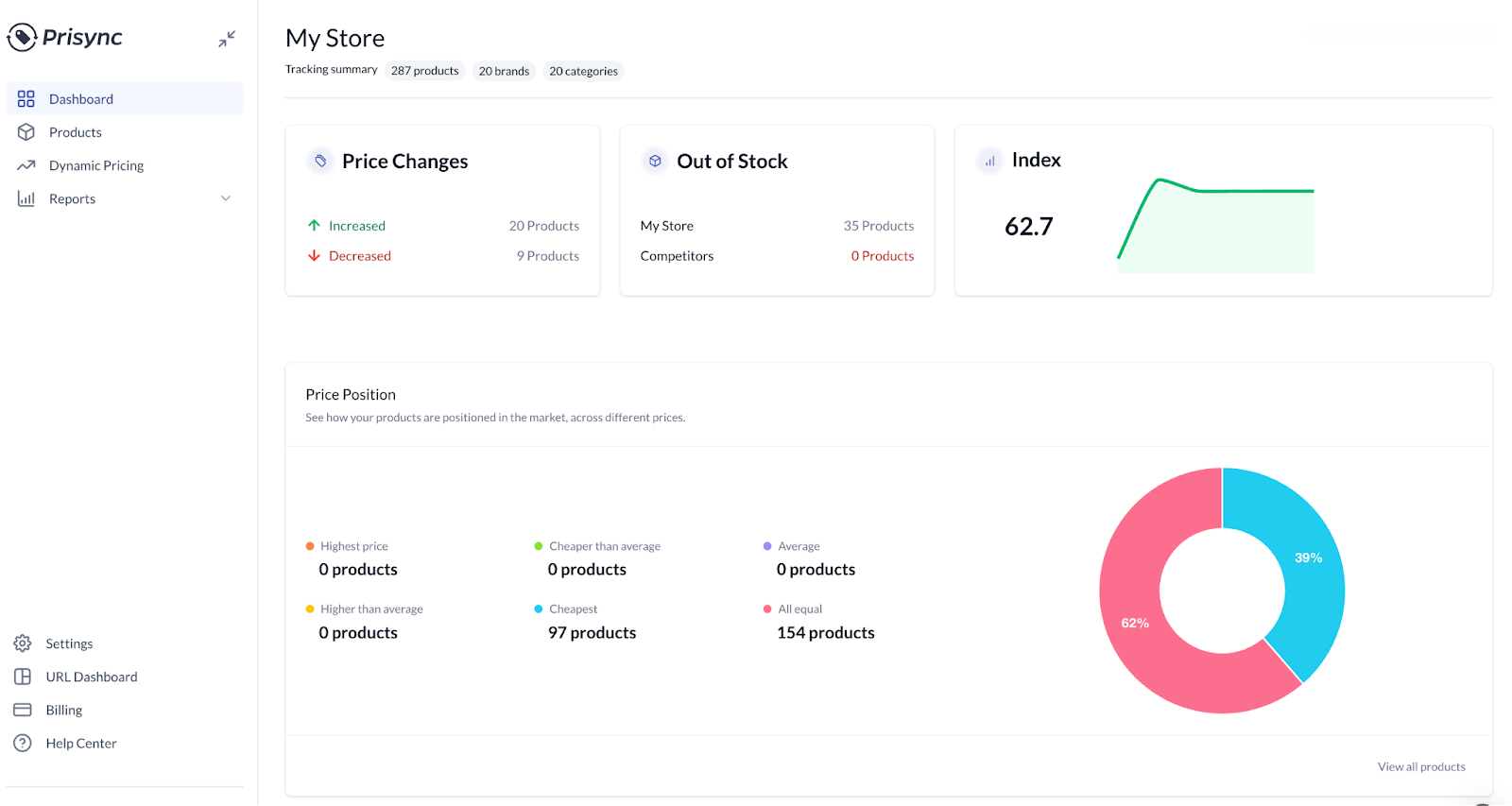
Prisync helps you track competitor prices and automatically adjust your pricing in one place. You can sync your store, monitor competitor data, and set dynamic pricing rules that update your prices in real time. With this tool, you can set repricing rules, and your store prices adjust automatically.
Key features
- Product-based scraping with unlimited competitors
- Dynamic pricing rules on all plans
- One-click Shopify, Magento, BigCommerce integration
- Automated competitor discovery and stock monitoring
Pros
- Scraping and repricing in one tool, no add-ons
- Transparent published pricing with a 14-day trial
- 24/7 customer support
Cons
- API access costs an extra 20%
- Dashboard customisation is limited
Pricing
From $99/mo (100 products) to $399/mo (5,000 products). API adds 20%. 14-day free trial.
3. Price2Spy
Best for: Mid-market retailers and brands that need high-frequency scraping, MAP monitoring, and deep analytics.
Scraping approach: URL-based scraping with stealth IP technology, up to 8 checks per day, and bot-protected site handling.
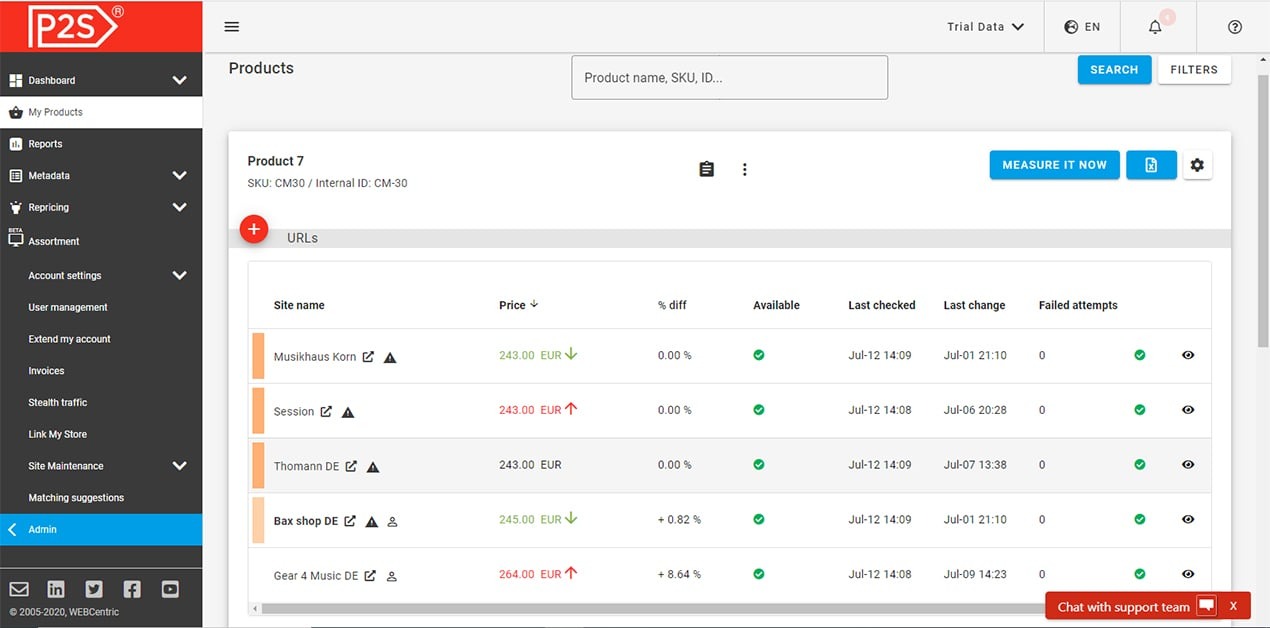
Some competitor sites take extra steps to block scrapers. Price2Spy makes a special effort to get through. Its stealth IP technology handles bot-protected pages that lighter tools bounce off, and it checks prices up to 8 times per day. Beyond prices, it pulls shipping costs, stock levels, and promotions.
One product tracked across five competitors counts as five URLs. That makes costs harder to forecast. But for teams that need frequency and MAP screenshot capture in one system, it covers serious ground.
Key features
- Scraping with up to 8 cheques a day
- Stealth IP technology for bot-protected sites
- MAP monitoring with screenshot capture
- Automatch + 25+ built-in pricing reports
Pros
- Published starting prices with a 14-day free trial
- Handles bot-protected sites that most tools cannot scrape
- Scraping, repricing, MAP, and analytics in one system
Cons
- URL-based pricing model scales unpredictably
- Add-on costs for repricing and automatch
Pricing
- Starter: $39.95/month for 500 URLs
- Basic: $157.95/month for 2,000 URLs
- Premium: custom pricing.
- 14-day free trial.
4. Bright Data
Best for: Enterprise teams that need to scrape pricing data from the most protected eCommerce sites at high volume.
Scraping approach: API-based scraping infrastructure with 150M+ residential IPs, JavaScript rendering, CAPTCHA solving, and pre-built eCommerce endpoints.
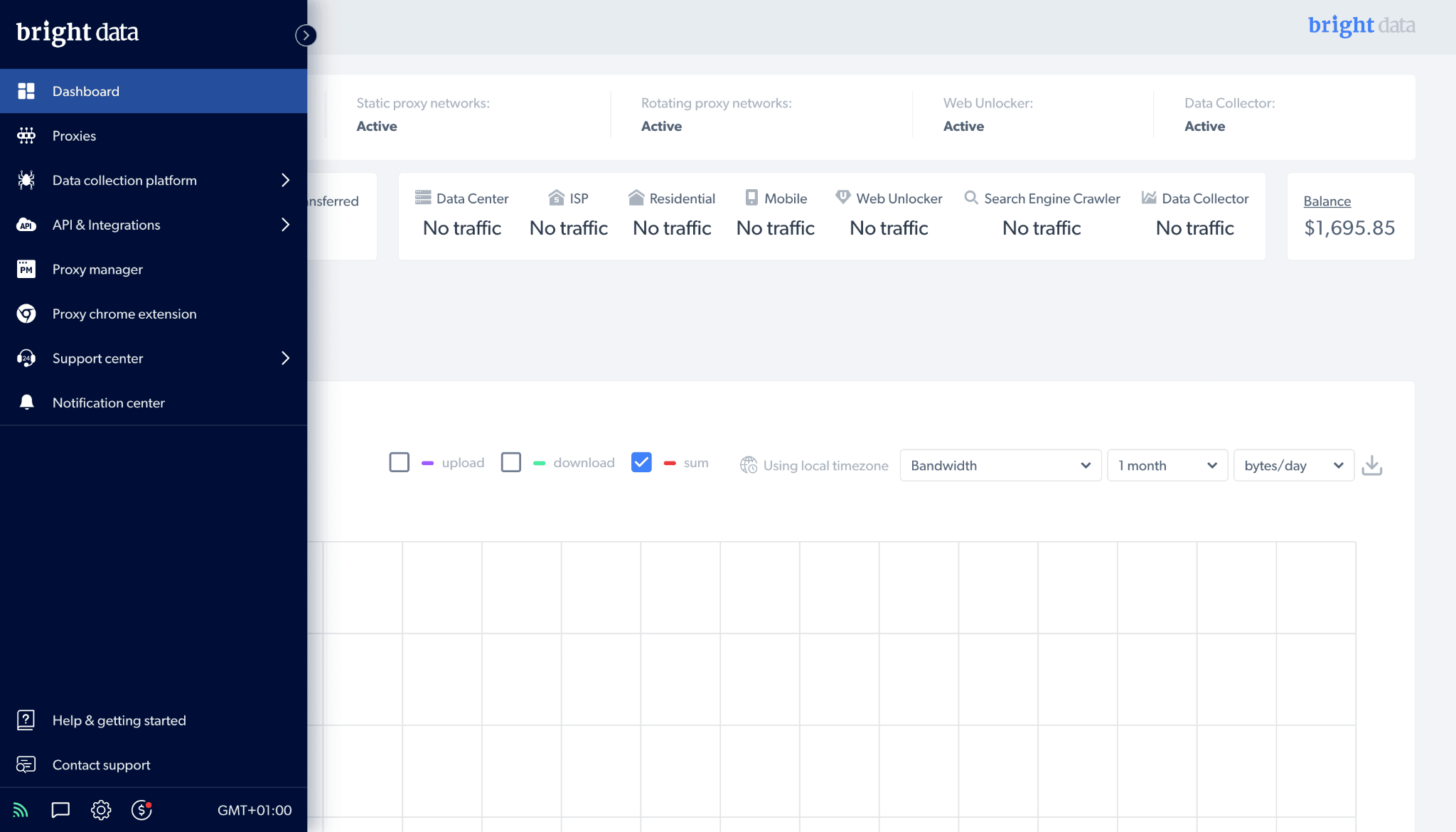
Bright Data is not a price monitoring dashboard. It is scraping infrastructure. Point it at a URL, and it handles proxy rotation, browser rendering, CAPTCHA solving, and anti-bot bypassing. Prebuilt scrapers are available for Amazon, Walmart, eBay, and dozens of other eCommerce sites.
Developers who need millions of pages scraped reliably will find the industry standard here. If you want competitor prices without touching the code, you may have to look elsewhere.
Key features
- 150M+ residential IPs across 195 countries
- Pre-built scrapers for major eCommerce platforms
- JavaScript rendering and CAPTCHA solving
- Structured data output in JSON, CSV, or API delivery
Pros
- 98%+ success rate on protected sites in independent benchmarks
- Largest proxy network in the industry
- Ready-made datasets if you want to skip scraping entirely
Cons
- Subscriptions start at $499/mo for most products
- Requires developer resources to set up and maintain
Pricing
- Web Scraper API from $1.5/1K records (pay-as-you-go).
- Subscriptions from $499/mo. Free trial available.
5. Apify
Best for: Developers who want pre-built eCommerce scrapers that they can customise and deploy without building infrastructure from scratch.
Scraping approach: Actor-based scraping platform with 6,000+ pre-built scrapers, including dedicated eCommerce tools for Amazon, Walmart, eBay, and any retail site.
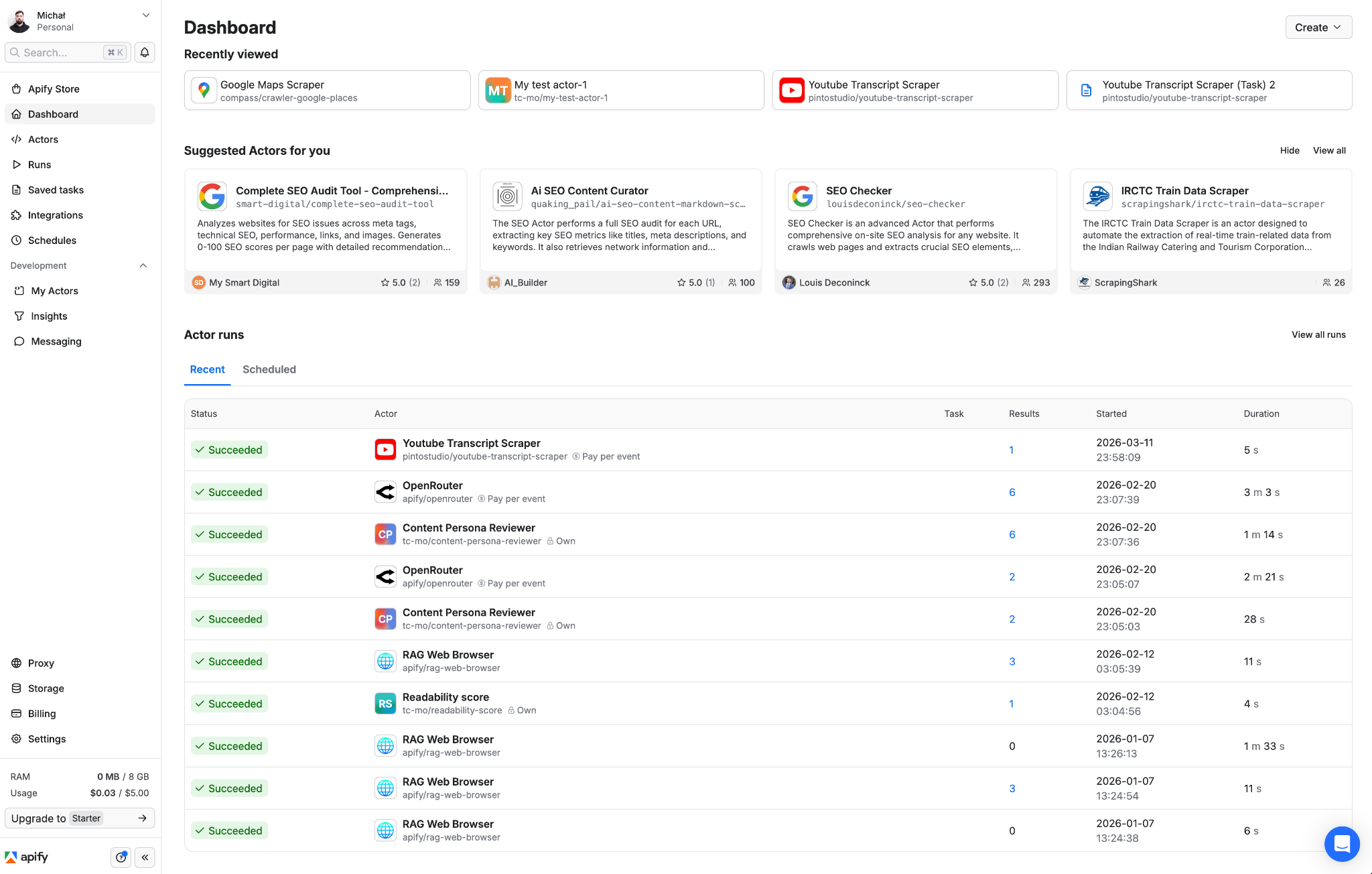
Building a custom scraper from scratch is expensive. Maintaining it becomes more difficult when sites change their HTML. Apify helps you run and customise pre-built eCommerce scrapers without having to build everything from scratch. You can use ready-made actors for sites like Amazon, Walmart, and eBay, schedule scraping tasks, and export data to your preferred tools. This makes it easier to quickly launch scraping workflows while still retaining full flexibility.
Key features
- 6,000+ pre-built scrapers, including eCommerce actors
- Works on Amazon, Walmart, eBay, and any retail URL
- Scheduled runs with webhook and API delivery
- Export to JSON, CSV, Excel, or direct integrations
Pros
- Generous free tier with $5 monthly credit
- Huge community library of maintained scrapers
- Version control and CI/CD for custom workflows
Cons
- Costs scale quickly at high volume
- Requires technical knowledge to customise actors
Pricing
- Free tier ($5/mo credit).
- Paid from $49/mo. enterprise is custom.
6. ShoppingScraper
Best for: e-commerce teams that need real-time price and seller data from major marketplaces via a simple REST API.
Scraping approach: Dedicated marketplace scrapers for Amazon, Walmart, Bol.com, Google Shopping, and other major platforms with EAN/GTIN-based product matching and automated scheduling.
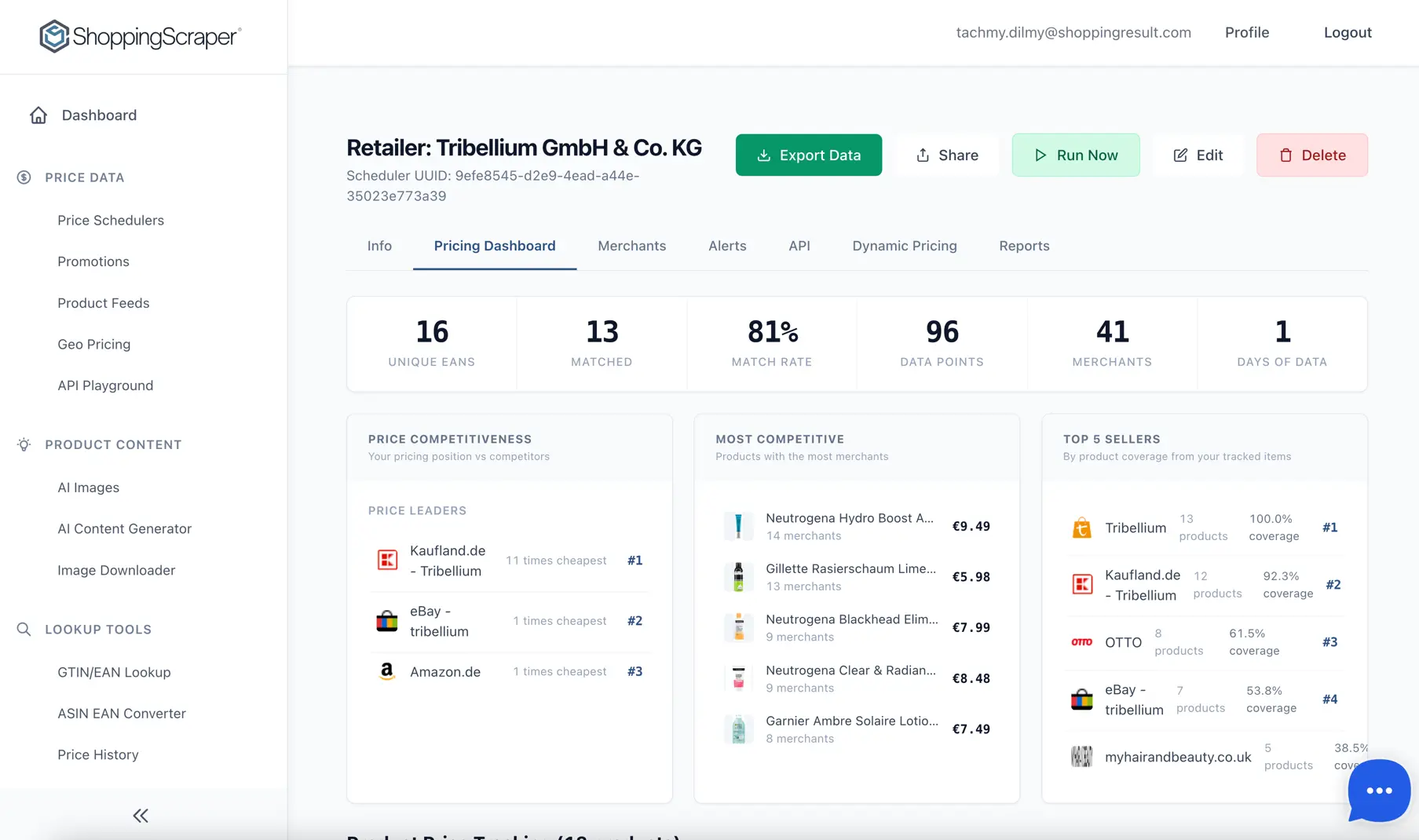
ShoppingScraper is an eCommerce-focused scraping platform designed to help retailers, brands, and agencies extract real-time pricing and seller data from major online marketplaces. Because of its focus on marketplace coverage and EAN/GTIN-based matching, ShoppingScraper works best for teams that primarily need structured price data from platforms like Amazon, Walmart, Bol.com, and Google Shopping.
Key features
- Dedicated scrapers for 13 marketplaces including Amazon, Walmart, and Google Shopping
- REST API with CSV and JSON export
- EAN/GTIN-based product matching for automated competitor tracking
- Geo-pricing across 50+ countries with automatic currency conversion
Pros
- Built specifically for eCommerce marketplace scraping
- EAN/GTIN matching removes manual competitor linking
- Free trial with 100 API credits, no credit card required
Cons
- Limited to supported marketplaces, not general web scraping
- Smaller user community compared to Bright Data or Apify
Pricing
- Startup: €49/mo
- Growth €199/mo
- Advanced €399/mo,
- Enterprise €999+/mo.
- Free trial with 100 credits.
7. Competera
Best for: Enterprise retailers that want competitor price scraping to feed directly into AI-driven pricing recommendations.
Scraping approach: competitor data collection combined with demand elasticity modelling and scenario testing.
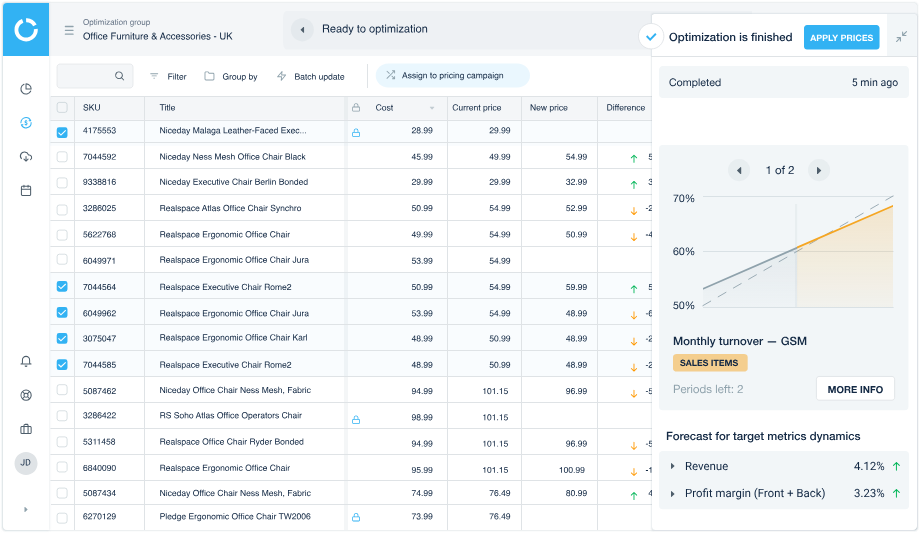
Competera helps you turn competitor pricing data into actionable pricing decisions using AI. You can collect competitor prices, analyse demand factors, and simulate pricing scenarios before making any changes. This way, you can optimise pricing strategies and improve margins with data-backed recommendations.
Key features
- Competitor price scraping across marketplaces
- AI pricing optimisation based on demand elasticity
- Scenario modelling before rollout
- Enterprise integrations and dedicated account management
Pros
- Scraping feeds directly into pricing recommendations
- Scenario modelling reduces pricing risk
- Dedicated implementation support
Cons
- Enterprise pricing only
- Significant setup and onboarding time
Pricing
Custom only. Contact Competera for a demo.
8. Priceva
Best for: Mid-size retailers who want price scraping, repricing, and MAP monitoring without paying for separate modules.
Scraping approach: Automated competitor scraping with formula-based repricing, MAP monitoring, and multi-format data export on every paid plan.
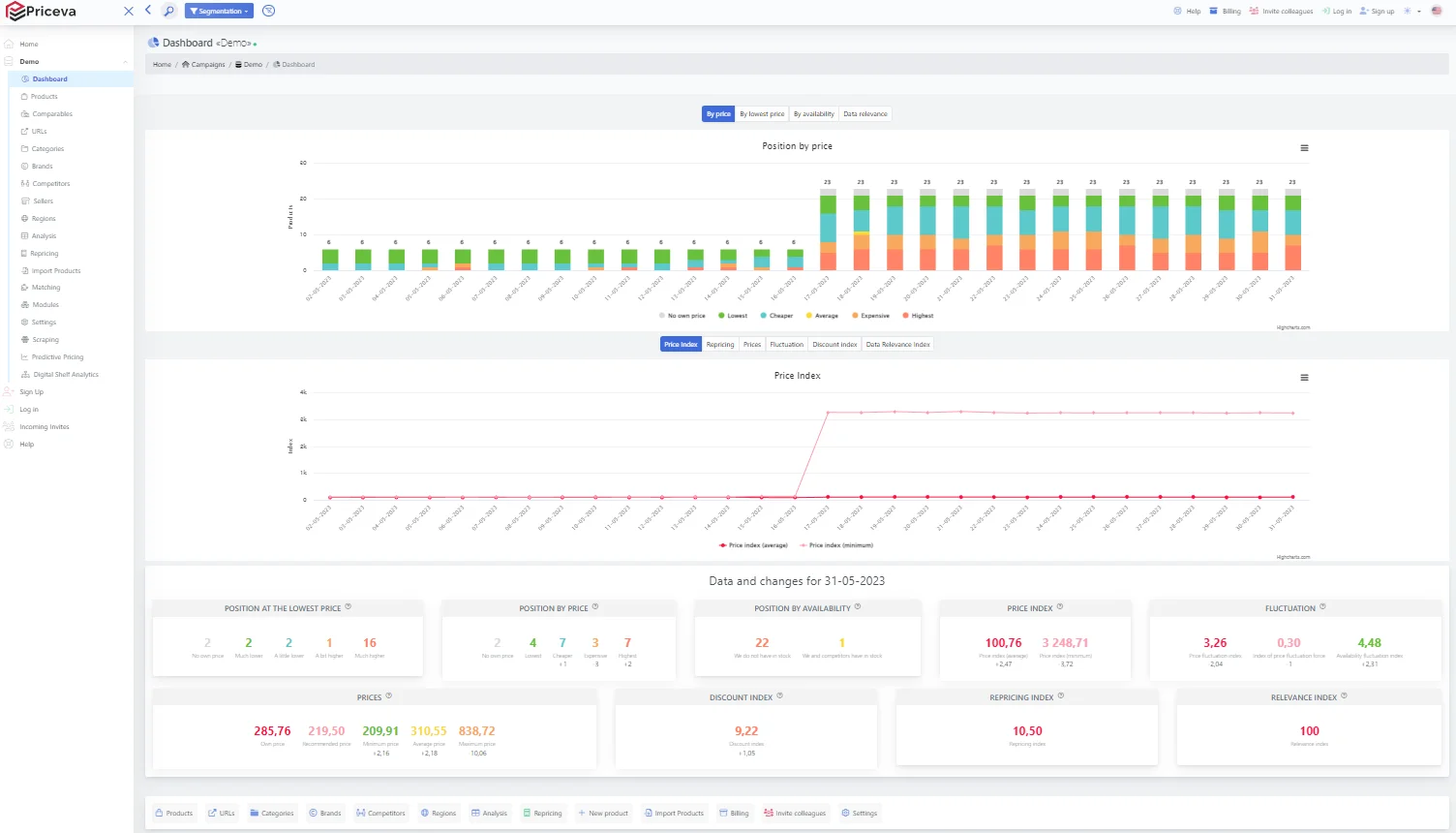
Priceva helps you monitor competitor prices and apply automated repricing without needing separate tools or add-ons. You can scrape pricing data, enforce MAP policies, and set custom pricing rules from a single platform. Free tier for 20 products. Exports in CSV, JSON, and XML. The interface could use a refresh, but the all-inclusive pricing is hard to argue with.
Key features
- Competitor price and stock scraping
- Built-in IP rotation and CAPTCHA handling
- Automated repricing with user-defined formulas
- MAP monitoring, API, and multi-format export
Pros
- Repricing and MAP are included on every paid plan
- Free starter tier for 20 products
- Flexible data export in CSV, JSON, and XML
Cons
- Data accuracy varies by source
- The interface feels dated
Pricing
Free (20 products). Paid from $99/mo.
9. Minderest
Best for: Brands and manufacturers scraping pricing data across distributor networks, marketplaces, shopping apps, and physical stores.
Scraping approach: AI-powered scraping across eCommerce sites, Amazon, Google Shopping, shopping apps, and offline channels in 40+ countries.
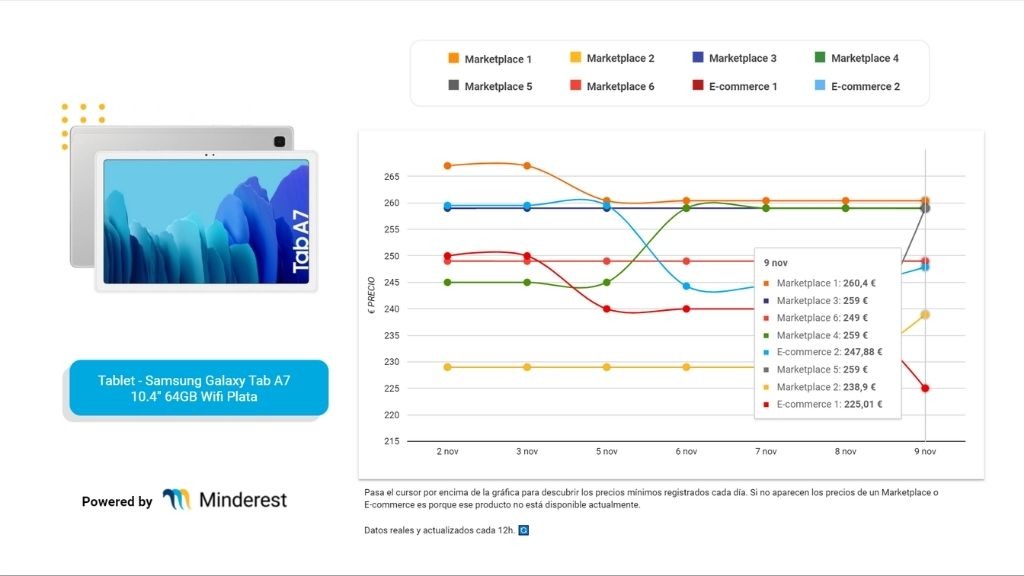
Minderest helps you track pricing data across online stores, marketplaces, apps, and even physical retail locations. You can monitor distributor networks, enforce pricing compliance, and match products across different regions and formats. AI matching works across languages, currencies, and naming conventions. The InStore module scrapes pricing from physical stores.
For a brand enforcing MAP across a European distribution network, the coverage is difficult to match.
Key features
- Scraping across online, offline, and app channels
- MAP and MSRP compliance monitoring
- AI-powered product matching across languages and currencies
- Catalog intelligence and assortment tracking
Pros
- 400+ customers across 40+ countries
- Scrapes channels that other tools cannot reach
- Dedicated customer success manager
Cons
- No public pricing, no free trial, minimum 3-month contract
- Product matching sometimes requires manual correction
Pricing
Custom only. Contact sales for a demo.
10. Octoparse
Best for: Non-technical teams that need to scrape e-commerce prices without writing code or waiting for developers.
Scraping approach: No-code visual scraper with point-and-click extraction and prebuilt templates for Amazon, eBay, AliExpress, and other major platforms.
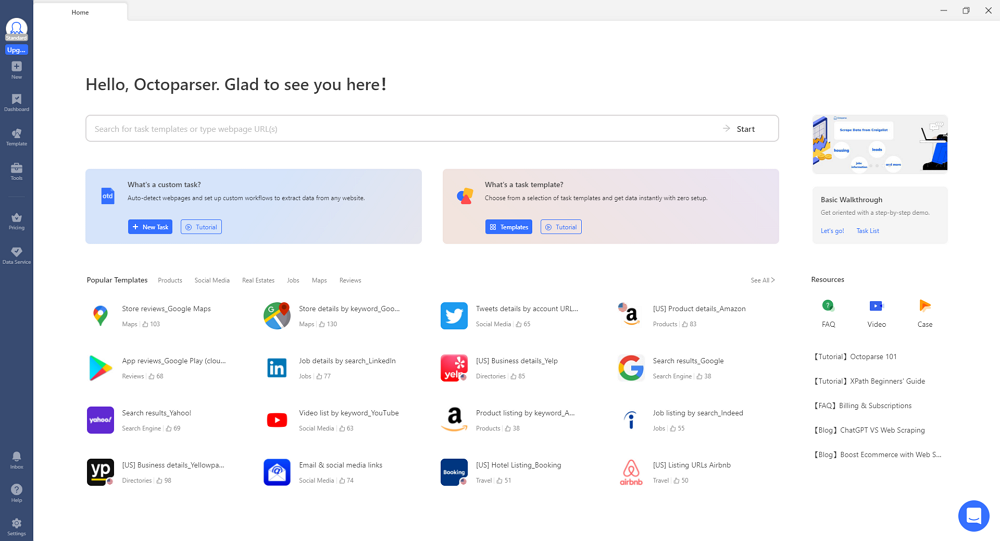
Octoparse helps you scrape pricing data from e-commerce websites without writing code. You can use a visual interface to select data, run scraping tasks in the cloud, and export results in multiple formats. This makes it easy for non-technical teams to collect competitor data quickly without relying on developers
Key features
- No-code point-and-click extraction
- Prebuilt templates for Amazon, eBay, AliExpress, Walmart
- Cloud-based scheduled scraping
- Export to Excel, CSV, JSON, or database
Pros
- No coding required at all
- Free tier to test before committing
- Handles JavaScript pages and proxy rotation
Cons
- Less flexible than API tools for complex pipelines
- Advanced features locked behind higher-tier plans
Pricing
Free tier available. Standard $83/mo. Professional $299/mo. Enterprise custom.
What makes a price scraping tool worth using
Anti-bot handling
Most eCommerce sites use bot protection. If the scraper cannot handle CAPTCHA, JavaScript rendering, and IP rotation, it will get blocked.
Data accuracy and parsing
Scraping raw HTML is easy. Extracting the right price from a page with dynamic content, variants, and promotions is harder. The best tools parse data into clean, structured fields you can use immediately.
Matching your products to competitors
The scraper needs to connect the right competitor listing to the right product in your catalogue. Some match by URL, others by GTIN, and a few use AI to match by title and attributes.
Data hygiene
Stale data gives you false confidence. Know how often the tool refreshes and whether it scales to the frequency your market demands.
Output and integration
Scraped data needs to go somewhere useful. Look for tools that export to CSV, JSON, or an API, or that feed directly into your e-commerce platform or BI tool.
How we selected these tools
We evaluated each tool on scraping reliability, anti-bot handling, data accuracy, eCommerce features, pricing transparency, and real user feedback across G2, Capterra, and developer communities.
How to choose the right Ecommerce price scraping tool
The right price scraping tool should save you time, not create more work. Look for a tool that:
- Handles scraping end-to-end so you don’t need to manage proxies, CAPTCHAs, or infrastructure
- Matches your products to competitors accurately without constant manual fixing
- Delivers clean, structured data you can use immediately (CSV, JSON, or direct integrations)
- Keeps data fresh and reliable with a scraping frequency that matches your market
- Scales with your catalog and competitors without unpredictable costs
- Lets you act on data quickly through alerts
Start scraping competitor prices today
If you want competitor price data without proxies, scrapers, or enterprise contracts, PricingHunter is worth a closer look.
Upload your products, approve the automated matches, and start receiving daily price data, including weekends. Every plan includes unlimited competitor scraping, price history, and product variant tracking.