



Quick summary
While Prisync is a powerful competitor price-tracking software, it may not be the perfect fit for every team. Some retailers outgrow the product limits faster than expected, while others find the extra 20% API charge or limited dashboard customisation harder to work around than anticipated.
This article compares the best Prisync competitors on the market so you can make an informed decision when choosing your next competitor price tracking and monitoring software.
Here are three worth knowing upfront:
Looking for a Prisync alternative?
If you’re here, you’re likely tired of dealing with Prisync limitations. Prisync is a solid tool for what it does. The dashboard is clean, support is responsive, and pricing is product-based and easy to understand. Many retailers get real value from it, but it may not be a perfect fit for all retail businesses.
The tier gaps leave mid-size catalogs overpaying. API access costs 20% extra. The dashboard does not bend to custom views. And once you need repricing or MAP monitoring, you are looking at different tools anyway. Whatever your reason for exploring alternatives, there are plenty of options. In this guide, we’ll break down the best Prisync alternatives in 2026.
Why listen to us?
At PricingHunter, we built our platform to help SME retailers track competitor prices without the complexity or cost of enterprise tools. Our team are competitor pricing specialists who talk to online retailers every day. That keeps this comparison grounded in real setup time, total cost, and day-to-day usability.
Why Look For Prisync Alternatives
Prisync is often a strong starting point. But retailers usually start looking at alternatives when their needs change. Here are the most common reasons.
1. You’re hitting gaps between pricing tiers
Prisync’s jump from 100 to 1,000 to 5,000 products leaves awkward gaps. If you track 300 or 2,500 products, you pay for unused capacity, and there’s no in-between.
2. You need API access without a hidden surcharge
Prisync charges an extra 20% on top of your subscription for API access. That cost is not obvious on the pricing page, so teams that need data in their systems often discover it after committing.
3. Your dashboard is not giving you the views you need
Prisync’s built-in views are clean but limited. If you need custom analysis or multi-competitor comparisons, you will likely end up exporting to spreadsheets, which adds manual work that the tool was supposed to remove.
4. You’re seeing gaps in scraping accuracy
Some competitor websites do not reliably return pricing, especially when their site structures change. If your monitoring coverage has holes, you are back to manual checking for those competitors.
5. You’re scaling, and multi-user access is too flat
Everyone on a Prisync account sees the same data with no role-based permissions. As your team grows and more people need access, the lack of tiered controls can slow things down.
Top 10 Prisync competitors
1. PricingHunter
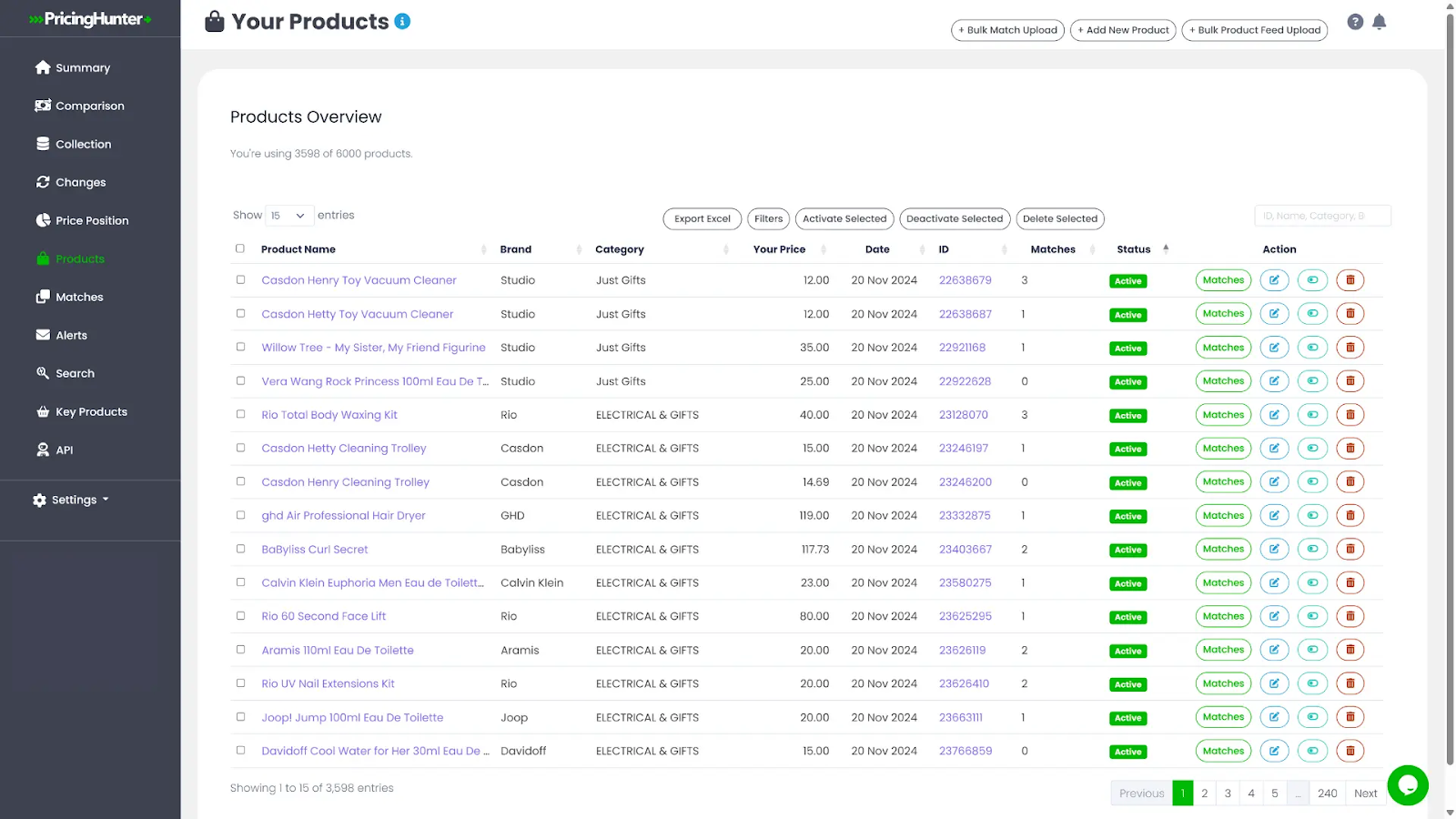
PricingHunter is a competitor price-monitoring tool built for small- to medium-sized eCommerce retailers who want daily competitor pricing without the cost or complexity of enterprise platforms. We built PricingHunter for SME retailers who were stuck manually checking competitor prices in spreadsheets or paying for enterprise tools packed with features they would never use.
It offers unlimited competitor tracking across all plans, without extra charges for product matching, alerts, or price history. Instead of paying for enterprise features you will never use, you upload your products, approve the automated competitor matches, and start getting daily pricing updates via email.
This way, you are not stitching together add-on modules, negotiating annual contracts, or exporting to spreadsheets to get the views you need. Unlimited competitor tracking, automated matching, price history, and API access are built in from the moment you start using it, and your plan scales as your catalog grows.
Key features
- Unlimited competitor tracking on every plan, so adding competitors never increases your cost
- Automated powered product matching that finds and suggests competitor matches for you to approve in a few clicks
- Daily price change alerts delivered to your inbox every morning, including weekends, so you never miss a move
- Price history with no time limit on stored data, giving you full visibility into how competitors have priced over time
- Product variant tracking that captures pricing across sizes, colours, and configurations on Professional and Premium plans
Pros
- Makes competitor tracking accessible without enterprise budgets or long contracts
- Transparent pricing with no hidden add-ons for matching, alerts, or history
- Gets you from sign-up to live competitor data in minutes
Cons
- More of a monitoring tool than a full pricing suite; no built-in dynamic repricing
2. PriceShape
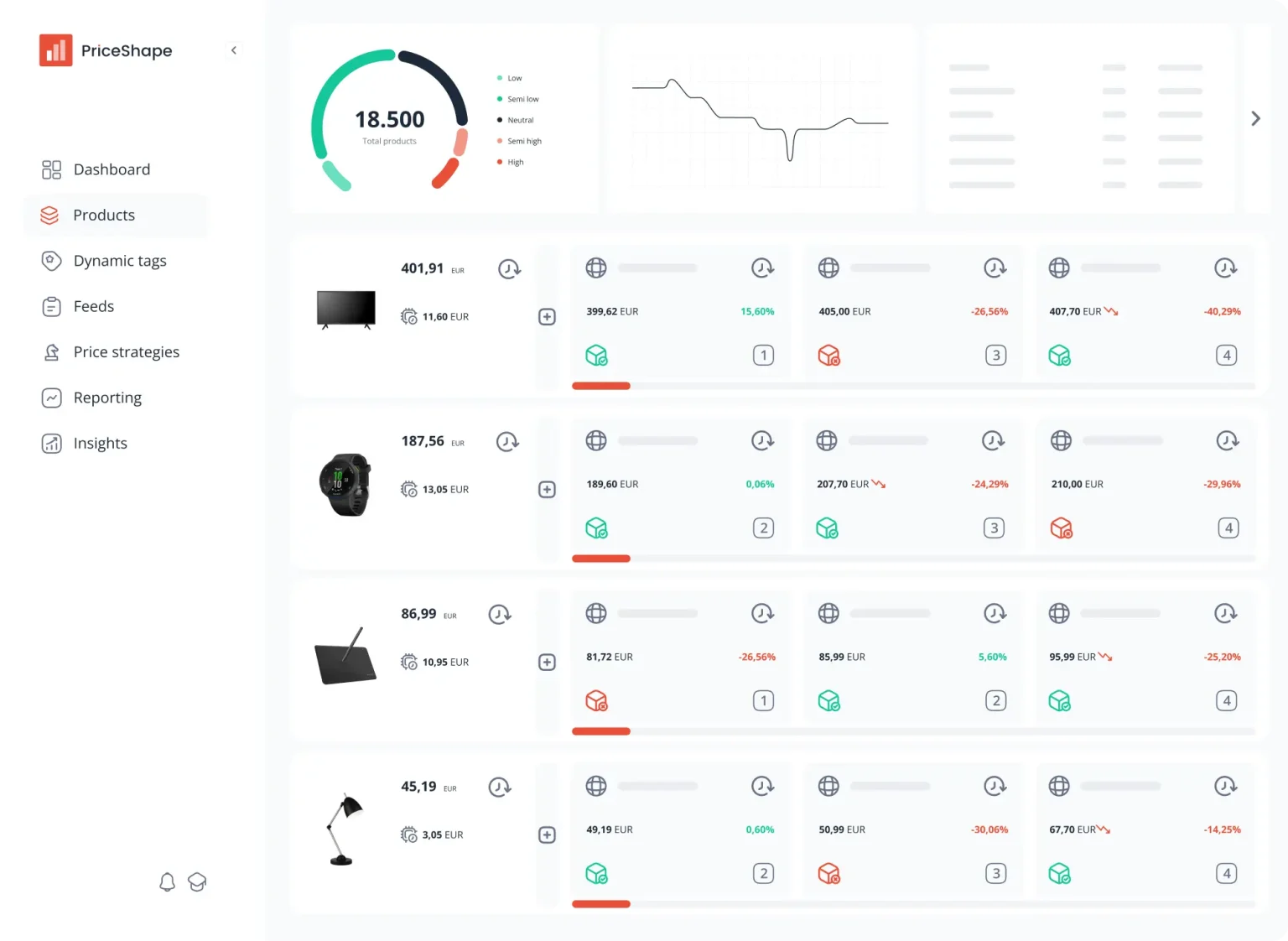
PriceShape is a common next step for retailers who want to link competitors’ prices to their ad spend. It helps you focus your marketing budget on products where you are actually competitive, rather than wasting money on items priced too high to convert. Instead of treating price tracking and ad spend as separate decisions, PriceShape connects the two, helping you focus your marketing budget on products where you are actually competitive.
Key features
- Real-time competitor monitoring across websites and Google Shopping
- Dynamic pricing rules, including cost-plus and competitive matching
- Feed editor for Google Shopping campaigns
- Price index scoring
- Dedicated customer success manager
Pros
- Connects pricing intelligence directly to ad performance, so spend goes further
- Intuitive interface that teams pick up quickly
- Affordable pricing for SMEs
- Responsive customer success support with structured onboarding
Cons
- No publicly listed pricing tiers, and scraping coverage can be limited on non-standard competitor sites
- No public API for custom integrations
3. Price2Spy
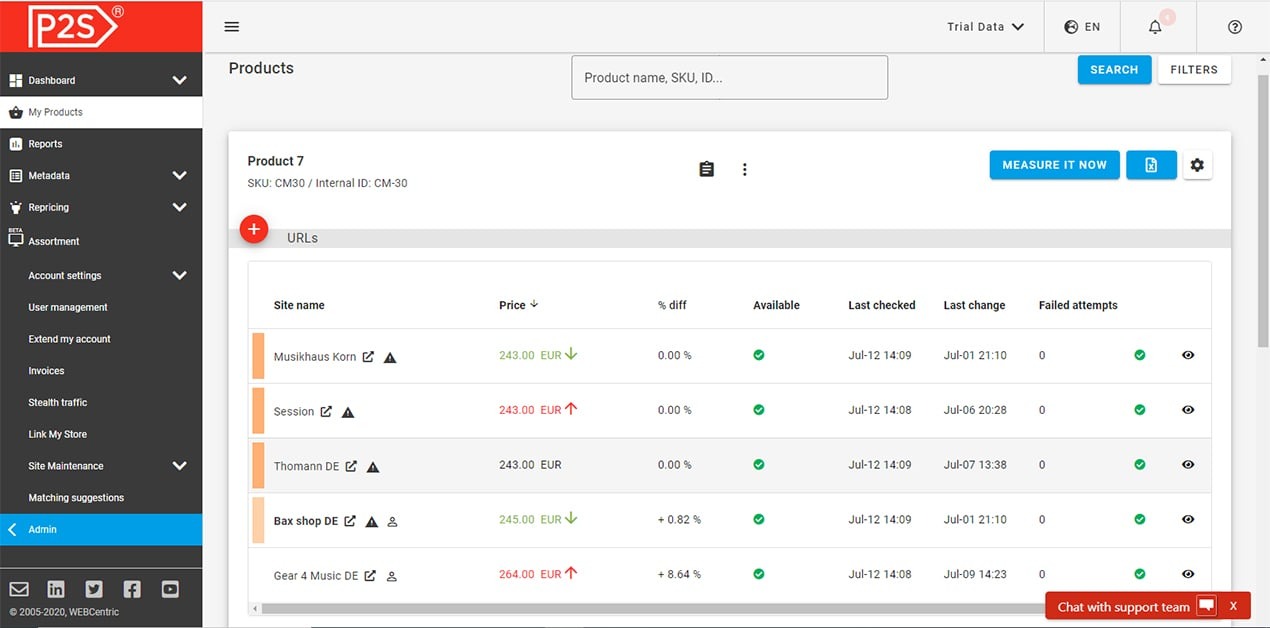
Price2Spy is a pricing intelligence platform built for mid-market to enterprise retailers and brands that need to monitor, reprice, and enforce MAP in a single system. Unlike Prisync, Price2Spy handles most advanced features natively, with an advanced repricing module, MAP monitoring with screenshot evidence, and 25+ built-in reports. Operating since 2010 across 40+ countries, it is one of the most established options in the space.
Key features
- Price monitoring with up to 8 checks per day on higher plans
- Advanced repricing module with custom pricing strategy rules
- MAP monitoring with screenshot capture for violation evidence
- Automatch for automatic competitor product matching
- 25+ built-in pricing reports and a customizable dashboard
Pros
- It covers monitoring, repricing, MAP, and analytics in one platform
- Strong customer support that reviewers consistently praise
- 15-year track record across 40+ countries
Cons
- URL-based pricing can be confusing; tracking one product across five competitors counts as five URLs
- High cost. The starting price is $999 per month; not many teams can afford it.
4. Minderest
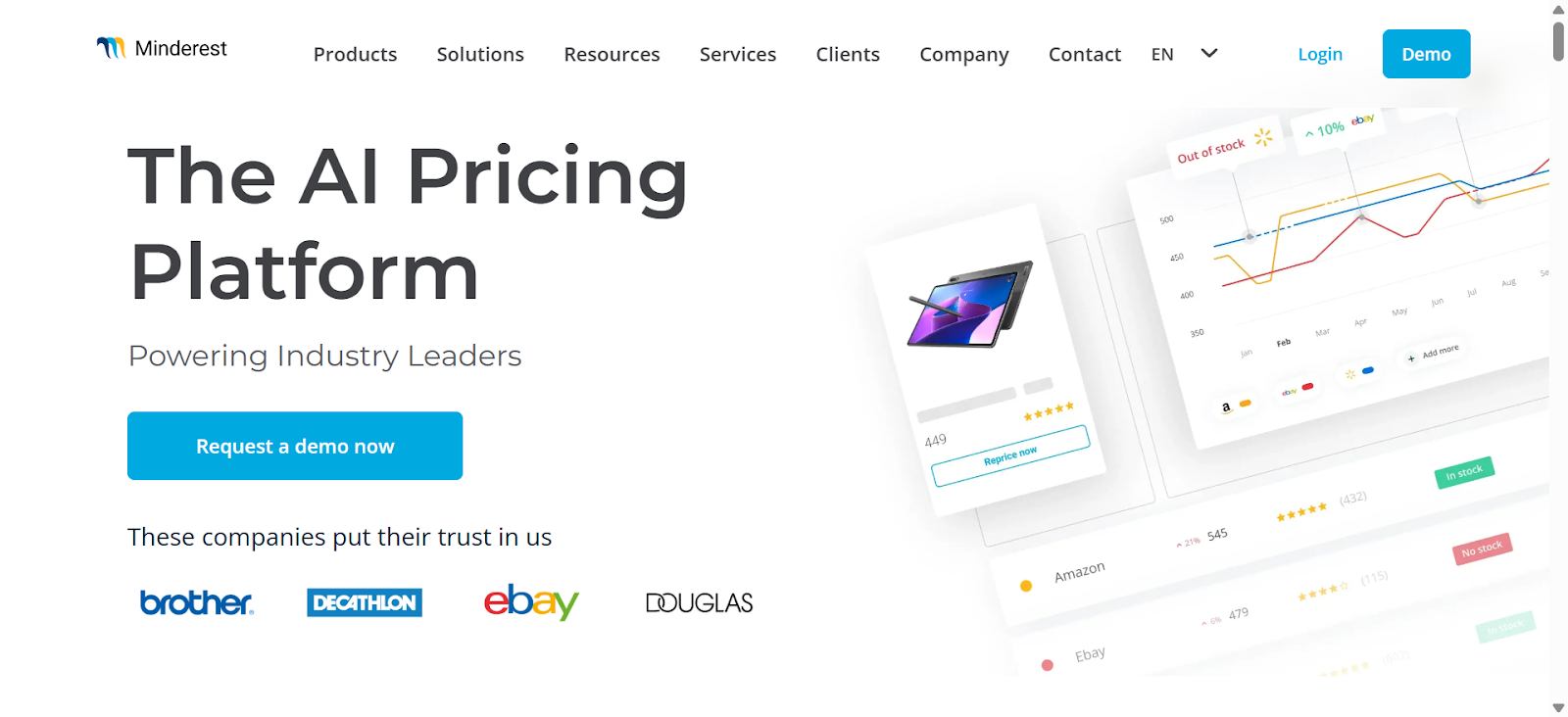
Minderest is a pricing intelligence platform designed for brands and manufacturers who need to monitor competitor prices across a niche. Unlike Prisync, which is designed for retailers tracking competitors, Minderest works from the brand side, providing MAP enforcement, MSRP compliance, and catalog intelligence across online and offline channels, helping brand teams spot violations and maintain pricing consistency without manual checks.
Key features
- MAP and MSRP monitoring across retailer and distributor networks
- Competitor tracking across websites, marketplaces, and offline channels
- Multi-country and multi-currency support for international operations
- Customisable alerts and automated reporting
- Catalog intelligence with assortment and stock analysis
Pros
- Strong specialisation in brand and manufacturer pricing intelligence
- Covers both online and offline retail channels
- Detailed MAP violation tracking and reporting
Cons
- No public pricing, which makes budget planning harder
- Enterprise-leaning complexity and setup
5. Pricefy
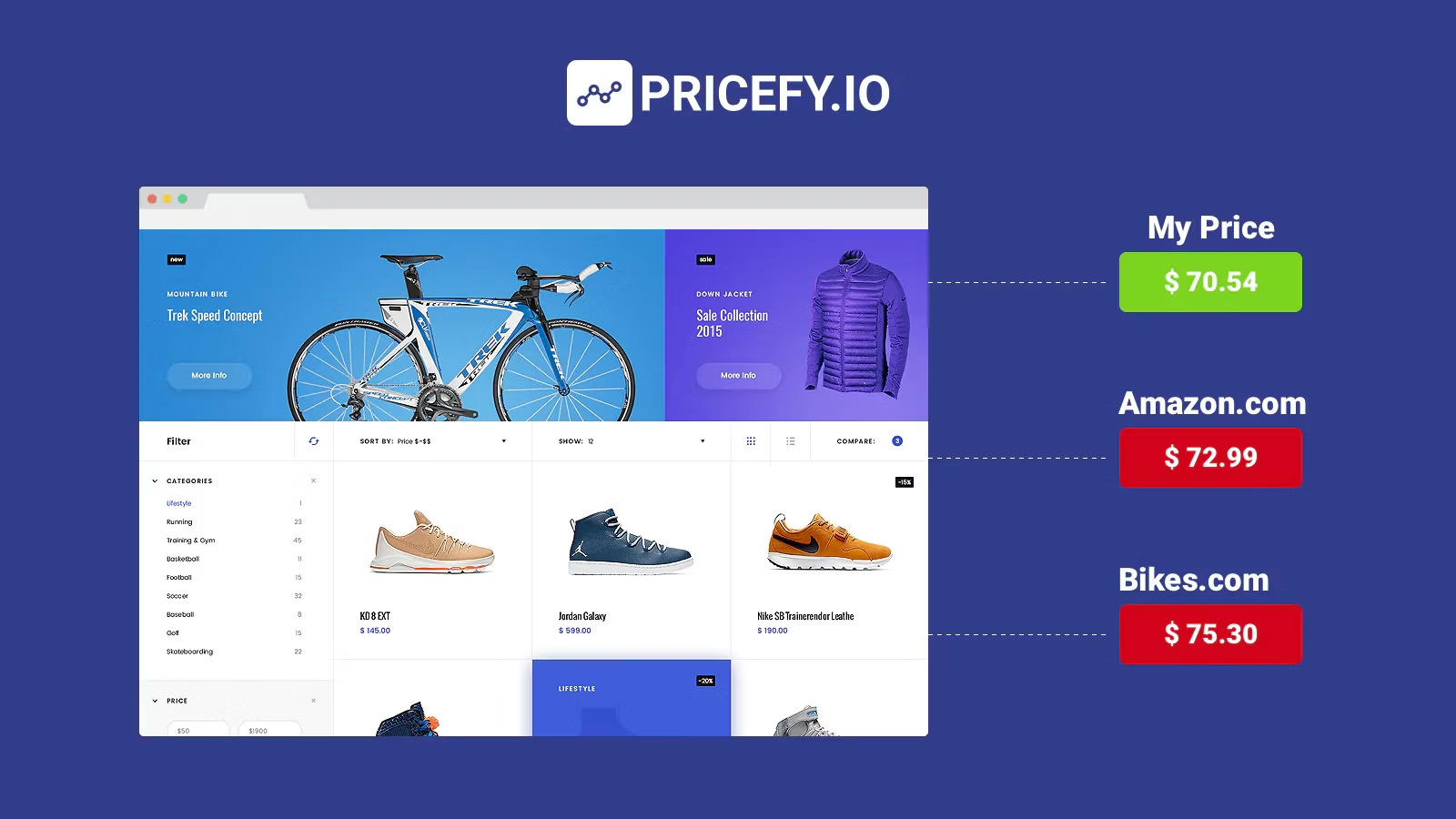
Pricefy is a budget-friendly option for small- and mid-size retailers. It offers price tracking, marketplace monitoring, and automated product matching at competitive price points. For teams comparing it to Prisync, the main difference is that Pricefy includes marketplace analysis and a repricing simulator, whereas Prisync only offers basic URL-based tracking.
Key features
- Competitor price tracking across websites and marketplaces
- Google Shopping integration for competitive positioning
- Manual and automated product matching
- Price alerts and stock monitoring
- Repricing simulator for previewing pricing strategy changes
Pros
- Competitive pricing for the number of SKUs included
- Clean interface that is easy to navigate
- Marketplace monitoring is included at base paid tier
Cons
- Advanced analytics and reporting are less developed
- The competitor count may be limited on the lower tiers
6. Competera
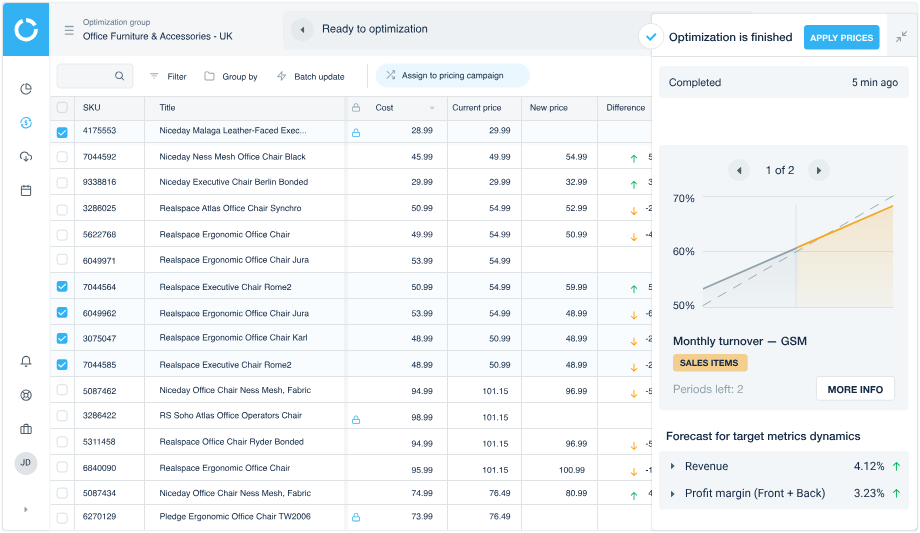
Competera is an AI-powered dynamic pricing platform built for large enterprise retailers with complex, multi-category strategies. Instead of rule-based repricing, it uses machine learning to recommend prices based on demand elasticity and market signals. The key edge over Prisync is a level of pricing intelligence that goes well beyond what any SME-focused monitoring tool can deliver.
Key features
- AI-driven price optimisation based on demand elasticity
- Dynamic pricing recommendations across product categories
- Scenario modelling for testing pricing strategies before rollout
- Market intelligence with competitor price and assortment tracking
- Enterprise integrations and dedicated account management
Pros
- Goes beyond rule-based repricing into demand-driven optimisation
- Strong fit for large retailers managing complex, multi-category pricing
- Scenario modelling reduces risk before making pricing changes
Cons
- Out of reach for most SME retailers due to budget and complexity
- Requires significant setup time and internal resources
7. Pricefx
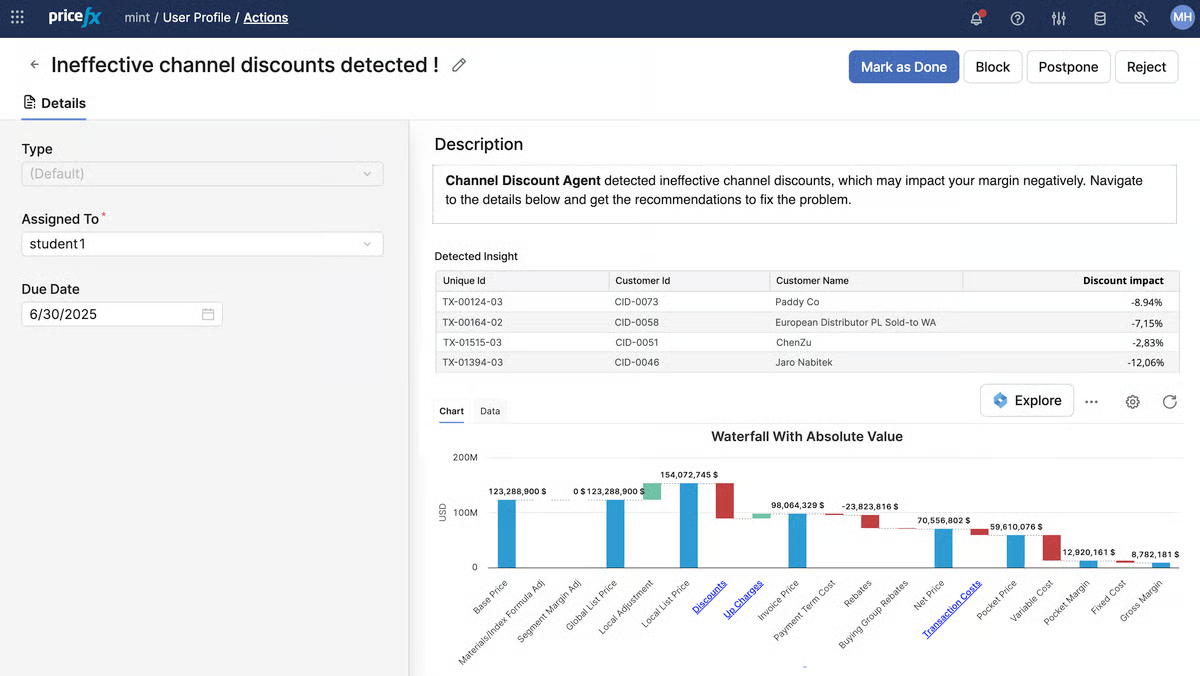
Pricefx operates in a completely different category from Prisync. Where Prisync is built for e-commerce retailers tracking competitor prices, Pricefx is an enterprise pricing intelligence platform designed for B2B manufacturers, distributors, and large-scale retailers who need end-to-end price management, optimisation, and CPQ (Configure, Price, Quote) capabilities. It is the right choice when competitor monitoring is just one input into a much larger pricing strategy.
Key features
- 125+ AI pricing agents for margin recovery and revenue optimisation
- Dynamic pricing and price optimisation powered by predictive analytics
- CPQ (Configure, Price, Quote) for complex B2B deal management
- Competitor price tracking integrated into broader pricing workflows
- ERP and CRM integration (SAP, Salesforce, and others)
Pros
- Covers the full pricing lifecycle from analysis to quoting
- AI-powered insights with 125+ ready-made pricing agents
- Cloud-native with fast deployment relative to legacy pricing tools
Cons
- Custom pricing only; built for enterprise budgets
- Requires implementation investment and often partner support for customisation
8. PriceMole
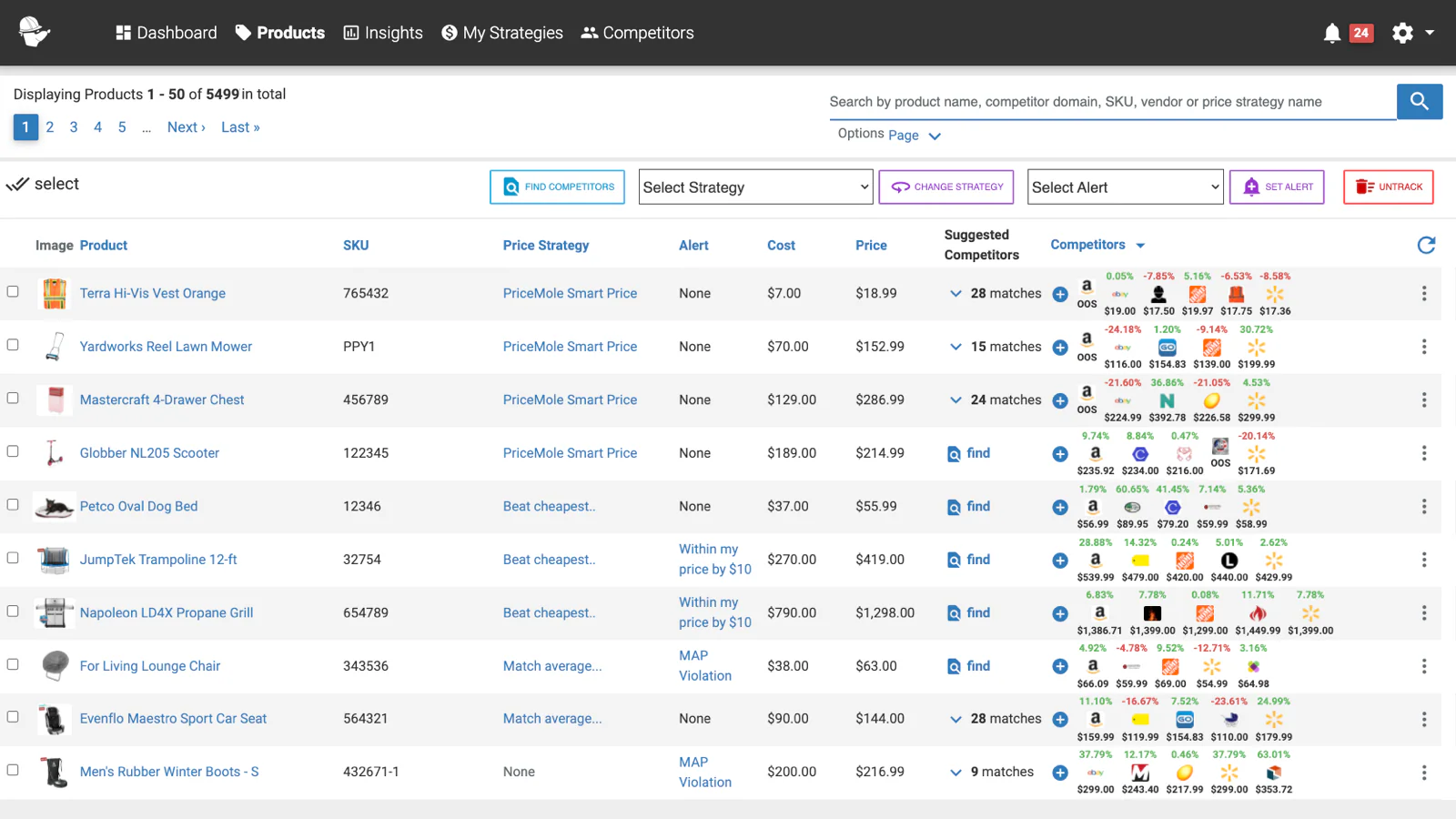
PriceMole is a competitor price tracking and repricing tool built for Shopify, BigCommerce, and WooCommerce stores. It lives inside your eCommerce platform, syncing products and applying repricing rules directly to your listings. The key edge over Prisync is all-inclusive pricing with no hidden fees, and everything is managed from your existing store dashboard.
Key features
- Direct integrations with Shopify, BigCommerce, and WooCommerce
- Automated repricing rules applied directly to your store
- AI automatching to find and link competitor products
- Competitor price comparison widget for your storefront
- All-inclusive pricing with no hidden fees or add-ons
Pros
- No separate login or tool to manage
- Repricing is applied directly to your store in real time
- All-inclusive pricing means no surprise add-on costs
Cons
- Limited to supported eCommerce platforms only
- Manual SKU URL setup
9. Boardfy
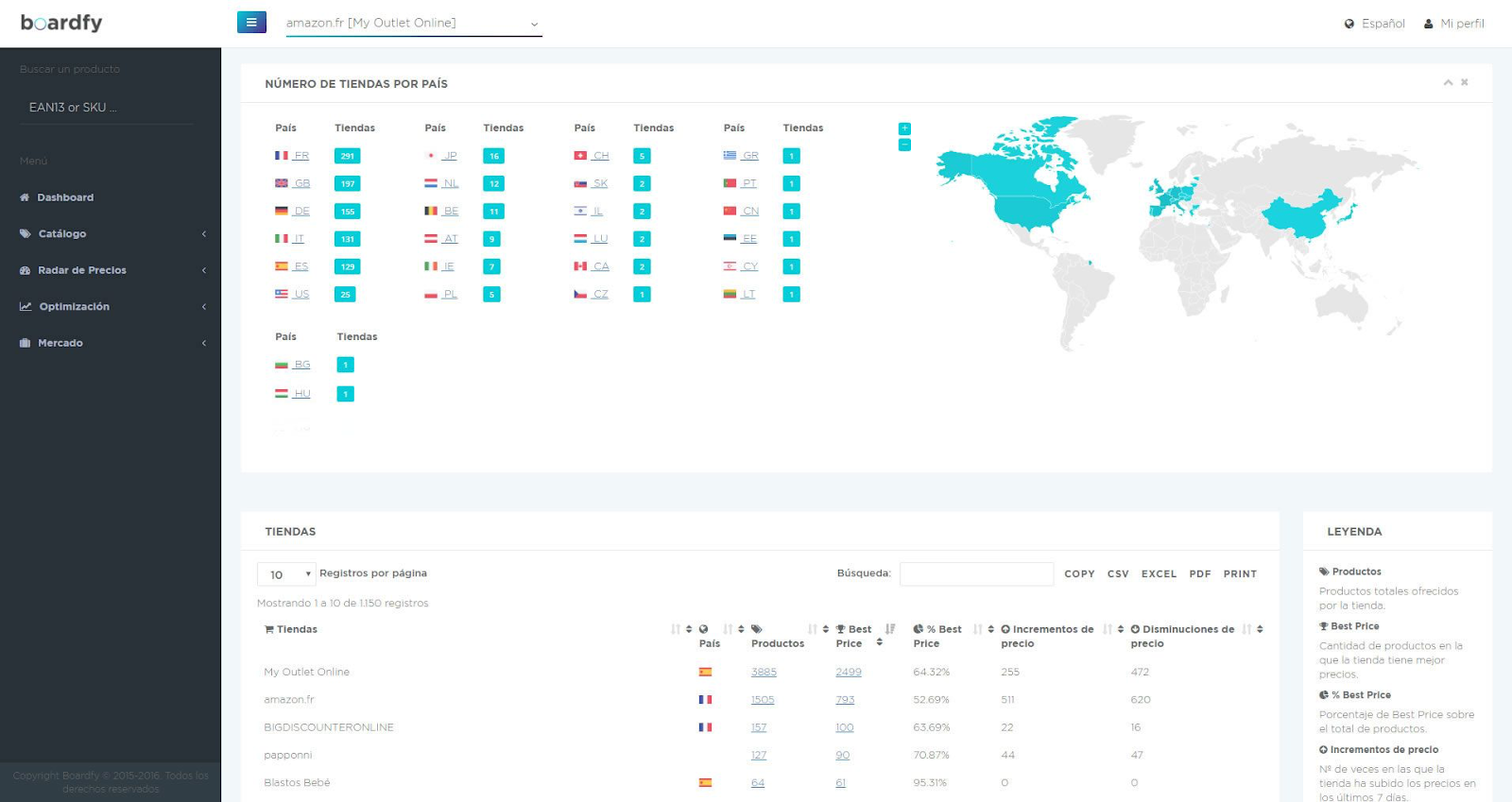
Boardfy is a dynamic pricing and competitor monitoring platform built for European eCommerce businesses selling across multiple marketplaces. Its AI repricing factors in 400+ variables with automated competitor detection via machine learning. The key edge over Prisync is its comprehensive European marketplace coverage across Google Shopping, Amazon, eBay, and Idealo, with CMS integrations that automatically sync price changes.
Key features
- Multi-marketplace competitor monitoring (Amazon, eBay, Google Shopping, Idealo)
- AI-powered dynamic repricing with 400+ pricing variables
- MSRP violation detection for brand monitoring distribution
- CMS integrations with Shopify, Magento, and PrestaShop
- Automated competitor detection using machine learning
Pros
- Comprehensive European marketplace coverage
- AI repricing considers hundreds of variables beyond competitor price alone
- CMS integrations sync price changes across platforms
Cons
- No publicly listed pricing tiers
- It can feel complex for retailers who only need basic monitoring
10. Visualping
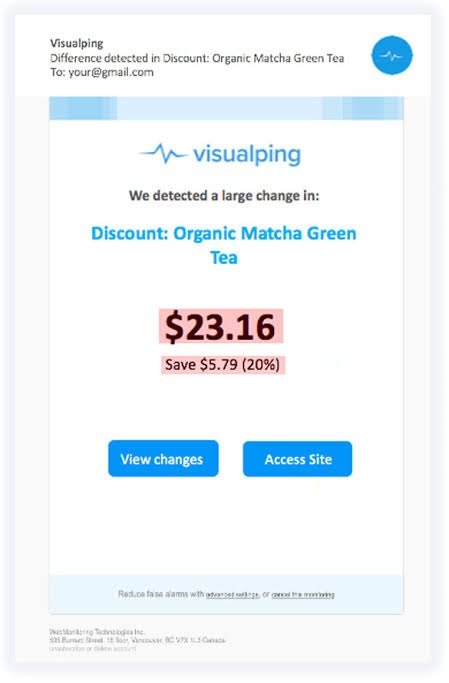
Visualping is a website change-monitoring tool for teams that need to track changes on any public web page without committing to a full e-commerce platform. Unlike Prisync, which requires a structured product catalog and SKU-level setup, Visualping lets you paste a URL, select the area of the page you want to watch, and start getting AI-powered alerts when something changes. It is the strongest option on this list for teams who only need to monitor a handful of competitor pricing pages at a fraction of the cost.
Key features
- Visual, text, and HTML website change monitoring for any public page
- AI-powered change summaries and important alerts filtering to reduce noise
- Checks are as frequent as every 2 minutes on paid plans
- Email and Slack alerts with screenshot comparisons
- Team workspaces and collaboration features on business plans
Pros
- No product catalog required
- AI filtering reduces false alerts from irrelevant page changes
- Affordable entry point for lightweight monitoring needs
Cons
- Not purpose-built for eCommerce pricing; no product matching or repricing.
- Scales poorly for large product catalogs
Finding the right fit: why PricingHunter stands out
If Prisync’s pricing gaps, API surcharge, or dashboard limitations are slowing you down, you are not short on alternatives. Different tools suit different needs, from enterprise repricing to AI-driven optimisation to simple competitor tracking.
If what you actually need is a straightforward, affordable way to track your competitors’ pricing, PricingHunter does that job well. You get unlimited competitors on every plan with no hidden add-ons and no contracts. It is built for retailers who want to spend less time fiddling with pricing software and more time making better pricing decisions.
Start your 14-day free trial with PricingHunter and see your competitors’ prices from day one. No credit card, no commitment, no hassle.