



Quick summary
For B2B pricing intelligence, Prisync offers three monitoring models — URL-based, channel-based, and hybrid — each with professional, premium, and platinum tiers. Prices range from $99/mo to $799/mo depending on the model and product count.
PricingHunter offers better pricing value for SME retailers that need affordable competitor monitoring without add-on costs or API surcharges.
Understanding when Prisync pricing works best and when it doesn’t
Prisync works best for e-commerce retailers who want competitor tracking and dynamic repricing in one tool.
The URL-based model suits retailers with a stable list of competitors. The Channel-based model suits retailers selling on Google Shopping or Amazon who want automated competitor discovery. The hybrid model combines both for full coverage.
Where things get complicated is the pricing structure itself. Three monitoring models, each with three tiers, create nine plan combinations. API access costs 20% extra on any plan. For retailers who want simplicity, the number of decisions before sign-up can be a barrier.
Why listen to us
We built a platform that starts with unlimited competitor tracking, automated matching, daily alerts (including weekends), and full price history on every plan. That gives us a clear view of where Prisync’s pricing structure creates value and where it creates unnecessary cost for SME retailers. This comparison is based on real usage patterns and verified pricing from Prisync’s own compare-plans page, not third-party estimates.
Prisync pricing overview
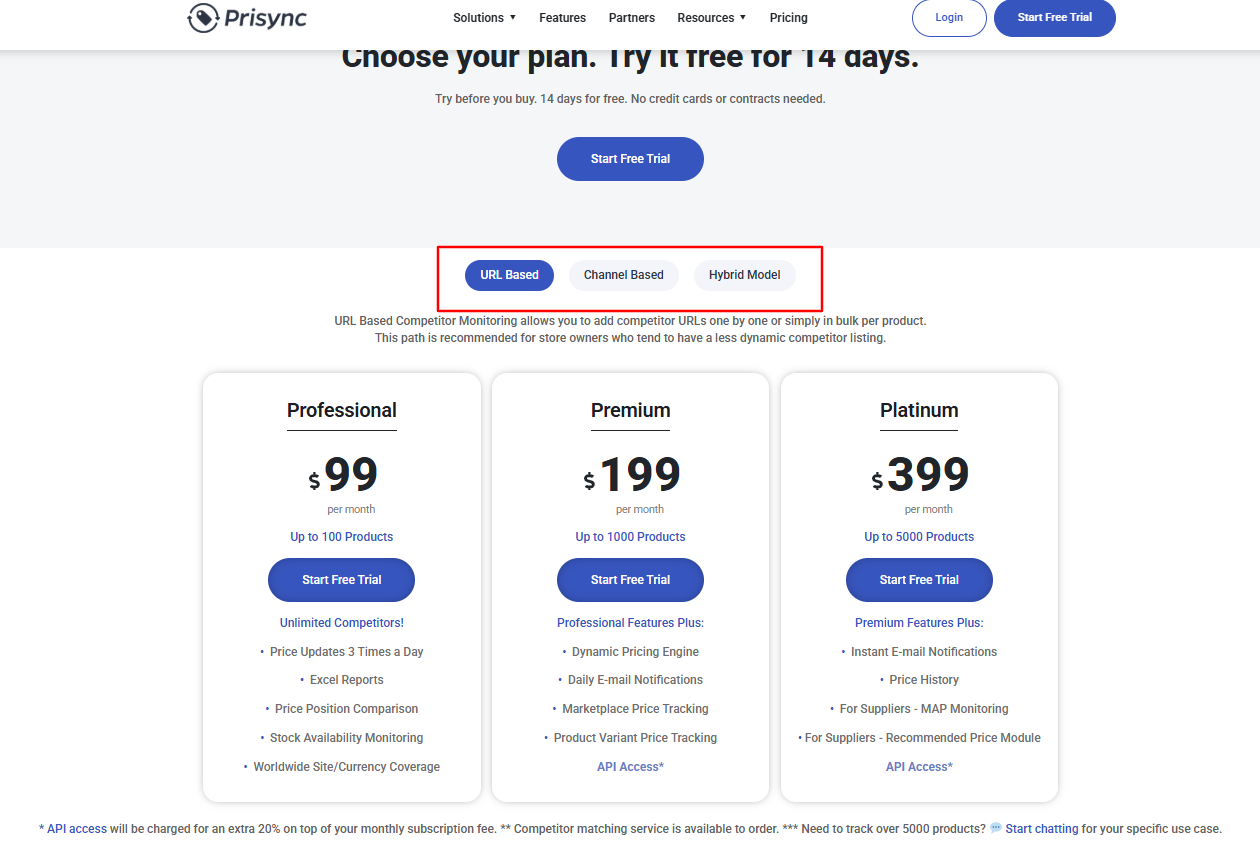
Prisync structures pricing around two variables: your monitoring model (how competitors are tracked) and your tier (how many products you track). All plans include unlimited competitors and a 14-day free trial with no credit card.
Breakdown of each Prisync monitoring model
1. URL-based monitoring ($99–$399/mo)
You add competitor URLs manually, one by one or in bulk. Prisync recommends this for retailers with a less dynamic competitor list.
- Professional ($99/mo): Up to 100 products, 3x daily price updates, Excel reports, price position comparison, stock availability monitoring, worldwide site/currency coverage.
- Premium ($199/mo): Up to 1,000 products. Professional features plus dynamic repricing engine, daily email notifications, marketplace price tracking, product variant tracking, API access.
- Platinum ($399/mo): Up to 5,000 products. Premium features plus instant email notifications, price history, MAP monitoring, recommended price module, API access.
2. Channel-based monitoring ($199–$599/mo)
Prisync automatically discovers and matches competitors across sales channels such as Google Shopping and Amazon using barcode-based matching. You do not add URLs manually because the platform finds competitors for you.
- Professional ($199/mo): Up to 100 products, daily price updates, 1 sales channel included. Additional channels +$100/mo each.
- Premium ($399/mo): Up to 1,000 products. Professional features plus dynamic repricing, daily notifications, marketplace tracking, variant tracking, and API access. 1 channel is included; additional channels are +$200/mo each.
- Platinum ($599/mo): Up to 5,000 products. Premium features, plus daily price-change notifications, price history, MAP monitoring, a recommended-price module, and API access. 1 channel is included; additional channels are +$200/mo each.
3. Hybrid model ($299–$799/mo)
Combines Channel-based automated discovery with manual URL tracking for competitors not listed on your sales channels. Channel prices update daily. Manually added URLs update 3x per day.
- Professional ($299/mo): Up to 100 products, price updates up to 3x daily, 1 sales channel included. Additional channels +$100/mo each.
- Premium ($599/mo): Up to 1,000 products. Professional features plus dynamic repricing, daily notifications, marketplace tracking, variant tracking, and API access. 1 channel is included; additional channels are +$200/mo each.
- Platinum ($799/mo): Up to 5,000 products. Premium features, plus instant notifications, price history, MAP monitoring, a recommended price module, and API access. 1 channel is included; additional channels are +$200/mo each.
API access costs an extra 20% on top of the monthly fee across all plans and models.
Prisync pricing pros and cons
Pros
- Published pricing across all nine plan combinations
- Unlimited competitors on every plan, regardless of the monitoring model
- 14-day free trial with no credit card required, and a free onboarding service included
- A dynamic repricing engine is available from the Premium tier, removing the need for a separate tool
Cons
- API access costs 20% extra on top of the monthly fee on every plan
- Dynamic repricing, daily notifications, and marketplace tracking are locked behind Premium
- Channel-based and Hybrid plans charge $100–$200/mo per additional sales channel, and the Nine plan combinations make comparison harder than simpler alternatives with published, all-inclusive pricing
Prisync’s pricing: further details
- API surcharge: 20% on top of your monthly fee, on every plan and every model. For example, a URL-based premium plan at $199/mo becomes $238.80/mo with an API.
- Additional sales channels: Channel-based and hybrid plans include 1 channel. Each additional channel costs $100/mo on Professional or $200/mo on Premium and Platinum. A hybrid premium plan tracking 3 channels costs $599 + $400 = $999/mo before API.
- Feature gating across tiers: Dynamic repricing, daily notifications, and marketplace tracking are unlocked only on Premium. Price history, MAP monitoring, instant notifications, and the recommended price module only unlock on Platinum. The Professional plan includes monitoring, but automatically acting on the data requires an upgrade.
- Model choice multiplies cost: The same tier costs differently depending on the model. Professional is $99 (URL-based), $199 (channel-based), or $299 (hybrid). Platinum is $399, $599, or $799. Choosing the wrong model at sign-up can double your spend.
PricingHunter pricing overview: What it costs and why it is better
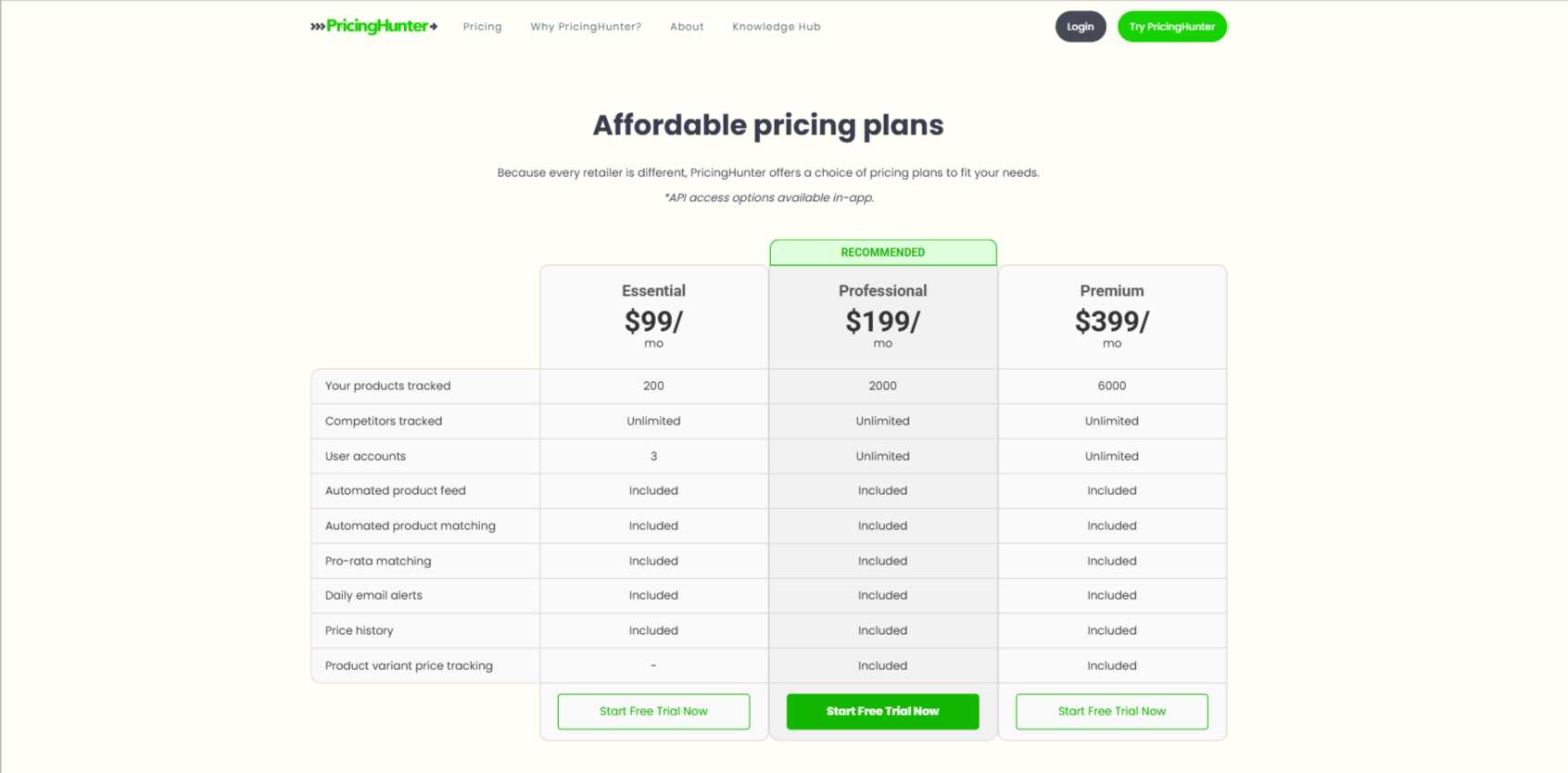
PricingHunter takes a different approach. Whereas Prisync splits pricing across three monitoring models, three tiers, API surcharges, and per-channel add-ons, PricingHunter offers three plans and a single price per plan. No monitoring model to choose. No surcharges. No hidden line items.
PricingHunter pricing pros and cons
Pros
- Every core feature is included on every plan with no feature gating across tiers.
- API access costs less than what Prisync charges.
- Price history stored indefinitely compared to how Prisync locks this behind Platinum ($399+).
- Daily alerts, including weekends, and month-to-month billing with no contracts.
Cons
- No built-in dynamic repricing engine — Prisync offers this from Premium.
- No channel-based automated competitor discovery from marketplaces.
When PricingHunter pricing can be more cost-efficient than Prisync
1. API access at a lesser cost
PricingHunter includes API access as a flat $29/mo add-on, regardless of plan size, and it’s still significantly cheaper than Prisync’s percentage-based surcharge. A Prisync Premium plan at $199/mo with an API costs $238.80/mo. At Platinum ($399/mo), API brings the total to $478.80/mo. That surcharge increases quickly.
2. More products at the same price
At $99/mo, PricingHunter tracks 200 products. Prisync tracks 100. At $199/mo, PricingHunter tracks 2,000, compared to Prisync’s 1,000. PricingHunter tracks 6,000 items at $399/mo, while Prisync tracks 5,000.
3. Price history from day one
PricingHunter includes unlimited price history on every plan. Prisync locks price history behind Platinum ($399/mo for URL-based, $599/mo for channel-based, and $799/mo for hybrid).
4. No per-channel add-on costs
PricingHunter charges a single flat price based on the products. Prisync’s Channel-based and Hybrid plans charge $100–$200/mo per additional sales channel. A hybrid premium plan tracking two channels costs $599 + $200 = $799/mo before API.
5. One simple pricing structure
PricingHunter has three plans. Prisync has nine combinations across three models, plus API surcharges and per-channel add-ons. PricingHunter lets you compare costs in under a minute.
Tracking competitor prices without the add-on costs
Prisync is a well-established platform with real depth in repricing and channel-based discovery. But the layered pricing of three models, three tiers, API surcharges, and per-channel fees mean that the starting price rarely reflects the final cost.
PricingHunter offers SME retailers unlimited competitor tracking, automated matching, daily alerts (including weekends), unlimited price history, and product feed integrations for Google Merchant Centre, Shopify & WooCommerce.
Try PricingHunter for free today, and track competitor prices without hidden costs.
FAQs about Prisync pricing
What is the difference between URL-based, channel-based, and hybrid plans?
URL-based lets you manually add competitor URLs. Channel-based automatically discovers competitors from sales channels such as Google Shopping and Amazon. The hybrid combines both for full coverage.
Does Prisync charge extra for API access?
Yes. API access costs an additional 20% on top of your monthly subscription fee on all plans.
How much do additional sales channels cost?
On channel-based and hybrid plans, 1 channel is included. Additional channels cost $100/mo on Professional or $200/mo on Premium and Platinum.