



If you sell in B2B, you already know that competitor pricing is harder to track than in retail. Your competitors negotiate rates by volume. They offer contract terms that never appear on a product page, and the listed price is rarely what their customers actually pay.
That gap creates problems when B2B teams try to use consumer-focused comparison tools. The data looks accurate until you realise it only captures list prices. This guide covers five tools that handle B2B price comparison at different levels of depth.
Why trust us?
We built PricingHunter for e-commerce retailers who were paying enterprise prices for tools they barely used. We integrate with Google Merchant Centre, Shopify, and WooCommerce feeds and see how B2B teams use pricing data differently.
We actively interact with B2B teams, and that hands-on experience is what shapes this comparison. We know where simpler tools cover the job and where the complexity of negotiated rates, contract pricing, and CPQ workflows demand something heavier. Every tool here was evaluated on verified pricing, confirmed features, and real user feedback.

5 best B2B price comparison tools compared
1. PricingHunter
Best for: SME B2B retailers who need daily competitor comparison without enterprise overhead.
B2B comparison approach: Automated matching with daily alerts and unlimited competitor tracking.
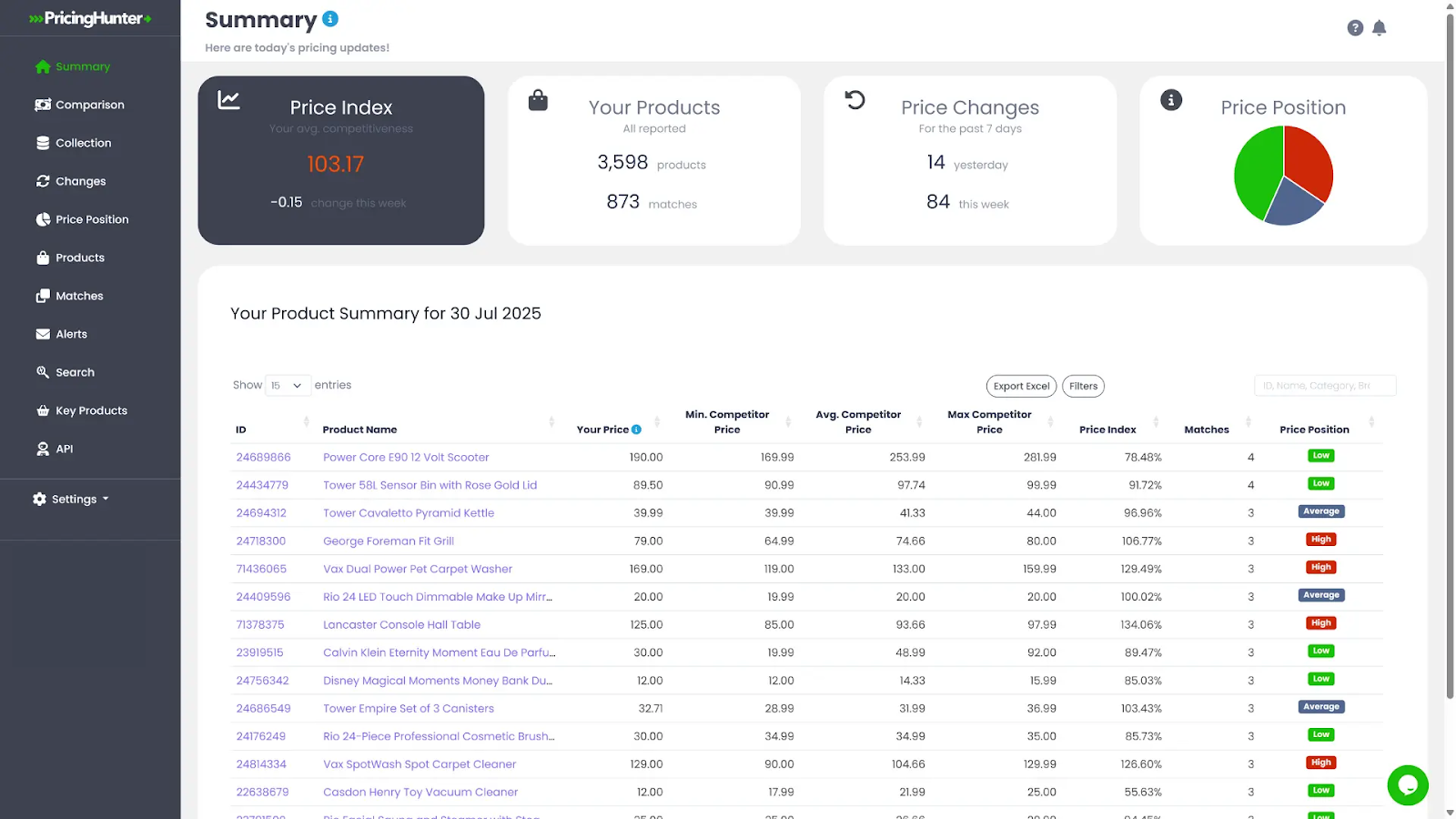
Not every B2B pricing decision requires demand modelling or CPQ integration. Sometimes you just need to know what competitors listed yesterday and what changed overnight.
PricingHunter does that job without complexity because you can easily connect your Google Merchant Centre, Shopify, or WooCommerce feed. From there, the platform scrapes it daily, automatically matches competitors, and sends comparison data to your inbox every morning. Weekends included.
Key features
- Automated product matching with manual approval, so you control which competitor links are tracked
- Daily comparison alerts delivered to your inbox, including weekends
- Feed integration with Google Merchant Centre, Shopify, and WooCommerce
- Price history with no time limit
Pros
- Feed integration keeps your B2B catalog synced daily without manual uploads
- Weekend alerts catch moves that happen when most B2B teams are offline
- Published pricing from $99/mo with no contracts
Cons
- Tracks published prices only, no visibility into negotiated rates or volume discounts
- No CPQ integration or deal management for complex B2B quoting
Pricing
- Essential plan: $99/mo for 200 products
- Professional plan: $199/mo for 2000 product URLs
- Premium plan: $399/mo (6,000)
- API access costs $29/£19/€25 per month as an add-on
- 14-day free trial available without credit card.
2. Prisync
Best for: B2B sellers who want comparison feeding into automated repricing.
B2B comparison approach: Product-based tracking with dynamic pricing rules and stock monitoring.
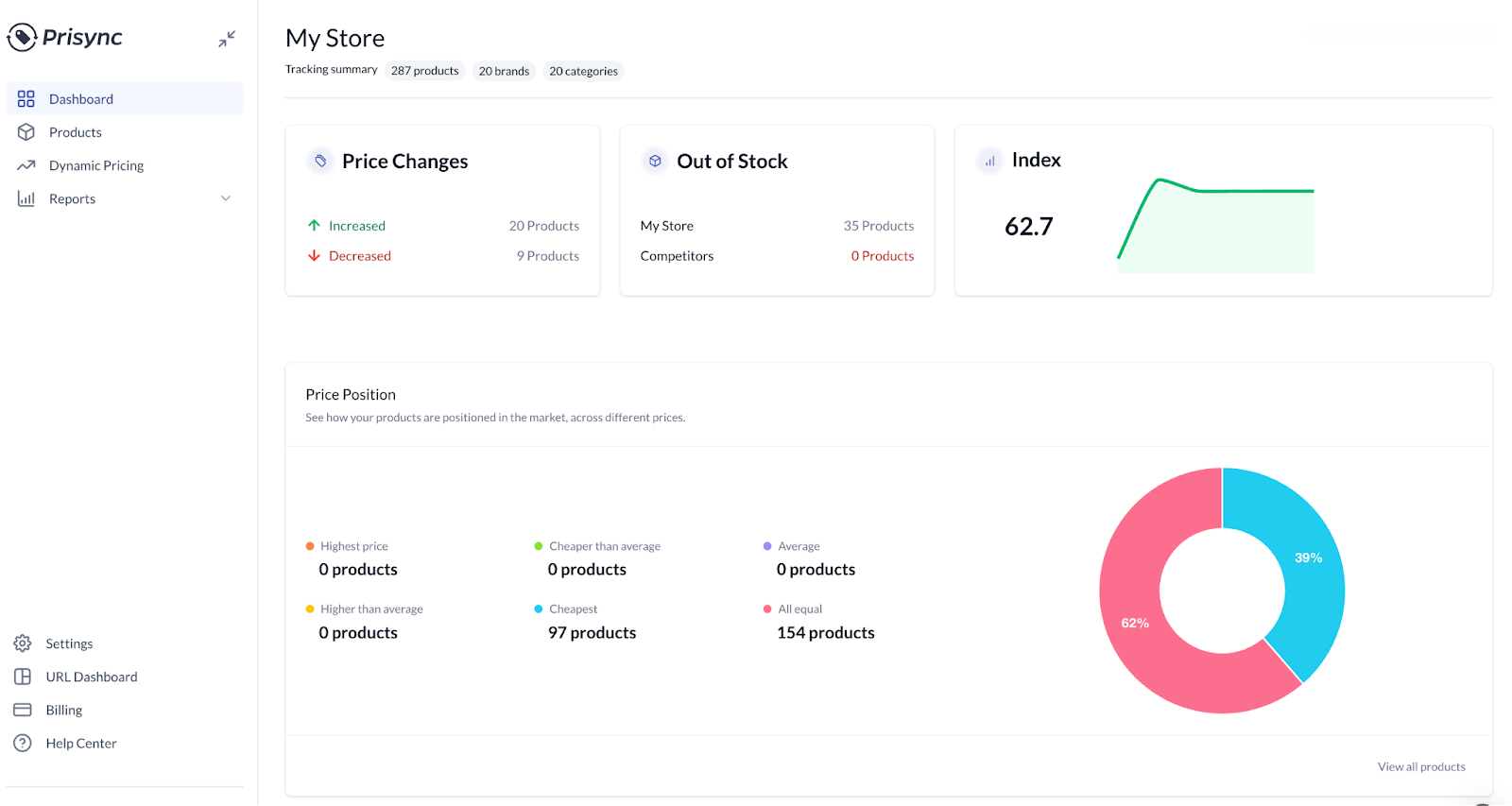
Prisync is a B2B price comparison tool that combines competitor price monitoring and automated repricing in a single platform.
In practice, it works like this: You connect the products you want to monitor, and Prisync identifies competing listings across channels such as Google Shopping and Amazon by matching barcodes.
It also tracks stock availability, so you can spot opportunities when a competitor runs out of inventory and demand shifts elsewhere. The trade-off is pricing complexity. Between multiple plan tiers, channel-specific add-ons, and an additional API surcharge, costs can be harder to predict than with simpler competitors.
Key features
- URL, Channel, and Hybrid monitoring with dynamic repricing on Premium
- Competitor stock availability tracking
- One-click Shopify, Magento, BigCommerce integrations
Pros
- Comparison and repricing in one tool, no separate platform needed
- Channel model finds B2B competitors you may not have tracked manually
- Published pricing with a 14-day trial and free onboarding
Cons
- 20% API surcharge scales the cost of integrating data into B2B systems
- Historical data locked behind Platinum ($399+)
Pricing
- URL-based plans: from $99/mo
- Channel-based plans: From $199/mo
- Hybrid based plans: From $299/mo
Related: Prisync pricing guide 2026: compare features, plans, and costs
3. Price2Spy
Best for: B2B brands monitoring how resellers price their products.
B2B comparison approach: Stealth IP scraping up to 8x daily with MAP screenshot evidence.
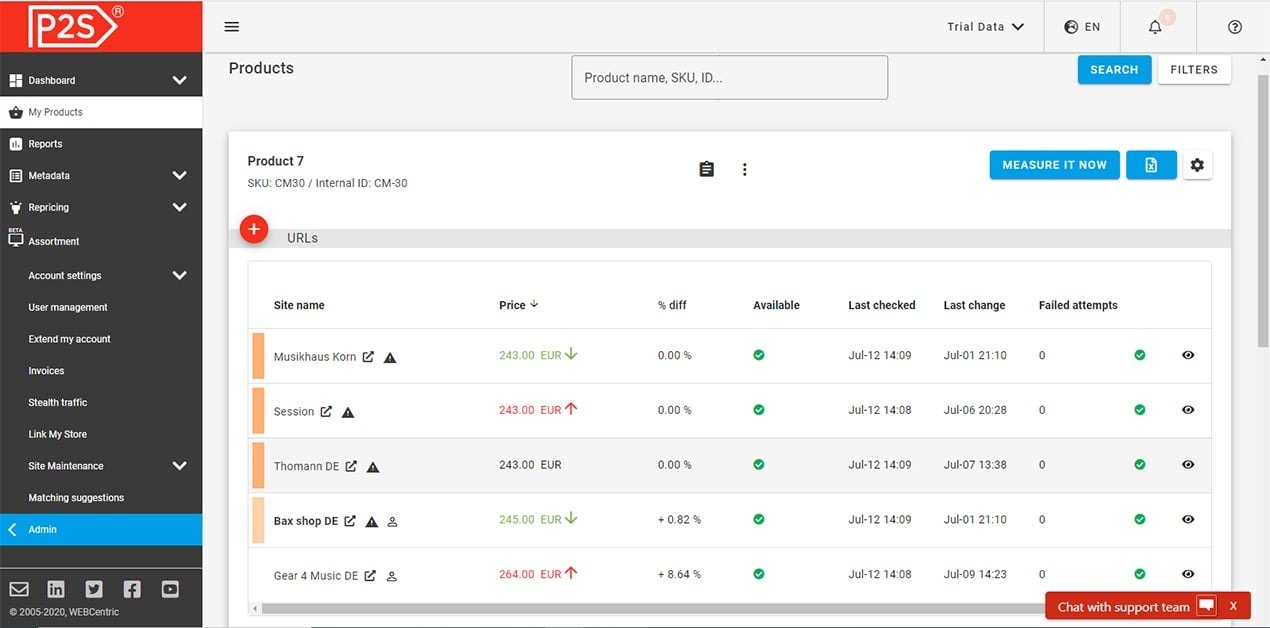
Price2Spy takes a channel-monitoring approach to B2B price comparison. Most features help brands understand how their products are priced across distributor, reseller, and marketplace networks. So if you sell through wholesalers, dealer networks, regional distributors, or third-party retailers, Price2Spy provides an easy way to track pricing consistency across every sales channel.
Key features
- Up to 8 price checks per day with stealth IP
- MAP violation capture with timestamped screenshot evidence
- 25+ analytical reports for reseller pricing trends
Pros
- Screenshot evidence makes reseller enforcement fact-based
- 8x daily checks catch intra-day pricing changes across distribution channels
- Published pricing from $39.95/mo
Cons
- URL-based model scales unpredictably with large reseller networks
- Repricing and automatch cost extra
Pricing
- Starter plan: $39.95/month for 500 URLs
- Basic plan: $157.95/month for 2,000 URLs
- Premium plan: custom pricing
Related: Learn how PricingHunter can be a better alternative to Price2Spy
4. Pricefx
Best for: Enterprise B2B teams managing contracts, quotes, and deal-level pricing.
B2B comparison approach: 125+ AI agents across CPQ, deal management, and competitive analytics.
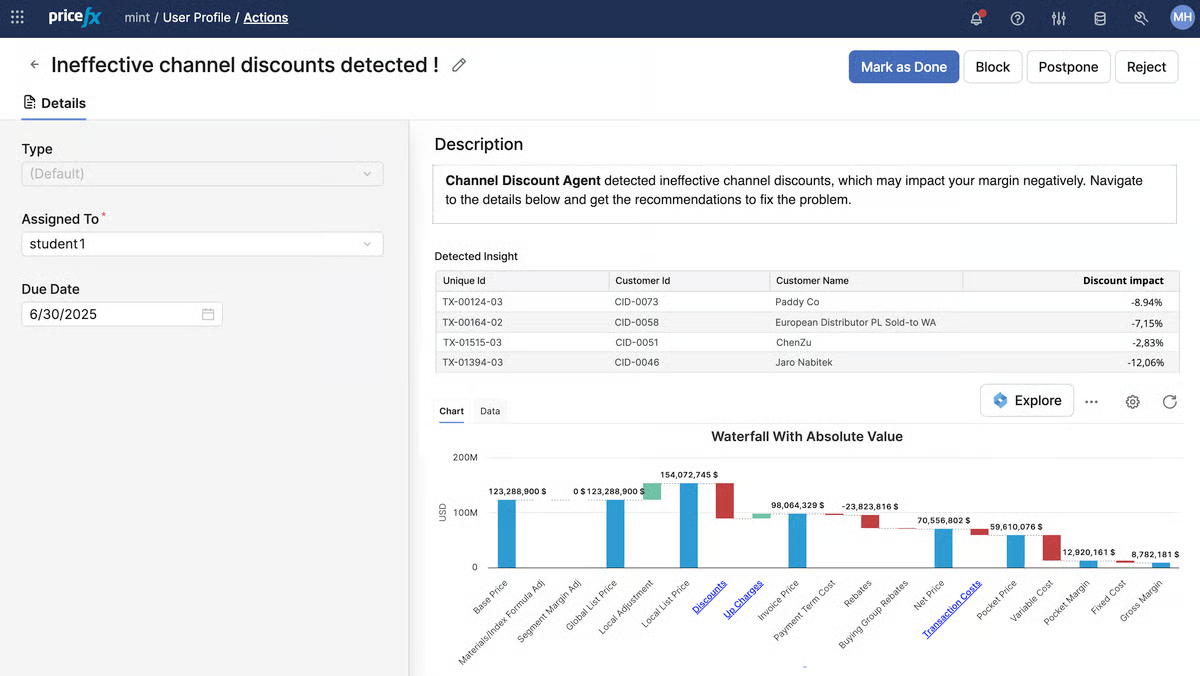
Pricefx helps manufacturers, distributors, wholesalers, and sales teams to manage contract pricing, configure-price-quote workflows, rebates, and deal-level profitability across large product catalogues.
Pricefx combines pricing management, sales execution, and competitive intelligence into a single cloud-native platform.
Key features
- CPQ + deal management + competitive analytics in one platform
- 125+ AI pricing agents across quoting, margin protection, and analysis
- Rebate management and contract pricing optimisation
Pros
- Handles negotiated pricing, volume tiers, and contract terms; other tools here ignore
- Cloud-native deploys faster than SAP or Oracle
- Competitive intelligence embedded across the pricing lifecycle
Cons
- Enterprise pricing, well beyond SME budgets
- Overkill for teams comparing published competitor list prices
Pricing
Custom only. Contact Pricefx for a demo.
5. Competera
Best for: Enterprise B2B retailers who want AI to set prices based on demand, not just competitor positions.
B2B comparison approach: Demand elasticity modelling with 930 deep learning models.
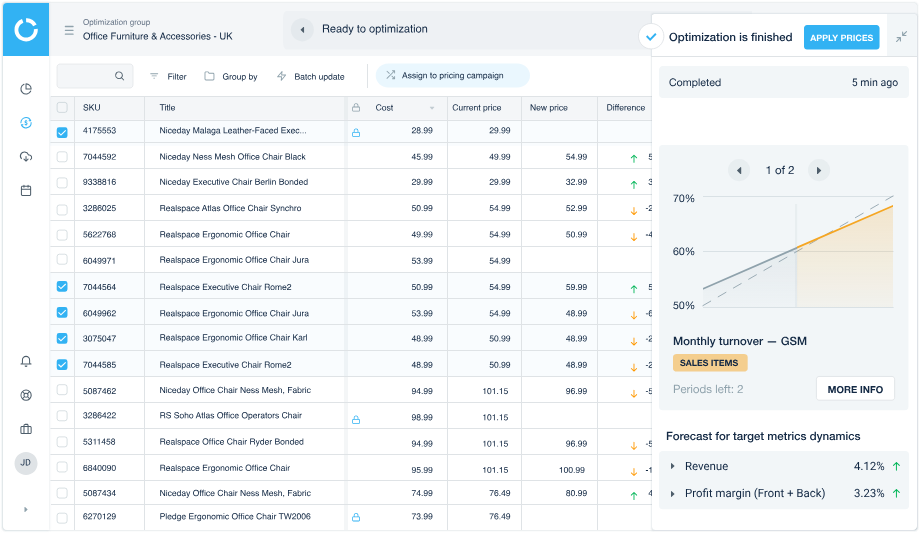
Competera is built for enterprise retailers and B2B companies that want pricing decisions driven by customer demand, not just competitor movements.
Because it analyses more than 20 demand signals, uses hundreds of deep learning models, and measures price elasticity at the SKU level, it's especially useful for organisations managing large product catalogues, where small pricing changes can have a significant impact on revenue and margins.
Key features
- Demand-based pricing with 930 market-specific deep learning models
- What-if simulations with 95%+ forecasting accuracy
- 98% AI product matching with SLA guarantees
Pros
- Goes past comparison into demand-driven price setting
- Competitive data available standalone without the AI platform
- What-if simulations reduce the risk of B2B price changes
Cons
- Requires a dedicated pricing team and weeks of implementation
- Custom pricing only, no trial
Pricing
Custom. Contact Competera for a demo.
How to choose the right B2B price comparison tool?
With several options to consider, a few questions can help you decide on the right tool for you.
1. What type of B2B pricing do you compare?
If you usually compare published webshop prices, you need a tool that suits that purpose, such as PricingHunter or Prisync. If you often compare reseller compliance, you may want to consider using Price2Spy.
2. Who on your team will use it?
PricingHunter sends data to your inbox. Pricefx integrates with the sales team's deal workflows. Pick based on how your team actually works.
3. Can your team realistically adopt it?
For example, PricingHunter is live in minutes. Pricefx and Competera need dedicated teams and weeks of setup. A simpler tool used daily beats a powerful one that collects dust.
Start comparing B2B competitor prices today
The right B2B price comparison tool depends on what pricing problem you are actually trying to solve. If you want to track what B2B competitors list on their websites and get alerts when prices change, PricingHunter is the strongest fit.
For B2B sellers who want comparison data to feed directly into automated repricing rules, Prisync combines both in a single subscription with one-click Shopify, Magento, and BigCommerce integrations.
For enterprise B2B teams managing negotiated rates, volume tiers, contracts, and CPQ workflows, Pricefx is the only tool on this list built for that level of complexity. For teams that want AI to recommend prices based on demand signals rather than competitor positions, Competera operates in that space.
Whatever you choose, prioritise the tool your team will actually use daily.
Ready to see how PricingHunter works for your B2B catalogue? Connect your Google Merchant Centre, Shopify, or WooCommerce feed, approve the automated matches, and start tracking unlimited competitors from day one.
Try PricingHunter free for 14 days.
Frequently asked questions
1. Can B2B comparison tools track negotiated contract rates?
Most tracks publish prices only. Pricefx is the exception, handling contract-based pricing, volume tiers, and deal-level optimisation.
2. How much does B2B price comparison software cost?
Published pricing ranges from $39.95/mo (Price2Spy) to $99/mo (PricingHunter, Prisync). Pricefx and Competera require custom quotes.
3. How often do B2B price comparison tools update data?
Most tools update daily. Some update multiple times per day for markets where prices shift fast. The right frequency depends on your category. If competitors reprice weekly, daily updates are more than enough.
4. Can I use a B2C price comparison tool for B2B?
Yes, if your B2B competitors publish prices on their websites. Many B2B retailers compete on listed prices as B2C sellers do, and standard comparison tools work well in that context. The gap appears when your market runs on negotiated rates, volume discounts, or contract terms that never show up on a product page