



Quick summary
In this article, we detail Pricefy’s pricing plans for e-commerce retailers tracking competitor prices. You will see how Pricefy structures its plans around SKU count, starting with a free plan for 50 SKUs and scaling through four paid tiers up to $499 per month for 25,000 SKUs.
You will understand how each pricing plan works, what drives upgrades, and when PricingHunter offers better value for SME retailers that need affordable, rapid competitor price monitoring.
Understanding when Pricefy pricing works best
Pricefy works best for small to mid-size retailers who want competitor monitoring and repricing without a heavy price tag. The free plan gives you 50 SKUs to test with, and the paid plans scale gradually from $49 to $499 per month.
It suits retailers who want dynamic repricing built into the same tool. If your team needs both tracking and repricing in a single subscription, the pricing structure makes the process straightforward.
Where things become less clear is in the gap between what the free plan offers and what smaller paid plans deliver. The jump from 50 SKUs (free) to 100 SKUs ($49/mo) is steep for what you get. And some features that SME retailers consider essential, such as dynamic repricing and MAP monitoring, unlock only at higher tiers.
Why listen to us
At PricingHunter, we have honed our skills at helping SME retailers who need practical pricing tools to automate product matching. We are actively comparing pricing tools on the market to determine what works best for you. Trust us to provide an insightful overview to inform your decision-making.

Pricefy pricing overview table
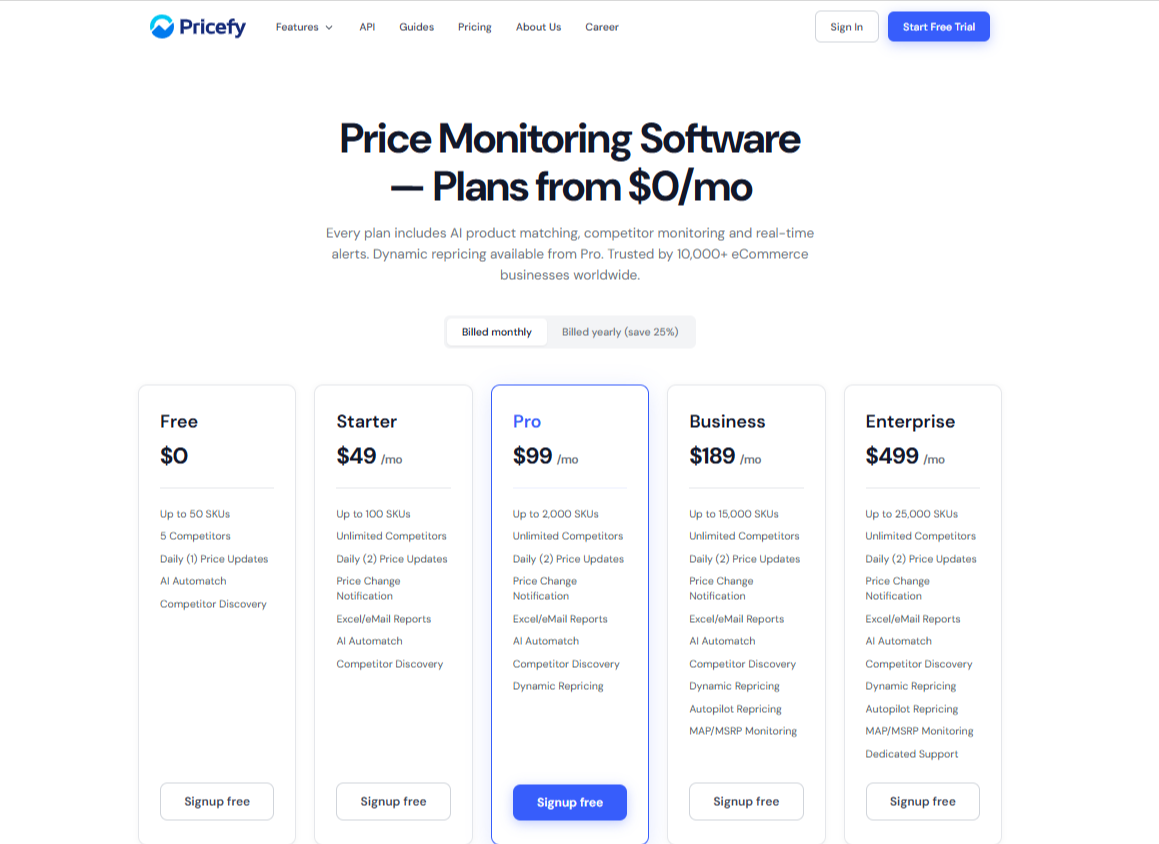
Pricefy’s pricing is based on SKU (stock keeping unit) count. Each product in your catalogue counts as one SKU, regardless of how many competitors you track for it. All plans include unlimited competitors and AI product matching.
A brief look at Pricefy’s current pricing structure:
Pricefy pricing tiers breakdown
1. Free Plan
The free plan gives you 50 SKUs, 5 competitors, 1 daily price update, AI automatch, and competitor discovery, with no credit card required. You can test the platform, but the 5-competitor cap and lack of alerts, repricing, or reports mean you are evaluating the interface more than the data.
2. Starter Plan ($49/mo)
The Starter plan unlocks unlimited competitors, two daily price updates, email alerts, and Excel reports for up to 100 SKUs. This is the first tier where you get actionable data delivered to your inbox. If competitor tracking is all you need, it works.
3. Pro Plan ($99/mo)
The Pro plan covers 2,000 SKUs and adds dynamic repricing. You set pricing rules, and the platform adjusts your prices based on competitor data. This is the first tier to combine monitoring and repricing in a single subscription. For retailers who have outgrown manual price adjustments, this is where Pricefy starts to earn its cost.
4. Business Plan ($189/mo)
The business plan covers 15,000 SKUs and adds autopilot repricing and MAP/MSRP monitoring. Autopilot analyses competitors’ prices hourly and automatically adjusts yours based on master rules. This tier suits mid-market retailers with larger catalogues and compliance requirements.
5. Enterprise Plan ($499/mo)
The Enterprise plan covers 25,000 SKUs and adds dedicated support. The business includes everything, plus a direct line to the Pricefy team. Retailers with giant catalogues need immediate resolution for downtime or data issues.
Pricefy pricing pros and cons
Pros
- A free forever plan with 50 SKUs and AI automatch lets you test data quality without entering a credit card
- Every paid plan includes unlimited competitors, so adding new sellers never increases your cost
- Dynamic repricing and monitoring live in the same subscription from the Pro plan ($99/mo), eliminating the need for a separate repricing tool
- All five tiers are published openly with a 25% annual discount
Cons
- Dynamic repricing is locked behind the Pro plan ($99/mo), and MAP monitoring is behind the Business plan ($189/mo), so you pay for the tier to get the feature
- The SKU jump from 100 (Starter) to 2,000 (Pro) leaves no option for retailers with 150-500 products who do not need a 2,000-SKU plan
- The free plan caps competitors at 5, while every paid plan offers unlimited, meaning the free tier does not provide a realistic performance test
- The 25% annual discount saves money but locks you in for 12 months — if you are still evaluating, you will actually pay the monthly rate
PricingHunter pricing overview and cost benefits
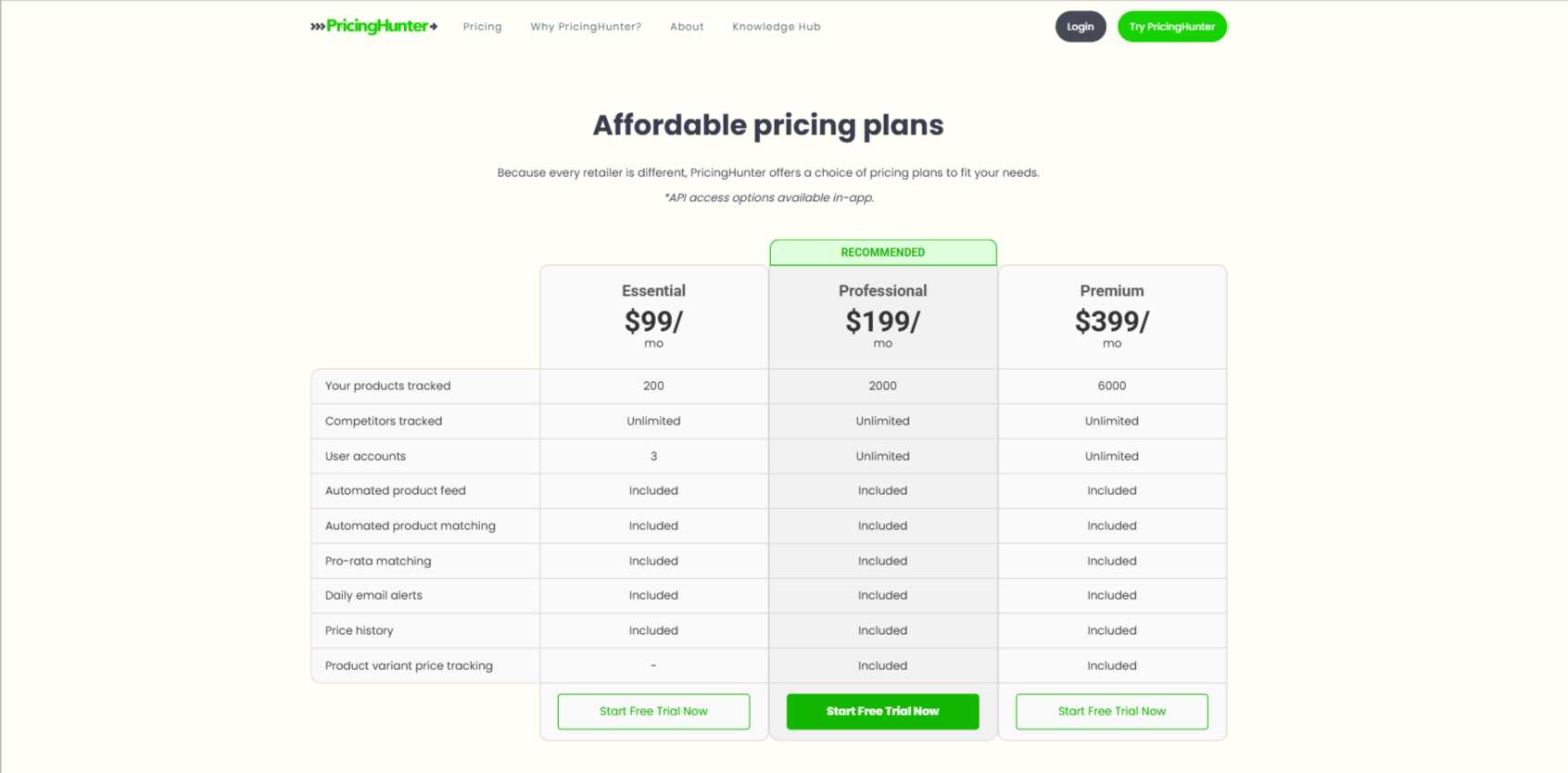
PricingHunter is a competitor price-monitoring tool built for e-commerce businesses that want to track market prices and stay competitive without manual effort. Its pricing plans take a different approach. Instead of spreading features across five tiers, it includes every core feature in every plan from day one.
PricingHunter plans
When PricingHunter pricing is more Cost-Efficient Than Pricefy
1. Every core feature is included on every plan
PricingHunter includes automated product matching, daily alerts (including weekends), unlimited price history, and product feed integrations for Google Merchant Centre, Shopify & WooCommerce. Pricefy offers repricing features on the Pro plan ($99/month), MAP monitoring on the Business plan ($189/month), and dedicated support on the Enterprise plan ($499/month). With PricingHunter, you pay for product count, not feature access.
2. Daily alerts seven days a week
PricingHunter sends alerts every morning, including weekends. Pricefy does not confirm weekend alert delivery on its pricing page. Missing a weekend price drop means reacting on Monday to data that is already two days old.
3. Reduced SKU gaps between plans
PricingHunter scales from 200 to 2,000 to 6,000 products. Pricefy’s pricing jumps from 100 (Starter) to 2,000 (Pro), with no options in between. A retailer with 150 products is forced into a $99/mo plan built for 2,000, paying 13 times the capacity they need.
4. A real free trial, not a capped demo
PricingHunter offers a 14-day free trial with your actual products and competitors. You see exactly how the platform performs with your real data before spending anything. Pricefy’s free plan lets you test, but with 5 competitors and 50 SKUs, it is closer to a feature preview than a working evaluation.
PricingHunter pricing pros and cons
Pros
- Published pricing across three plans with no sales calls, no custom quotes, and no surprises.
- Unlimited competitor tracking on every plan means adding sellers never increases your cost.
Cons
- No built-in dynamic repricing engine — Pricefy offers repricing from the Pro plan and autopilot from Business.
Tracking competitor prices without the tiered trade-offs
Pricefy is a capable tool for retailers who want competitor monitoring and repricing at accessible price points. It works well for teams willing to move up tiers as their catalogue and feature needs grow.
PricingHunter takes a different approach. It gives SME retailers unlimited competitor tracking, automated matching, daily alerts (including weekends), and full price history in every plan from day one. No tiered feature gates. No contracts.
Start your free trial with PricingHunter and track competitor prices without hidden costs.
FAQs About Pricefy pricing
Does Pricefy have a free plan?
Yes. The free plan includes 50 SKUs, 5 competitors, one daily price update, and AI automatch. No credit card required.
Can you upgrade or downgrade your Pricefy plan?
Yes. You can switch plans at any time from your dashboard. Upgrades are prorated. Downgrades apply credit to your next billing cycle.
What happens if you exceed your Pricefy SKU limit?
Pricefy notifies you when you approach your limit. You can upgrade instantly or remove products to stay within your current tier.
Does Pricefy offer annual billing?
Yes. Annual billing saves 25% compared to monthly pricing across all paid plans.