



Your team probably already tracks competitor prices. But can you tell which changes are worth acting on?
Most retailers can't. Despite having the data, you still have to figure out which competitors to watch, where your positioning is shifting, and when to reprice before you lose the sale.
Price intelligence software can close this gap. It turns raw competitor data into something your team can act on. This guide covers the 10 best tools on the market right now. Here’s a look at the top three:
Why listen to us?
PricingHunter delivers price intelligence to SME retailers every day. We see firsthand which intelligence capabilities teams actually use versus which ones sit untouched. Every tool here was evaluated on that basis, using verified pricing, confirmed features, and real user feedback.

10 best price intelligence tools compared
1. PricingHunter
Best for: SME retailers who need competitor intelligence without enterprise overhead.
Intelligence approach: Automated matching with daily alerts, unlimited tracking, and price history analytics.
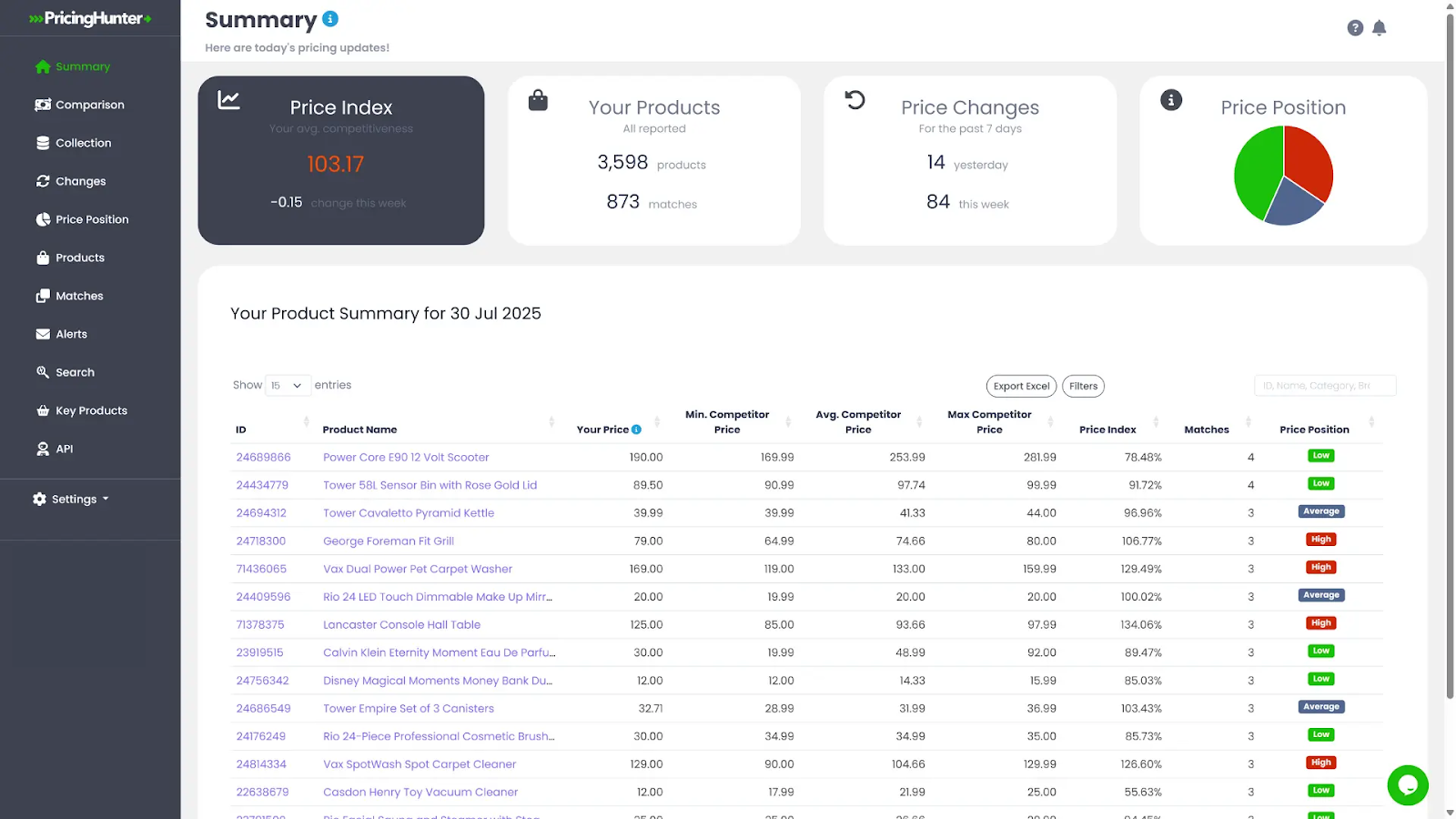
PricingHunter lets you track, compare, and act on competitor pricing data from one platform, without configuring dashboards, training AI models, or booking a demo first.
This eliminates the daily friction that drains most pricing teams. It minimizes manual work by automatically syncing your product catalog from Google Merchant Center, Shopify, or WooCommerce feeds, and matching competitor products for approval.
As a result, most retailers are looking at live competitor intelligence within minutes of signing up. Every plan includes unlimited competitor tracking at no extra cost.
Key features
- Unlimited competitor tracking across every plan
- Live feed integration with Google Merchant Centre, Shopify, and WooCommerce
- Lifetime price history with no time limit
- Accurate data collection, bypassing anti-scraping technology
- Automated product matching with daily alerts
Pros
- Transparent pricing with 200 products at entry, double what Prisync offers at the same price
- Real-time feed integration keeping your catalog synced daily without manual uploads
- Flexible month-to-month billing with no contracts
Cons
- Observational intelligence tool
Pricing
- Essential plan: $99/mo (200 products)
- Professional plan: $199/mo (2,000)
- Premium plan: $399/mo (6,000)
- API access costs $29/£19/€25 per month as an add-on
- 14-day free trial
2. Prisync
Best for: Sellers who want intelligence and automated repricing in the same subscription.
Intelligence approach: Product-based tracking with dynamic pricing rules and competitor stock monitoring.
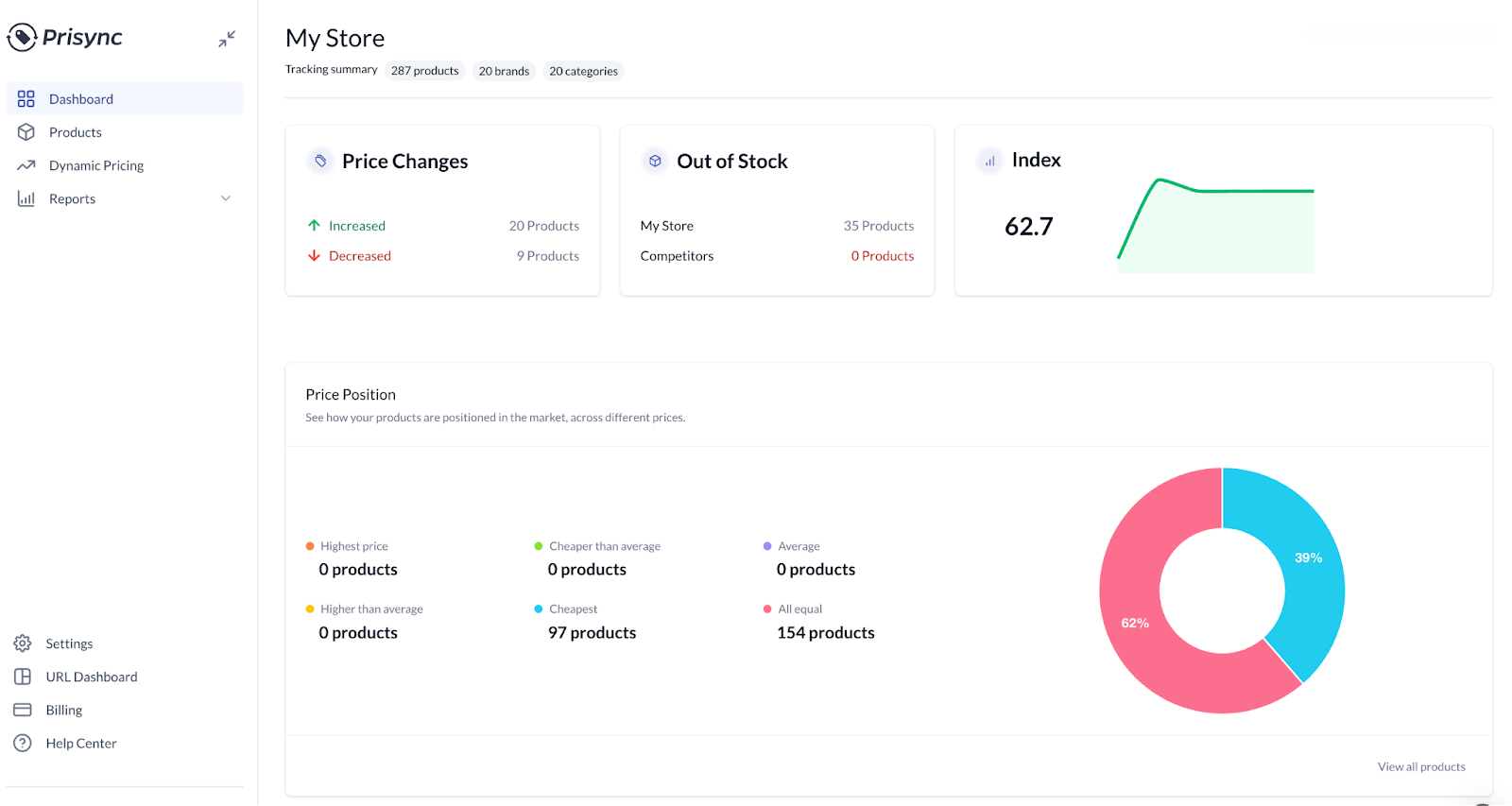
Prisync is a price intelligence software that helps retailers optimize prices. It tracks competitor data and stock availability in real time, allowing teams to respond quickly to changing market conditions.
Key features
- Flexible monitoring with URL, Channel, and Hybrid tracking available
- Dynamic repricing rules available from Premium
- Competitor stock availability tracking
Pros
- Intelligence feeds directly into repricing
- The channel-based model surfaces competitors you were not tracking
- 14-day free trial with free onboarding
Cons
- Historical intelligence locked behind Platinum ($399+)
- 20% API surcharge makes BI integration expensive
Pricing
- URL-based plans: From $99/mo
- Channel-based plans: From $199/mo
- Hybrid based plans: From $299/mo
Read more: Prisync Pricing Guide 2026.
3. Price2Spy
Best for: Brands that need pricing analytics with teeth for enforcement.
Intelligence approach: Historical trend analysis with MAP tracking, and screenshot evidence.
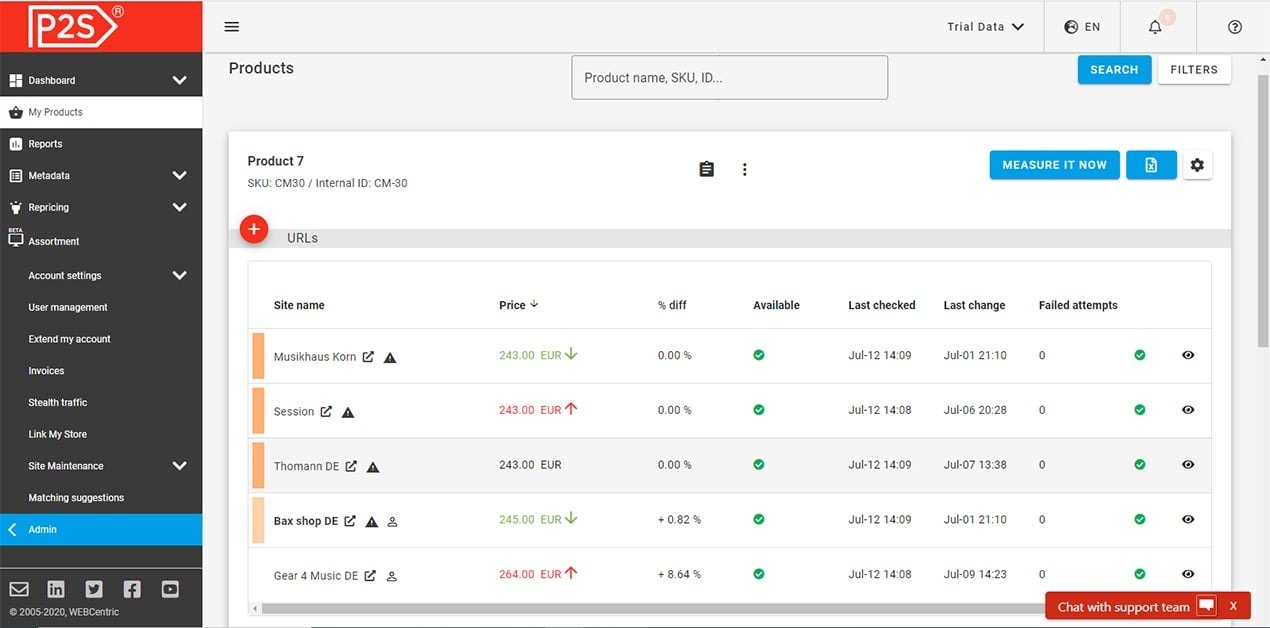
Price2Spy is a pricing intelligence platform that combines competitor monitoring with MAP compliance tracking. It offers 25+ analytics reports covering pricing trends, competitor benchmarking, and market positioning, while automatically capturing timestamped screenshots of violations.
Key features
- 25+ built-in analytical reports
- MAP monitoring with timestamped screenshot evidence
- Up to 8 price checks per day with stealth IP
Pros
- Offers deep analytical reporting for the price
- Screenshot evidence for MAP enforcement conversations
- Published pricing from $39.95/mo
Cons
- URL-based model that scales with competitor count, not product count
- Repricing and automatch cost extra
Pricing
- Starter plan: $39.95/mo (500 URLs)
- Basic plan: $157.95/mo (2,000 URLs)
- The premium plan is custom
4. Competera
Best for: Enterprise retailers who want AI to recommend prices, not just report them.
Intelligence approach: Demand factors analysis using 900+ accurate, deep learning models.
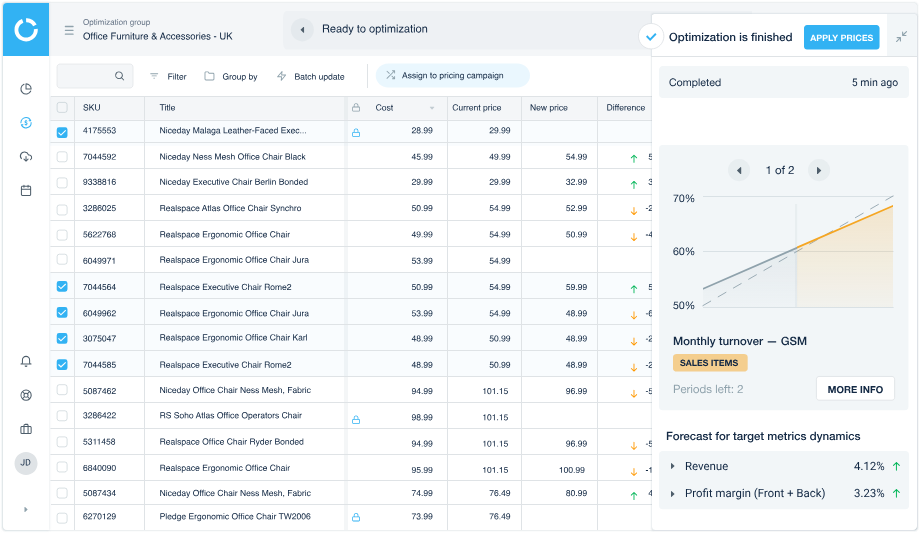
Competera redefines what price intelligence means for enterprise teams. Instead of showing you what competitors charge, it analyses demand elasticity, seasonality, and cross-category effects, and then recommends your prices. Its what-if simulations let you test the impact before committing. results require weeks of ERP integration, AI model training, and a dedicated pricing team to execute
Key features
- Demand-based pricing with several deep learning models
- Accurate What-If simulations
- 98% AI product matching with SLA guarantees
Pros
- Predictive intelligence model
- Clients report higher revenue recovery and margin recovery
- Competitive data available as a standalone product
Cons
- Requires a dedicated pricing team and weeks of implementation
- Custom pricing only with no free trial
Pricing
Custom. Contact Competera for a demo.
5. Omnia Retail
Best for: Enterprise teams who want intelligence flowing directly into automated execution.
Intelligence approach: In-house data across multiple domains feeding into a visual Pricing Strategy Tree.
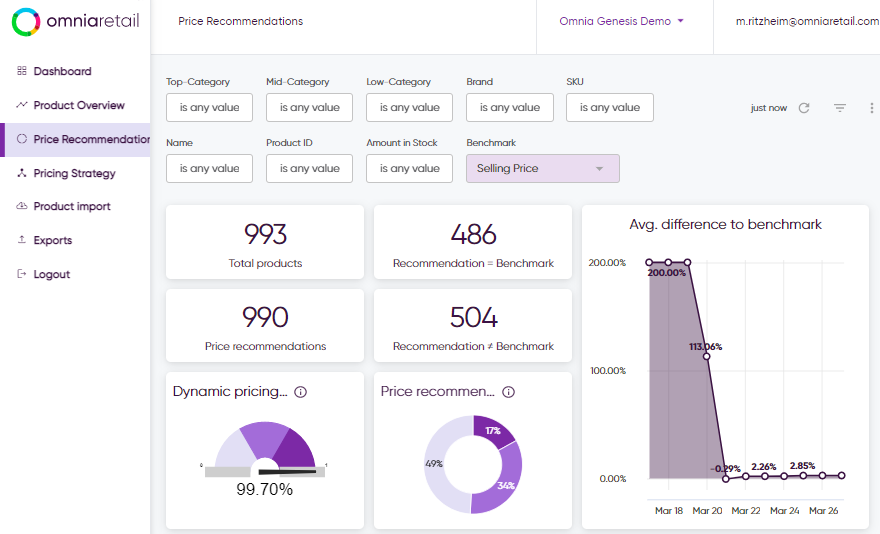
Omnia Retail collects competitive data in-house and channels it into a visual rule builder where pricing teams define, test, and deploy strategies without code. Intelligence does not sit in a dashboard waiting for someone to interpret it. It flows into executable pricing rules.
Key features
- Pricing Strategy Tree for visual rule building
- In-house scraping across 35,000+ domains
- Price Explanation for full decision traceability
Pros
- Intelligence flows into execution, not a separate workflow
- In-house data removes third-party dependency
- Every automated decision is traceable
Cons
- Custom pricing only
- Implementation takes days to weeks
Pricing
Custom. Contact Omnia Retail for a demo.
6. Intelligence Node
Best for: Enterprise brands needing real-time intelligence at a scale most tools cannot approach.
Intelligence approach: 1.2B+ SKUs with data refreshing every 10 seconds and 99% matching accuracy.
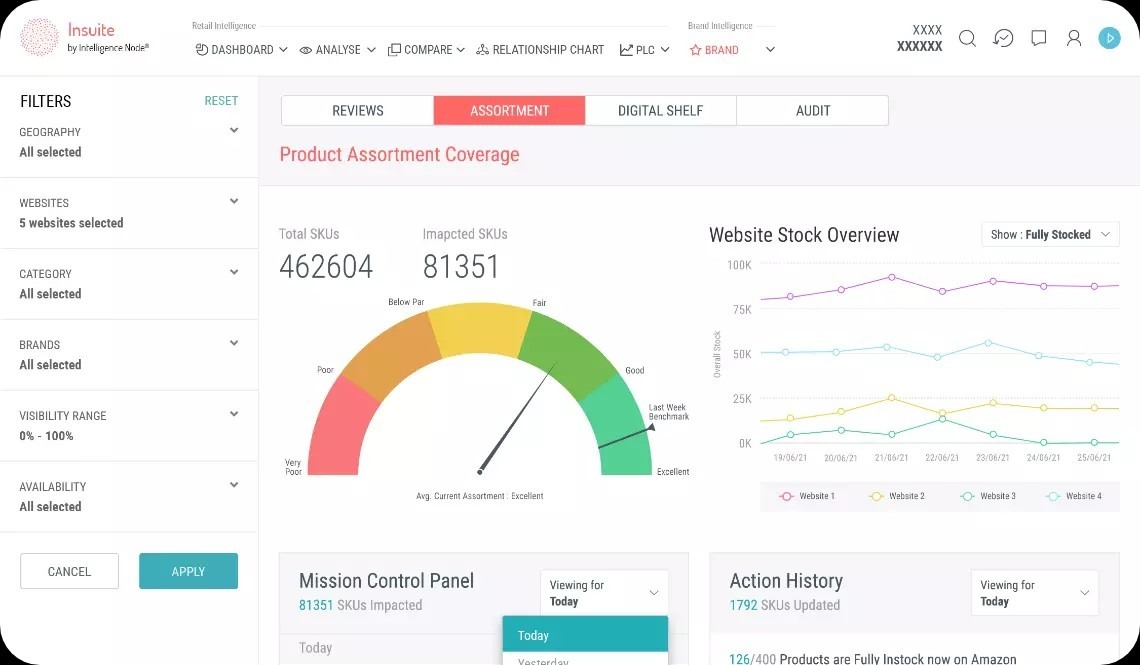
Intelligence Node is an enterprise-grade pricing intelligence platform designed for brands that need near real-time visibility across massive product catalogs and retail networks. It tracks competitor prices, promotions, assortment gaps, and MAP violations across more than 1.2 billion SKUs, with data refreshed as frequently as every 10 seconds.
Key features
- 1.2B+ SKUs with 10-second refresh
- 99% AI matching accuracy (patented)
- Modular subscription model
Pros
- Broadest intelligence coverage on this list
- 10-second refresh catches moves daily tools miss
- Buy only the modules you need
Cons
- Enterprise pricing only
- Steep learning curve for new teams
Pricing
Custom quote price. Contact the Intelligence Node for a quote.
7. Minderest
Best for: Brands needing intelligence from multiple channels.
Intelligence approach: AI intelligence across websites, shopping apps, and physical stores in 40+ countries.
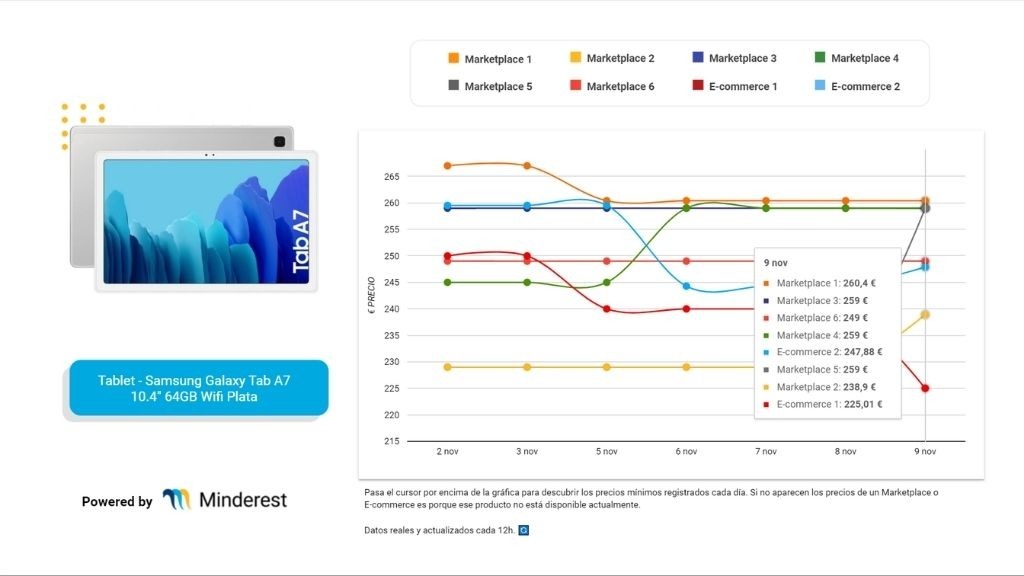
Minderest extends pricing intelligence into shopping apps, physical retail via the InStore module, and regional marketplaces across languages and currencies. Its AI matching features also handles product linking across naming conventions.
Key features
- Intelligence across online, apps, and physical stores
- AI matching across languages and currencies
- InStore module for brick-and-mortar capture
Pros
- Reaches channels that other tools cannot
- AI matching across languages without manual setup
- Dedicated customer success manager
Cons
- No public pricing, no trial, 3-month minimum
- Matching occasionally needs manual correction
Pricing
Custom only. Contact sales.
Related: Find out why PricingHunter is a better alternative to Minderest.
8. PriceShape
Best for: Retailers who want intelligence tied directly to ad spend performance.
Intelligence approach: Feed editor with dynamic price tags connecting competitor data to Google Shopping ROAS.
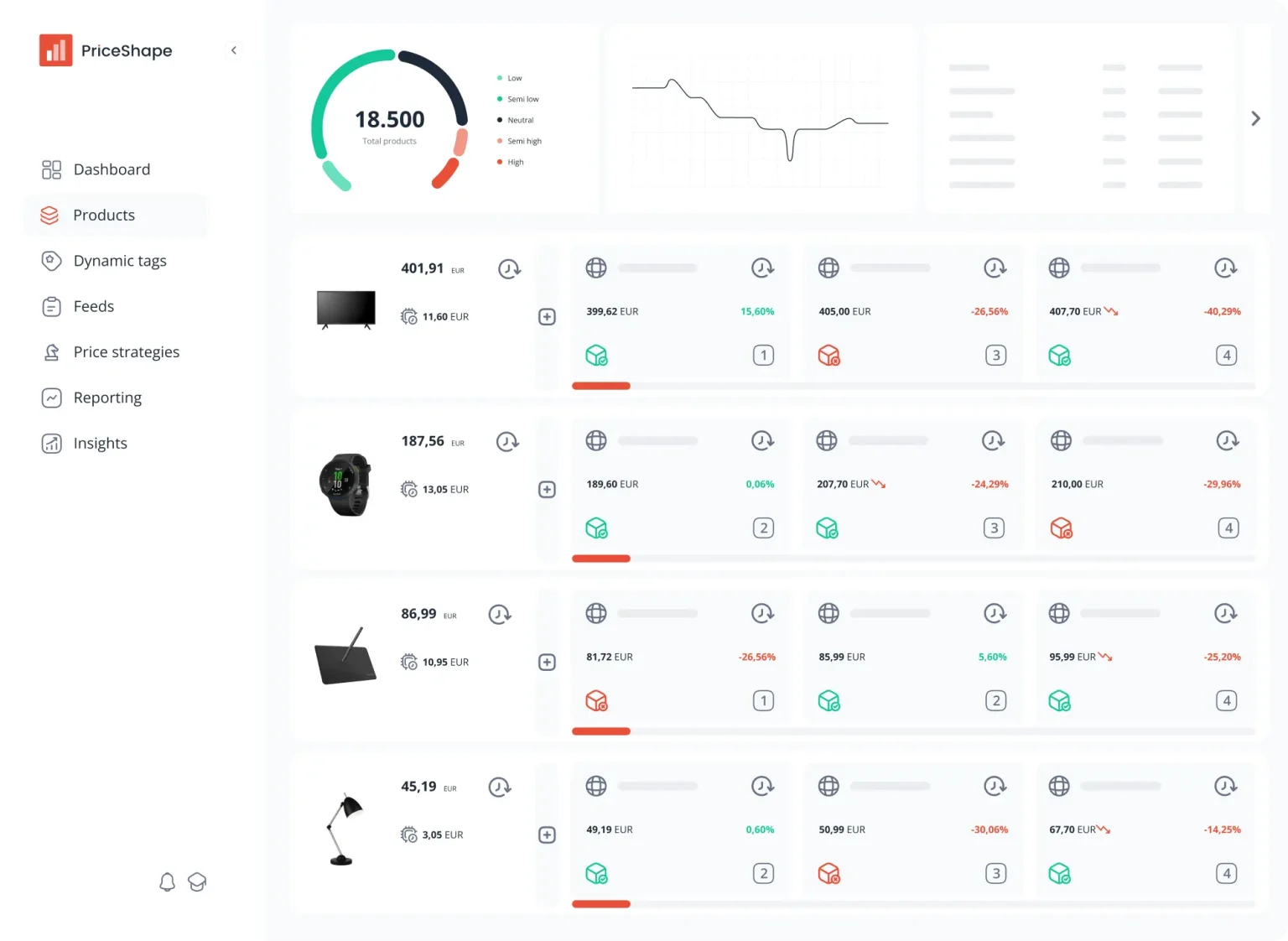
PriceShape is a pricing intelligence platform that links competitor pricing data to Google Shopping performance. It combines price monitoring, feed optimization, and automated repricing to help retailers identify competitively priced products. Unlike traditional price tracking tools, its focus is on improving both pricing strategy and shopping campaign ROAS.
Key features
- Google Shopping feed editor with dynamic price tags
- 20 to 30 repricing strategies
- Multi-currency support
Pros
- Links intelligence directly to ad spend, unique on this list
- Wide repricing strategy range
- Structured onboarding with customer success
Cons
- Starts from €999/mo with customer success as an add-on
- Demo only, no self-service trial
Pricing
From €999/mo. Custom quotes based on products and markets.
9. Pricefx
Best for: Enterprises that need intelligence embedded across the entire pricing function.
Intelligence approach: 125+ AI agents across CPQ, deal management, margin optimisation, and competitive analytics.
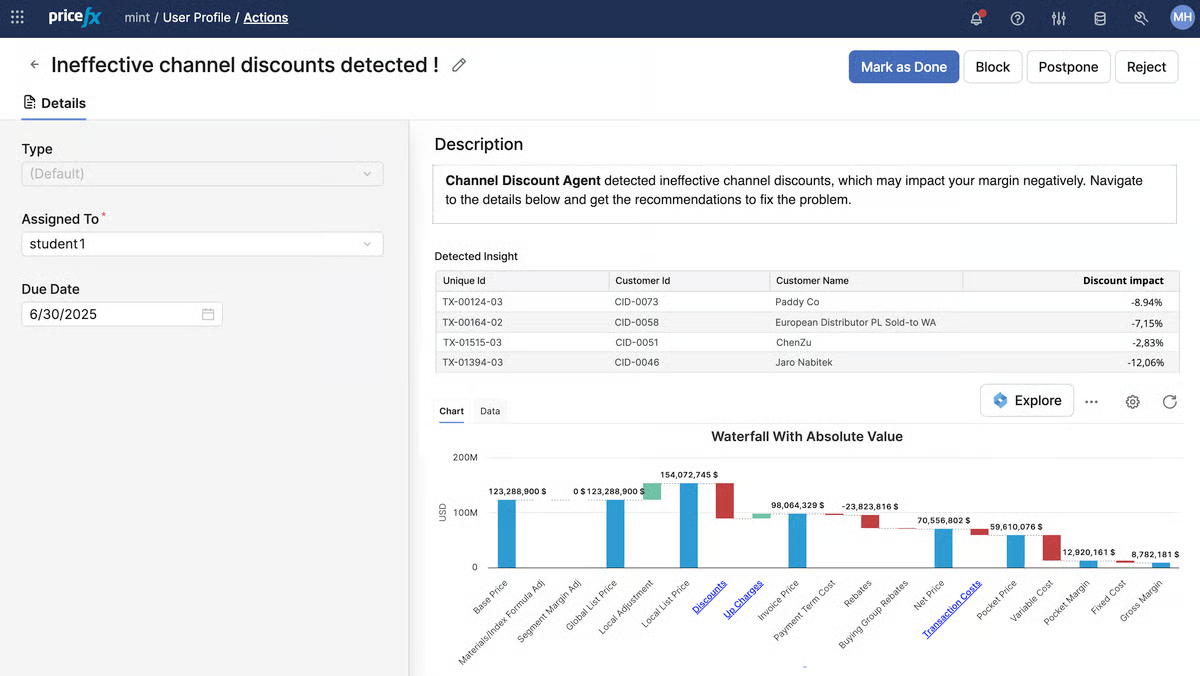
Pricefx is an enterprise pricing platform that combines competitive intelligence with pricing execution. It brings together competitor analytics, CPQ, deal management, rebate management, and margin optimization in a single system, helping businesses turn market insights into profitable pricing decisions across the entire pricing function.
Key features
- CPQ + deal management + competitive analytics in one platform
- 125+ AI pricing agents
- Cloud-native architecture
Pros
- Intelligence embedded across the pricing lifecycle, not siloed
- Deploys faster than legacy enterprise systems
- Handles B2B and B2C pricing complexity
Cons
- Enterprise pricing, well beyond SME budgets
- Overkill for teams needing competitor visibility only
Pricing
Custom only. Contact Pricefx for a demo.
10. BlackCurve
Best for: Retailers who want AI that can test before committing.
Intelligence approach: AI analysis of competitor prices, demand signals, and inventory with A/B price testing.
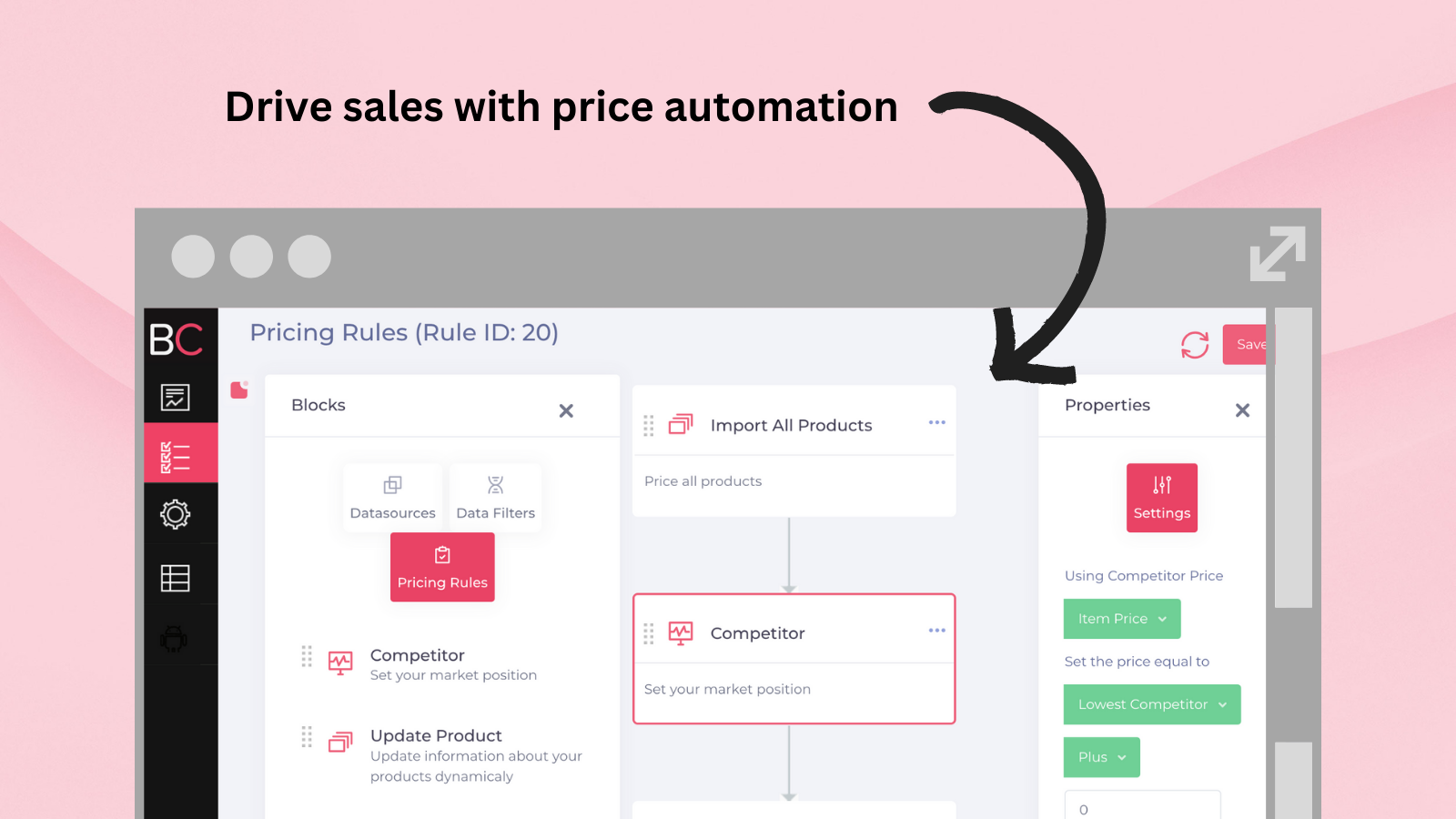
BlackCurve is a pricing intelligence and optimization platform that uses AI to analyze competitor prices, demand, and inventory data. It recommends pricing changes designed to improve margins and revenue, while A/B testing capabilities let retailers validate pricing strategies.
Key features
- AI repricing targeting margin improvement
- A/B price testing before full rollout
- Shopify, Magento, BigCommerce, Amazon, eBay integrations
Pros
- A/B testing validates intelligence-driven changes before rollout
- Free plan with a paid option from $28/mo, the most accessible AI tool here
- Set up under an hour
Cons
- Smaller user base
- Interface feels dated
Pricing
- Free plan available
- Paid plans: From $28/mo, for 4 editions
How to choose the right price intelligence platform
With so many options, a few key questions will help you focus on the most relevant ones.
1. What problem are you solving?
If you are tackling the issue of Competitor alerts, PricingHunter or Prisync are suitable tools. If you want MAP enforcement with proof, Price2Spy is ideal. Choose the tool based on the problem it solves, rather than just its feature list.
2. Who on your team will use it?
If nobody logs into the dashboard, the intelligence is wasted. Pick based on how your team actually works.
3. Can your team realistically adopt it?
PricingHunter and BlackCurve are live in minutes. Competera and Pricefx need dedicated teams and weeks of setup. A simpler tool your team uses daily beats a powerful one that collects dust.
Choose a pricing intelligence tool that saves you time
The right pricing intelligence platform should reduce manual monitoring, not add another dashboard to manage. If it doesn't, you're paying twice: once for the software and again for the hours spent gathering and organizing pricing data yourself.
Look for a solution that:
- Automatically keeps your product catalog up to date without manual uploads
- Tracks competitor price changes and delivers alerts proactively instead of requiring constant monitoring
- Stores long-term pricing history so you can spot trends and make better pricing decisions over time
That's exactly what PricingHunter delivers.If you want pricing intelligence that arrives in your inbox every morning at a cost you can predict. In addition, you can connect your Google Merchant Centre, Shopify, or WooCommerce feed, approve the automated matches, and start tracking unlimited competitors with full price history from day one.
Try PricingHunter free for 14 days.
Frequently asked questions
1. How is price intelligence different from price monitoring?
Price monitoring tells you what competitors charge. Price intelligence goes further by analysing trends, spotting patterns, and, in some cases, recommending pricing responses.
2. How much does price intelligence software cost?
Published pricing ranges from free (BlackCurve) to $99/mo (PricingHunter, Prisync). Enterprise platforms like Competera, Omnia Retail, PriceShape, and Pricefx require custom quotes.
3. Do I need technical skills to use price intelligence software?
No. Most tools connect directly to platforms like Shopify, WooCommerce, and Google Merchant Centre, making setup and competitor tracking straightforward for non-technical users.