



For many retailers, managing competitor pricing data can be a challenge, especially when you have to deal with outdated spreadsheets, missed price drops, and manual checks. Price monitoring tools for competitors fix these issues by automating tracking, matching products to the right competitor listings, and pushing alerts when prices change.
This guide breaks down the 13 best tools for monitoring competitor prices in e-commerce, covering pros and cons and comparing tools by use case, pricing model, and what you actually get before the upsells start.
Best competitor price monitoring tools at a glance
Why listen to us?
We built PricingHunter for online retailers who need competitor pricing data without having to think twice about sourcing intelligence. We talk to e-commerce teams every day about how they collect competitor data and make use of it, and this guide reflects what we hear: what works, what breaks, and what matters.
13 best competitor price monitoring tools compared
1. PricingHunter
Best for: SME retailers who want to monitor competitors’ prices without enterprise contracts, add-on costs, or a weeks-long onboarding process.
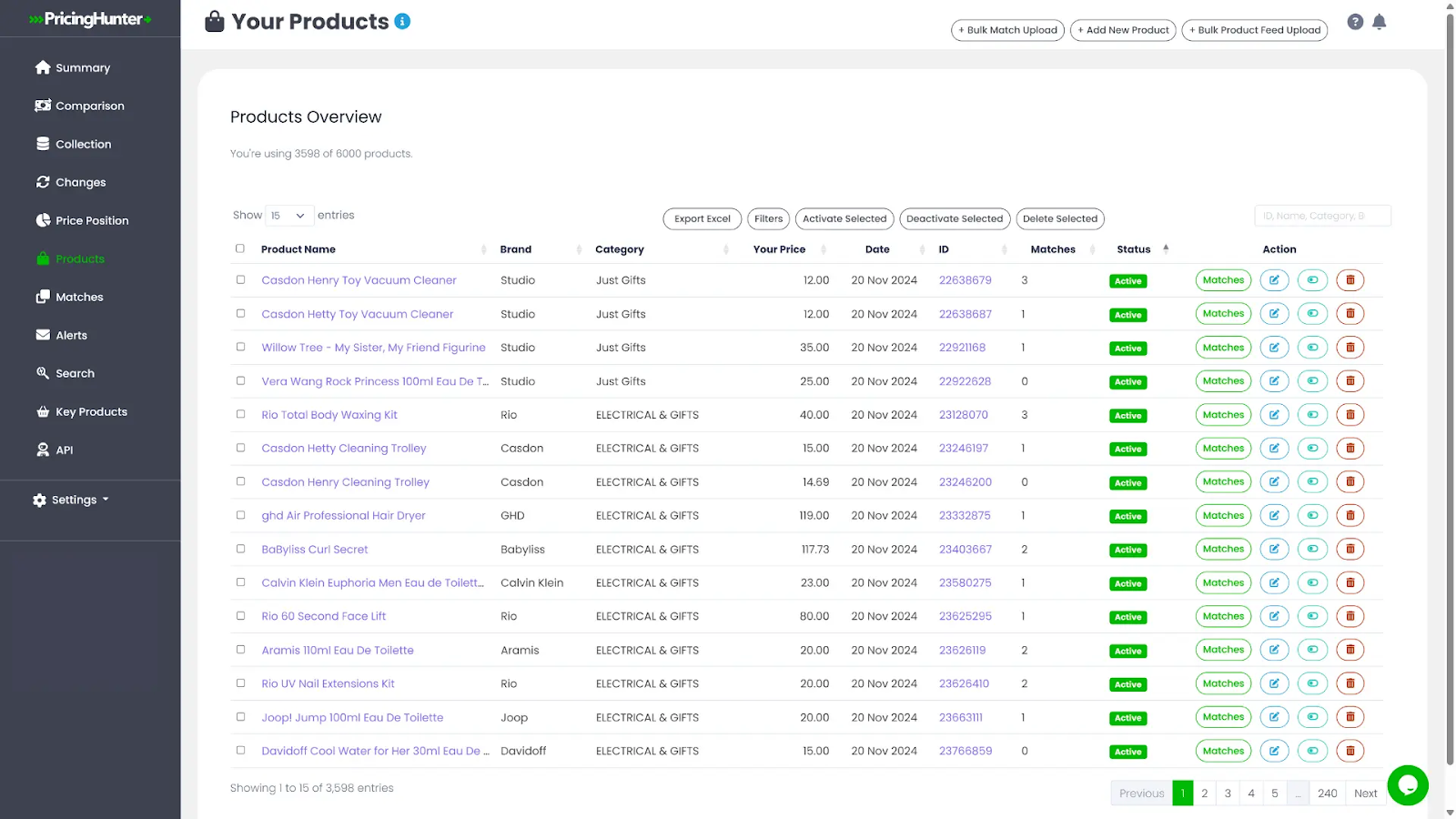
PricingHunter helps you track competitor prices in one platform, with automated monitoring, price history, and daily pricing alerts without manual checks or spreadsheets.
What makes PricingHunter stand out is its all-inclusive pricing model, which goes beyond basic tracking to include unlimited competitor monitoring, automated product matching, daily alerts, including weekends, and price history with no expiration.
Unlike tools that require onboarding calls and custom quotes, it is self-service. Connect your Google Merchant Center, Shopify, or WooCommerce feed and receive daily catalogue updates and competitor pricing insights every morning.
As a result:
- You can view live competitor data within minutes of signing up.
- Adding new competitors never increases your cost. Track as many as you need.
- Price history is stored indefinitely, so you can spot patterns over months or years without data expiring.
Key features
- Unlimited competitor tracking on every plan
- Automated product matching with daily alerts, including weekends
- Live feed integration with Google Merchant Center, Shopify, and WooCommerce – products update automatically daily
- Price history with no time limit. API available as a per month add-on
Pros
- Transparent pricing, with no hidden fees
- Live data in minutes – no onboarding meetings, no implementation project
- Month-to-month billing, no contracts, 14-day free trial without a credit card
- Unlimited competitor tracking on every plan with no per-competitor fees
Cons
- No built-in dynamic repricing
Pricing
- Essential plan: $99/mo (200 products)
- Professional plan: $199/mo (2,000 products)
- Premium plan: $399/mo (6,000 products)
- API access is $29/mo
- 14-day free trial
Try PricingHunter free for 14 days.
2. Prisync
Best for: E-commerce retailers on Shopify, Magento, or BigCommerce who want monitoring and repricing in one subscription.
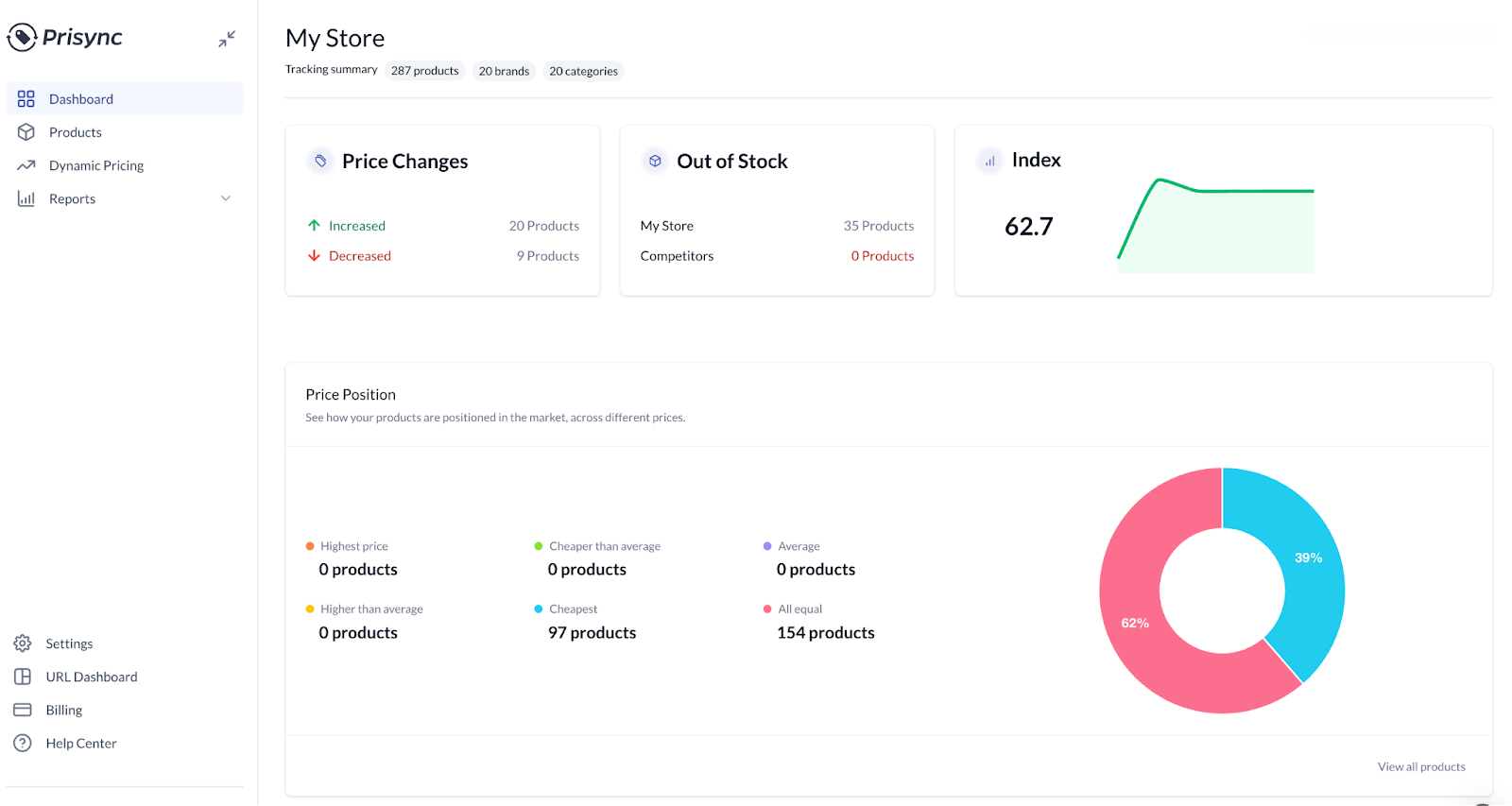
Prisync is primarily used by mid-sized sellers who want competitor tracking and repricing in a single tool. It covers the basics of monitoring well, but teams choose Prisync over simpler alternatives because of its repricing layer. The channel-based model discovers competitors from Google Shopping and Amazon through barcode matching.
Key features
- URL-based, Channel-based, and Hybrid monitoring models
- Dynamic pricing rules on Premium and above
- One-click Shopify, Magento, BigCommerce integrations
Pros
- Repricing and monitoring in one tool with published pricing from $99/mo
- Channel-based discovery finds competitors you did not know existed
- 14-day free trial with free onboarding and 24/7 support
Cons
- API costs 20% extra on every plan, scaling from $19.80 to $159.80/mo
- Price history and MAP monitoring locked behind Platinum ($399+)
Pricing
- URL-based from $99/mo
- Channel-based from $199/mo
- Hybrid from $299/mo
Read more: Prisync pricing guide 2026: Pricing plans, hidden costs, and alternatives.
3. Price2Spy
Best for: Mid-market brands that need high-frequency monitoring, MAP enforcement, and timestamped evidence.
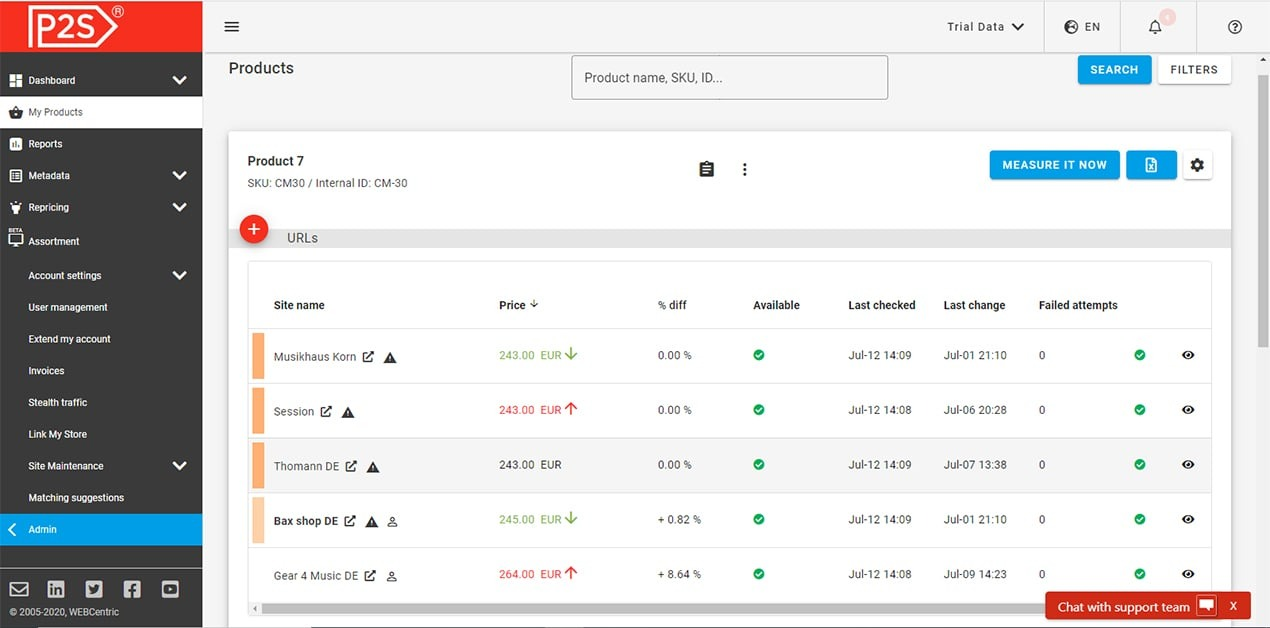
Price2Spy covers standard tracking, but brands choose it over lighter tools for its enforcement feature. The URL-based model means costs scale with the number of competitors, not the number of products.
Key features
- Up to 8 price checks per day with stealth IP
- MAP monitoring with timestamped screenshot evidence
- 25+ built-in analytical reports
Pros
- Published pricing from $39.95/mo, the lowest entry point on this list
- Screenshot evidence gives brands defensible proof of MAP violations
- 25+ reports covering trends, positioning, and violation patterns
Cons
- URL-based model scales unpredictably with large competitor sets
- Repricing and automatch are add-on modules at an extra cost
Pricing
- Starter plan: $39.95/mo (500 URLs)
- Basic plan: $157.95/mo (2,000 URLs)
- Premium plan: Custom
4. Competera
Best for: Enterprise retailers with dedicated pricing teams who need AI recommendations based on demand elasticity.
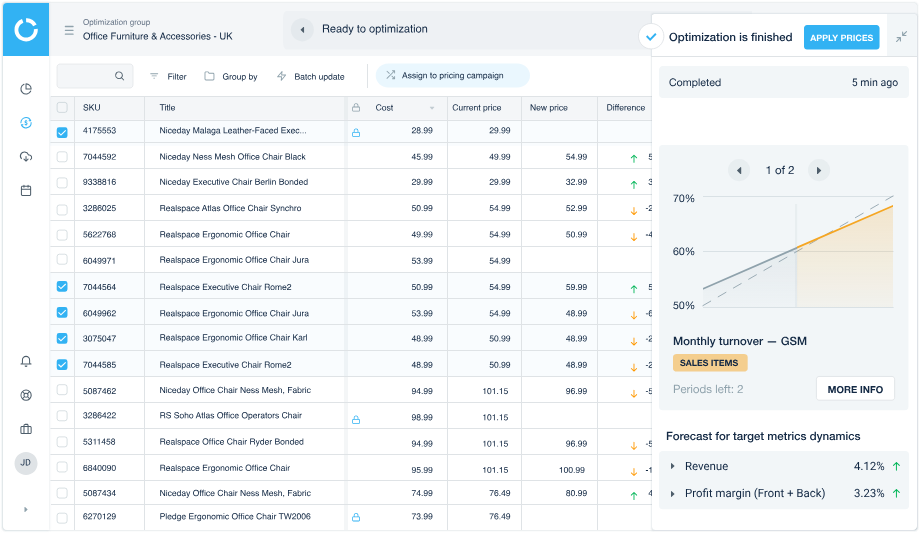
Competera is used by enterprise teams with dedicated pricing departments and six-figure software budgets. The reason they choose it over simpler competitors is that the prediction layer and the contextual AI analyse 20+ demand factors through 930 deep learning models, recommending prices at the SKU level. Although, results require weeks of ERP integration, AI model training, and a dedicated pricing team to execute.
Key features
- Demand-based pricing with 930 deep learning models
- What-if simulations with 95%+ forecasting accuracy
- 98% AI product matching with SLA guarantees
Pros
- Moves beyond tracking into demand-driven pricing recommendations
- Clients report 8% revenue recovery and 6% margin recovery on average
- Competitive data product available standalone without committing to the AI platform
Cons
- Custom pricing only, with no published plans or self-service trial
- Requires a dedicated pricing team and weeks of implementation
Pricing
Custom pricing plan, as you’ll need to contact Competera for a demo.
Also read: Competera pricing guide 2026: What you'll pay and what you'll get
5. Omnia Retail
Best for: Enterprise retailers seeking automated pricing execution via a visual strategy engine.
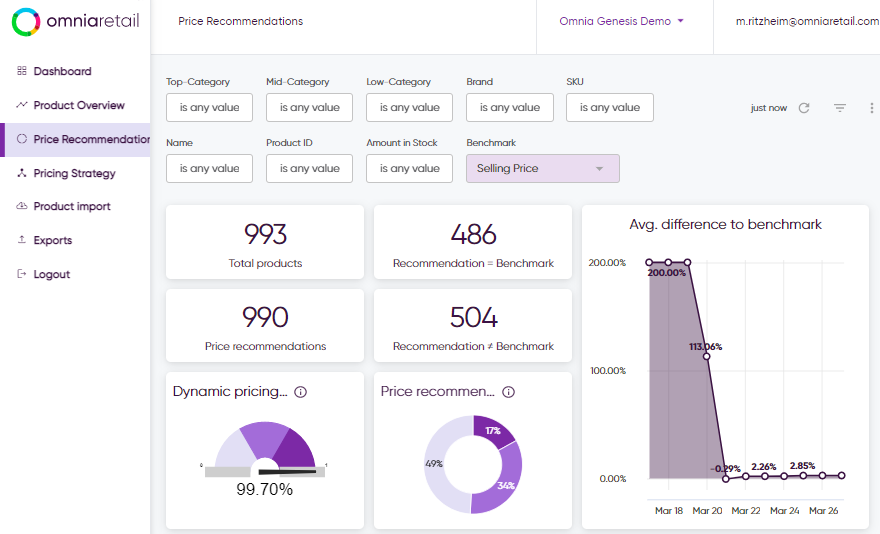
Omnia Retail is built for enterprise pricing teams that need granular control over pricing decisions without relying on developers. Unlike many competitors that depend on third-party data providers, Omnia collects pricing data in-house across more than 35,000 domains. Its no-code pricing engine lets teams create, test, and automate complex pricing rules at scale while maintaining full control over margins and pricing strategy. Implementation takes days to weeks, and the platform assumes a team that can configure and maintain complex pricing logic.
Key features
- Pricing Strategy Tree for visual rule building
- In-house scraping across 35,000+ domains
- Price Explanation for full decision traceability
Pros
- Most advanced visual pricing automation for enterprise retail
- In-house data removes third-party scraper dependency
- Every automated decision is traceable
Cons
- Custom pricing only, with no published plans
- Implementation takes days to weeks
Pricing
Custom. Contact Omnia Retail for a demo.
Head-to-head comparison: Prisync vs. Omnia Retail: Which Platform Delivers Better Pricing Intelligence?
6. PriceShape
Best for: Mid-market European retailers who want dynamic pricing tied to Google Shopping ROAS.
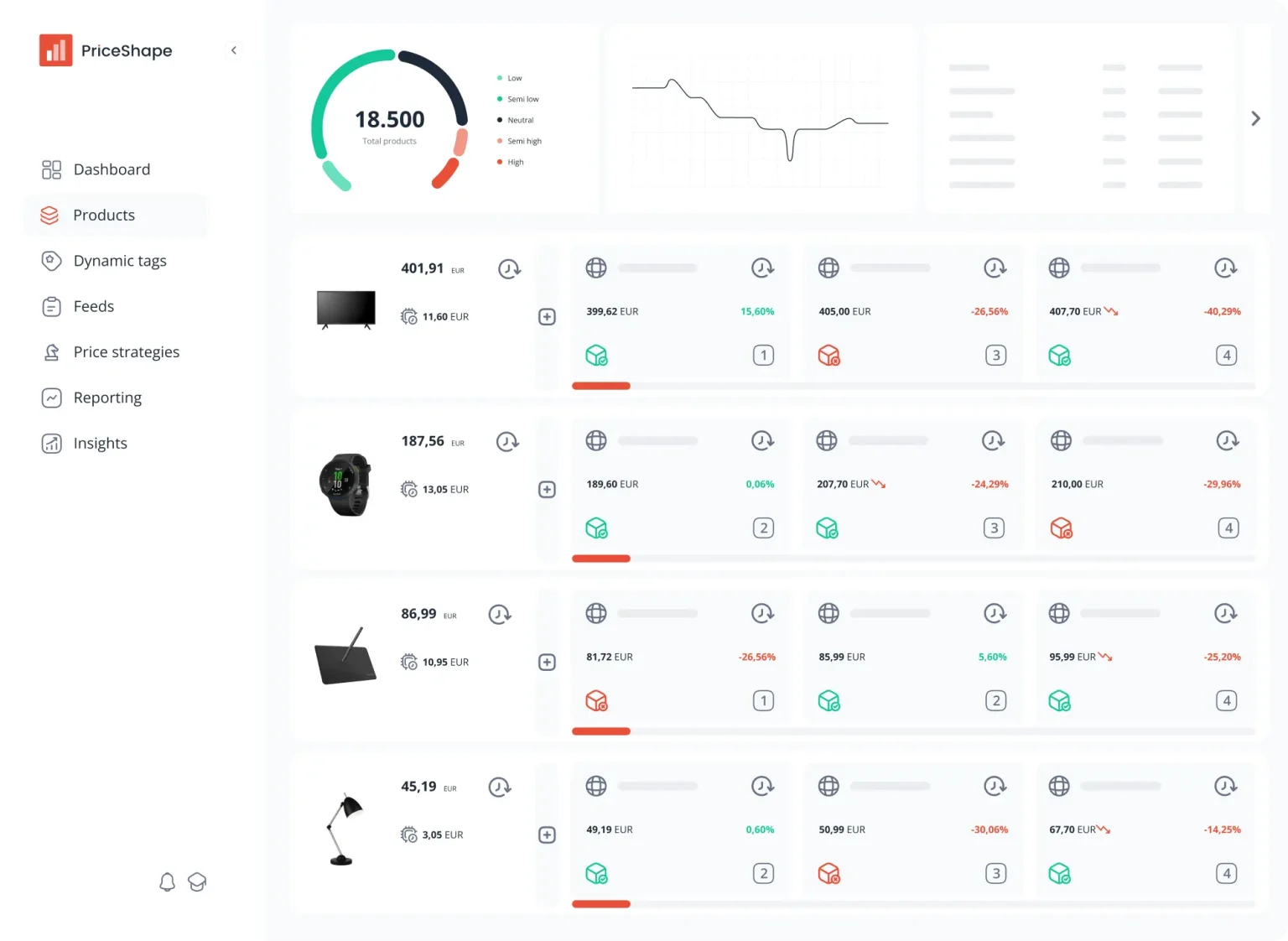
PriceShape is a Danish platform used by retailers who sell across European markets and run Google Shopping campaigns. The reason they choose it over monitoring-only tools is the connection between pricing data and ad spend. Its feed editor inserts dynamic price tags into Google Shopping campaigns so the budget focuses on competitively priced products.
Key features
- Google Shopping feed editor with dynamic price tags
- 20 to 30 repricing strategies available
- Multi-currency support across European markets
Pros
- Ties competitor data directly to Google Shopping ROAS
- Wide range of repricing strategies from cost-plus to psychological pricing
- Strong customer success with structured onboarding
Cons
- Starts from €999/mo with customer success as an add-on
- No self-service trial, demo only with sample data
Pricing
From €999/mo. Custom quotes based on products and markets.
Looking for a simpler alternative? See why PricingHunter is a strong replacement for PriceShape.
7. Minderest
Best for: Brands monitoring pricing across distributor networks, marketplaces, and physical retail globally.
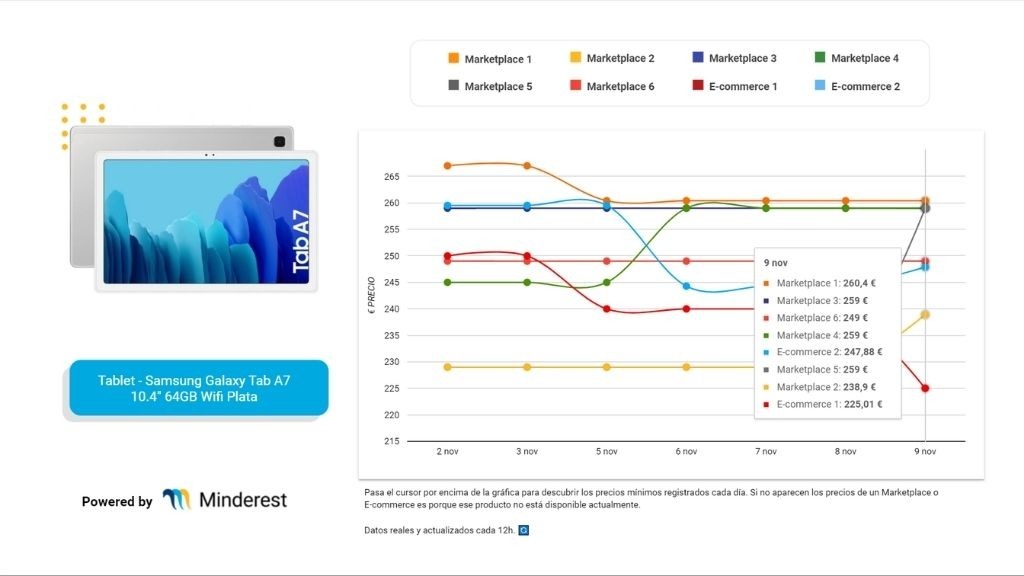
Minderest serves brands that manage global distribution. The reason brand teams choose it over e-commerce-focused tools is because of channel reach. It monitors pricing in shopping apps, physical stores via the InStore module, and regional marketplaces across languages and currencies.
Key features
- AI monitoring across online, offline, and apps
- InStore module for brick-and-mortar price capture
- Product matching across languages and currencies
Pros
- Tracks channels that other tools cannot reach, including offline and apps
- AI matching across languages, currencies, and naming conventions
- Dedicated customer success manager
Cons
- No public pricing, no free trial, 3-month minimum contract
- Matching sometimes requires manual correction on niche products
Pricing
Custom only. Contact sales for a demo.
8. Pricefy
Best for: Small retailers who want to test competitor monitoring at zero cost before committing.
Pricefy is used by small e-commerce retailers who want to evaluate monitoring before spending. What makes it stand out is the free-forever plan, which includes 50 SKUs, AI automatch, and competitor discovery at no cost.
Key features
- Free forever plan with 50 SKUs and AI automatch
- Repricing from Pro ($99/mo), autopilot + MAP from Business ($189/mo)
- Shopify, WooCommerce, Magento, BigCommerce integrations
Pros
- Free forever plan to test data quality before committing
- Published pricing with 25% annual discount
- Repricing and monitoring in one subscription from $99/mo
Cons
- Free plan caps competitors at 5, which does not reflect real-world usage
- Shopify App Store reviews flag scraping reliability issues
Pricing
- Free: 50 SKUs
- Starter: $49/mo
- Pro: $99/mo
- Business: $189/mo
- Enterprise: $499/mo
Related: Pricefy pricing guide 2026: compare features and plans
9. BlackCurve
Best for: E-commerce retailers who want AI repricing with A/B price testing.
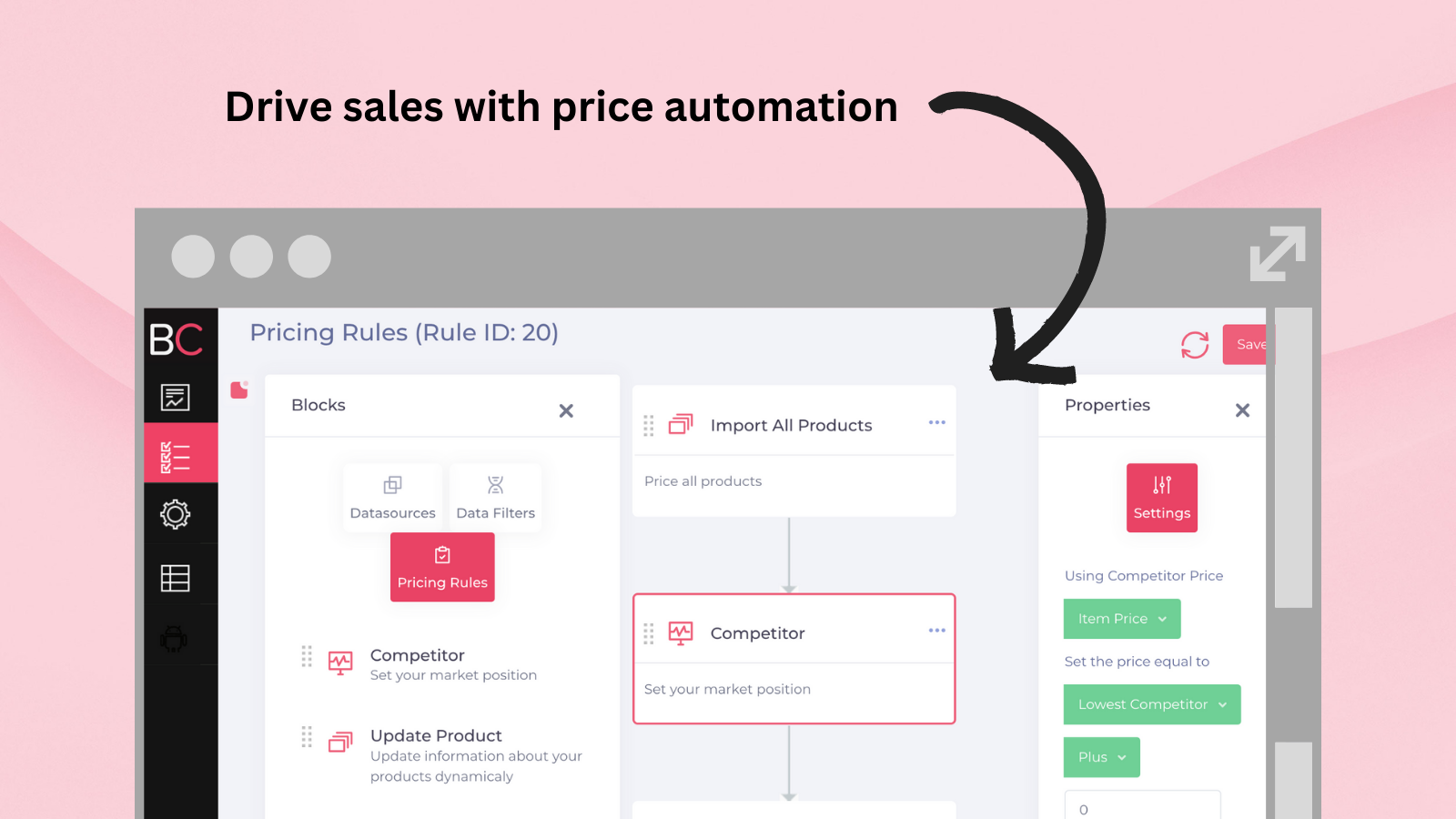
BlackCurve is used by retailers who want AI to do more than track competitors. It analyses prices, demand, and inventory, then recommends adjustments that focus on margins rather than matching the lowest price. The reason some teams choose it over other AI tools is A/B price testing.
Key features
- AI repricing based on competitor, demand, and inventory data
- A/B price testing before full rollout
- Shopify, Magento, BigCommerce, Amazon, eBay integrations
Pros
- A/B testing validates changes before full rollout
- Free plan with paid tiers from $28/mo
- AI targets margin improvement, not a race to the bottom
Cons
- Smaller user community compared to Prisync or Competera
- Interface feels dated, according to some reviewers
Pricing
- Free plan available
- Paid from $28/mo with 4 editions
10. Intelligence Node
Best for: Enterprise brands that need real-time global monitoring at massive scale.
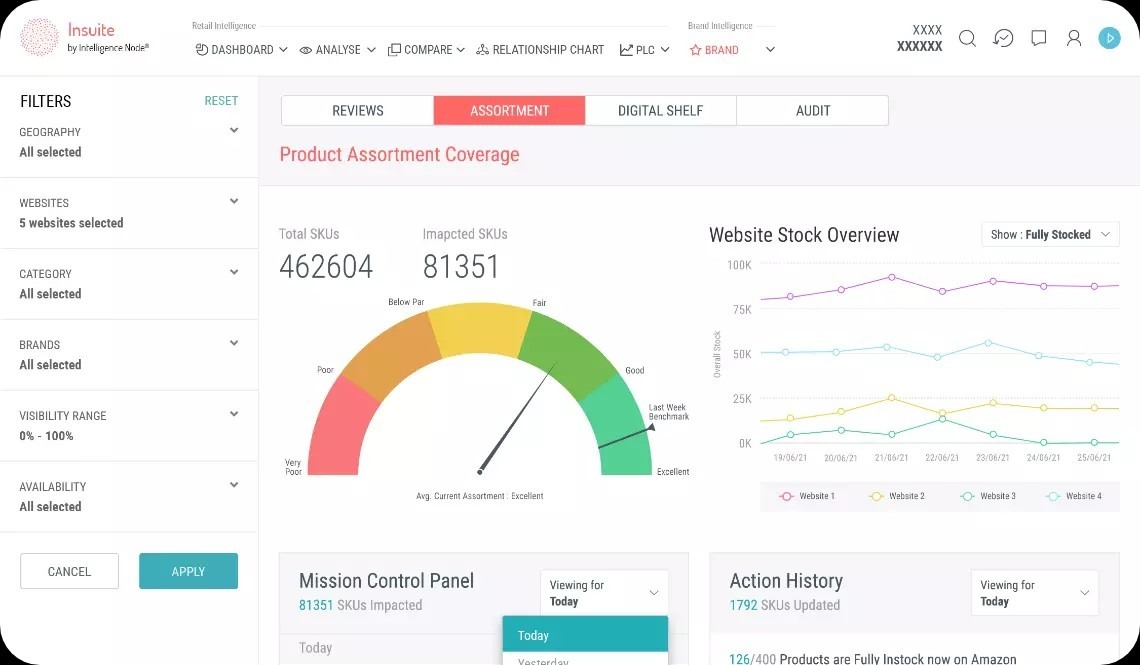
Intelligence Node operates at a scale most tools here cannot match: 1.2 billion+ SKUs, 190,000 brands, and data refreshed every 10 seconds. It is a top choice because of its modular buying feature. It is worth noting that it is enterprise pricing only, and the analytics depth assumes a team with the capacity to interpret and act on the data.
Key features
- 1.2B+ SKUs with 10-second data refresh
- 99% AI matching accuracy (patented)
- Modular subscription model
Pros
- 1.2B+ SKUs with 10-second refresh rates, though that scale is built for global brands managing catalogs most SME retailers will never reach
- 99% AI matching accuracy (patented), which justifies the enterprise price tag for teams with the volume to benefit
- MAP module captures violation screenshots automatically
Cons
- Custom enterprise pricing only
- The interface can be complex for new teams
Pricing
Custom. Contact the Intelligence Node for a quote.
11. Dealavo
Best for: European brands that prioritise data accuracy and want human verification on every match.
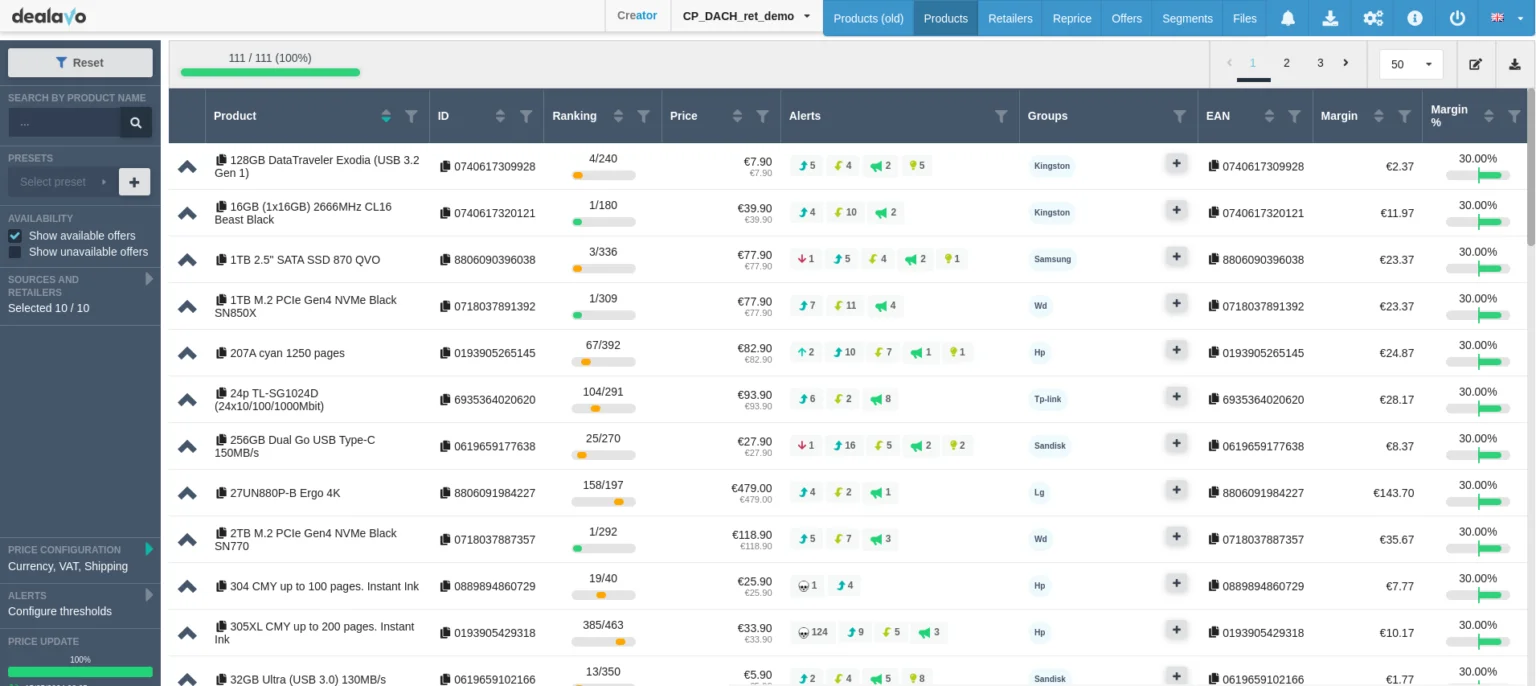
Dealavo serves brands where a bad product match leads to real consequences. The reason accuracy-focused teams choose it over automated alternatives is the human QA layer. Every match is verified before it reaches your dashboard.
Key features
- Human-verified product matching on every data point
- Promotion and coupon tracking alongside pricing
- Coverage across 30+ European countries
Pros
- Human QA catches matching errors that automated tools miss
- 7-day free trial with strong European coverage
- Promotion and coupon tracking alongside pricing
Cons
- Custom pricing only
- Less established in North American markets
Pricing
Custom. 7-day free trial available.
12. Priceva
Best for: Mid-size retailers who want monitoring, repricing, and MAP in one subscription.
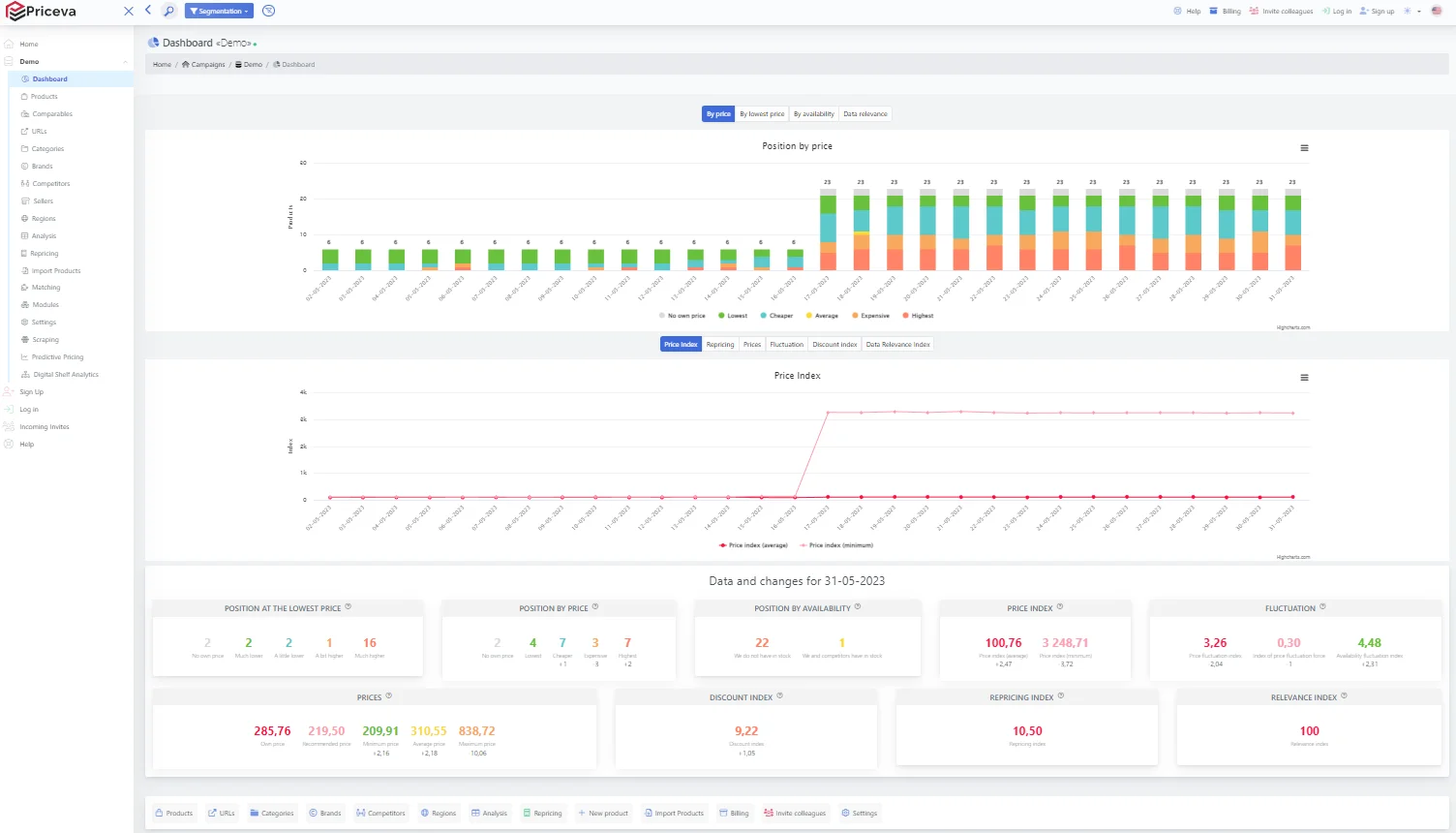
Priceva is used by mid-size teams who want everything bundled. Most tools on this list charge extra for repricing or MAP. Priceva includes both in every paid plan: scraping handles IP rotation, proxies, and CAPTCHAs behind the scenes.
Key features
- Repricing and MAP are bundled into every paid plan
- IP rotation, proxy management, and CAPTCHA handling are built in
- Multi-format export: CSV, JSON, XML
Pros
- Repricing and MAP included with no add-on costs
- Free tier for 20 products
- Multi-format export for flexible data use
Cons
- Data accuracy varies depending on the source site
- Interface feels dated compared to newer tools
Pricing
Free (20 products). Paid from $99/mo.
13. NetRivals (by Lengow)
Best for: Enterprise retailers and brands that need price monitoring at scale across thousands of websites and marketplaces.
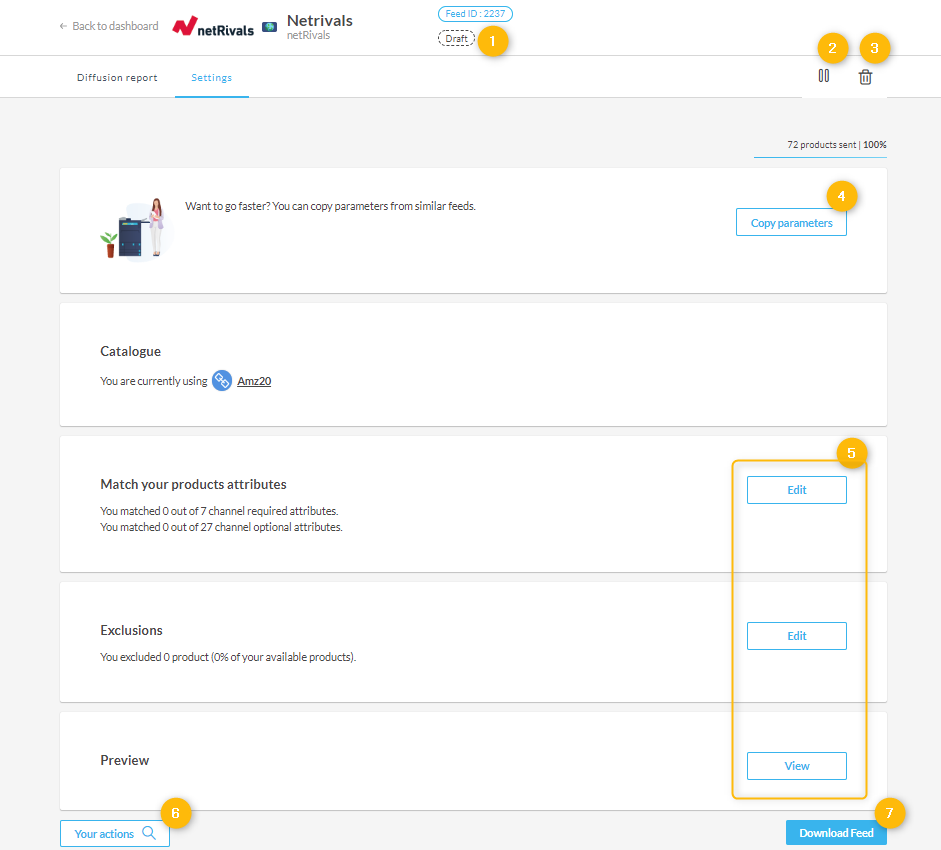
If your competitor list runs into the hundreds and your catalogue spans multiple countries and marketplaces, most monitoring tools start to struggle. NetRivals is built for that scale.
Now part of Lengow’s eCommerce suite, NetRivals connects monitoring data directly to feed management and marketplace distribution. That integration is its real advantage for enterprise teams already using Lengow. The trade-off is that it has custom-only pricing.
Key features
- Monitoring across DTC sites, marketplaces, and comparison engines
- AI product matching by title, image, and attributes
- Dynamic pricing with margin protection rules
Pros
- Massive website coverage (35,000+)
- AI matching works without shared GTINs
- Connected eCommerce stack through Lengow
Cons
- Custom pricing only
- Best value when paired with other Lengow products
Pricing
Custom only. Contact NetRivals for a demo.
What to look for in a competitor price monitoring tool
When choosing a price monitoring tool, focus on features that will save you time and optimise your workflow. Look for platforms that offer the following:
- Matching accuracy
The tool needs to connect your products to the right competitor listings. If the matching is wrong, the data is useless. The best tools let you review and approve matches rather than blindly trusting automation.
- Monitoring frequency
Daily updates are the baseline. Some tools check prices multiple times per day. If you sell in a market where competitors frequently change prices, monitoring frequency is a top feature to consider. Tools like PricingHunter sends automated daily alerts to your inbox to keep you updated.
- Transparent pricing
It is important to know how pricing scales before you commit to any tool. Some tools charge by product count. Others charge by URL, by competitor, or by module. A few publish nothing at all and require a sales conversation. PricingHunter publishes all pricing plans with no hidden fees or demo required.
Start monitoring competitor prices today
Most competitor price monitoring tools either charge enterprise rates or deliver raw data that still requires manual input, but PricingHunter eliminates both problems.
With PricingHunter, you have access to unlimited competitor tracking, automated product matching, daily alerts including weekends, and price history that never expires. All these at a starting price of $99/mo with no contracts or hidden fees.
Brands using PricingHunter access competitor pricing data fast, at a predictable cost, without a sales process. All you need to do is sign up for a trial, upload your products, approve the automated matches, and start receiving daily data, including weekends.
Start your 14-day free trial today!